Dependent Care FSA Eligibility for Adult Care Recipients
Adult day care and spouse care qualify if disability, residency, and dependency tests are met.

A Dependent Care FSA can pay for adult day care, in-home aides, and other custodial care for a spouse or parent, not just for kids in daycare. Whether the account actually lets a caregiver use it comes down to a specific set of IRS tests around disability, residency, and dependent status, borrowed directly from the same tax code that governs the Child and Dependent Care Tax Credit. Most employees never learn this because open enrollment materials are built around a toddler in a carrier, not a parent in an adult day program. That gap between what the benefit legally covers and what employees think it covers is worth closing, and it takes some unpacking to do it right.
The account itself runs under IRC Section 129, administered as part of a cafeteria plan under Section 125. Contributions come out of payroll pre-tax, which means they reduce taxable income, a distinction that matters later when comparing the DCFSA to its cousin, the dependent care tax credit. Adult day care is recognized as a core eligible expense category under dependent care FSA rules, alongside child care expenses like preschool and summer camp. So the adult-care use case stands as a core, intended part of the benefit. It's baked into the plan design from the start.
The three categories of qualifying individuals under IRS rules, and which two apply to adults
The rules governing the Child and Dependent Care Tax Credit define the categories of people whose care expenses can be reimbursed, and there are three such categories. First: a child under 13 who is the employee's tax-dependent qualifying child. Second: a spouse who is physically or mentally incapable of self-care and lives with the employee more than half the year. Third: a disabled adult tax dependent, or someone who would have qualified as a dependent except for a specific income or filing exception, who is also incapable of self-care and lives with the employee more than half the year.
The two adult categories, the disabled spouse and the disabled adult dependent, share the same disability and residency tests. Where they differ is in how the tax relationship gets established, and that difference turns out to carry real weight (more on that in the dependency section below).
How binary this structure is becomes clear here. A parent, sibling, or in-law who needs help but doesn't check every box in one of these three categories isn't a qualifying individual at all, no matter how much care they actually require. There's no fourth category, no partial credit, no "close enough." Either the person fits cleanly inside one of these three boxes, or the expenses aren't reimbursable under the plan. Full stop.
What "incapable of self-care" means under IRS standards, and what it excludes
Here's where a lot of caregivers get tripped up. IRS Publication 503 (2025) defines incapable of self-care narrowly: the person can't attend to their own hygiene or nutritional needs because of a physical or mental defect. That's the whole test, more or less, and it's stricter than most people assume going in.
Two formulations from Publication 503 anchor the standard. A person qualifies if they can't dress, bathe, or feed themselves due to a disability. A person also qualifies if they need constant attention to keep from injuring themselves or someone else. Notice what's absent from that list: help with cooking, cleaning, paying bills, or managing a household doesn't count on its own. Neither does an inability to care for young children because of a medical condition. Those are real burdens, certainly, but they sit outside the IRS definition.
So what does that mean on the ground? An elderly parent who needs a ride to appointments or help with groceries may not clear the bar. A parent who can't get dressed unassisted, or who wanders and needs someone watching them for safety, very likely does. The standard also runs independent of other disability determinations. Qualifying for a federal disability benefit program, for instance, doesn't automatically satisfy this test, because the frameworks measure different things.
No IRS form certifies this status. There's no checkbox, no doctor's note that makes it official for DCFSA purposes. The determination sits with the taxpayer, which also means it sits exposed to audit scrutiny if the IRS ever asks for backup. Keeping some documentation of the condition and its functional impact isn't required by the form, but it's the kind of thing that matters if the claim is ever questioned.
The residency requirement as it applies to adult day care
The qualifying individual has to share the employee's principal home for more than half the year. Counted in days, that means the majority of the calendar year, not a summer visit or an extended holiday stay. A parent living in their own apartment across town doesn't meet this test even if the employee pays every one of their bills.
Adult day care creates a specific carve-out that requires close understanding. If the qualifying individual spends at least 8 hours a day in the employee's household, on a regular basis, payments for care received outside that home, at a licensed adult day center, for example, can still be reimbursed. So a parent who goes to an adult day program during working hours and comes home every night still counts as living with the employee, and the day program fees are eligible.
That carve-out has a hard edge, though. An adult in full-time residential memory care or a nursing home doesn't meet the residency test, even if the employee is footing the entire bill. The distinction is whether the home base is the employee's household or the facility itself. Publication 503 (2025) actually walks through this with a named example: Amy pays an adult day care center for Sam's care so she can work, which is about as directly on-point as an IRS illustration gets.
The tax-dependency requirement for non-spouse adults, and the income bypass that changes the calculus
For a spouse, dependency isn't the issue, the marital relationship covers it. For a parent, sibling, or adult child, though, the person generally has to be claimable as the employee's tax dependent. And that's where things get interesting, because the standard dependency test for a qualifying relative caps that person's gross income at $5,200 for 2025. A lot of aging parents blow past that number just from Social Security retirement benefits or a part-time job, which would seem to disqualify them.
Except it doesn't, not for DCFSA purposes. Under IRC §21(b)(1)(B), as Newfront explained in a November 2025 breakdown, the gross income limit is specifically stripped out of the qualifying-person definition when the individual is incapable of self-care. That means a parent earning well above $5,200, purely from Social Security, say, can still count as a qualifying individual for the DCFSA as long as the disability and residency tests are met. The bypass extends further too: the adult can still qualify even if they filed a joint return, or even if someone else could have claimed the employee as their own dependent.
One clarification matters here, and benefit guides skip it more often than they should. This bypass only operates inside the DCFSA and CDCTC framework. It does not make the parent claimable as a dependent on the employee's actual tax return. Those are two separate questions with two separate rule sets, and conflating them is probably the single most common misread of this whole area. An employee can legitimately run a parent's day care costs through a DCFSA without ever listing that parent as a dependent on their federal income tax return.
The work-related expense requirement as it applies when a spouse is the qualifying individual
DCFSA dollars only cover care that lets the employee work or actively look for work. Paying for adult day care on a week the employee is on unpaid leave, for instance, doesn't generate a reimbursable expense, because the "work-related" thread breaks.
For married employees, the default rule requires both spouses to be working, or job-hunting, for expenses to qualify. Two exceptions loosen that. A spouse enrolled full-time in school gets treated as earning $250 a month for every month of enrollment. And a spouse who is incapable of self-care gets the same deemed-income treatment, $250 per month, regardless of actual earnings.
That second exception is the one that matters most here, because it directly overlaps with the spousal qualifying-individual category discussed earlier. Picture a household where one spouse works full-time and the other is incapable of self-care and needs an in-home aide during the day. The working spouse's income alone would seem to leave the couple one earner short of the "both spouses working" requirement. But the deemed $250-a-month rule fills that gap, treating the non-working spouse as gainfully employed for DCFSA purposes even though no actual paycheck exists. It's a narrow rule, but for exactly this household structure, it's the rule that makes the whole benefit usable.
Self-employed individuals generally can't open a DCFSA at all, since these accounts run through employer-sponsored cafeteria plans. They typically lean on the Dependent Care Tax Credit instead, though access through a working spouse's employer plan remains an option if that spouse is a W-2 employee.
Reimbursable and explicitly excluded expenses for adult qualifying individuals
Licensed adult day care center fees sit squarely inside the eligible category. So does payment to an in-home aide or housekeeper whose duties include caring for the dependent, and placement fees paid to locate a qualified care provider also count.
There's a restriction on who can be paid that trips up families more than it should. The provider can't be the employee's own child under 19. If the qualifying person is the employee's child under 13, the provider can't be that child's other parent. And more broadly, the provider can't be anyone the employee claims as a tax dependent. This becomes a real problem in the common scenario where one sibling handles the bulk of an aging parent's care and another sibling, the one with the DCFSA, wants to pay them for it. If that caregiving sibling is claimed as the employee's dependent, the payment doesn't qualify.
What falls outside the DCFSA entirely: medical or nursing care (that belongs under a health FSA or HSA instead), any expense that isn't custodial in nature. The line drawn here is between custodial care and medical care, and it's not always obvious where it falls. An adult day center's daily fee is eligible. A skilled nursing visit billed separately by a medical provider is not, even if it happens at the same facility on the same day.
Substantiation isn't optional, either. IRS substantiation rules require that reimbursement claims be backed by third-party documentation covering provider name, date of service, and dollar amount. Employee self-certification alone doesn't satisfy the requirement, and a plan that lets employees self-certify without backup is taking on real disqualification risk.
Contribution limits in 2025 and the permanent increase taking effect in 2026
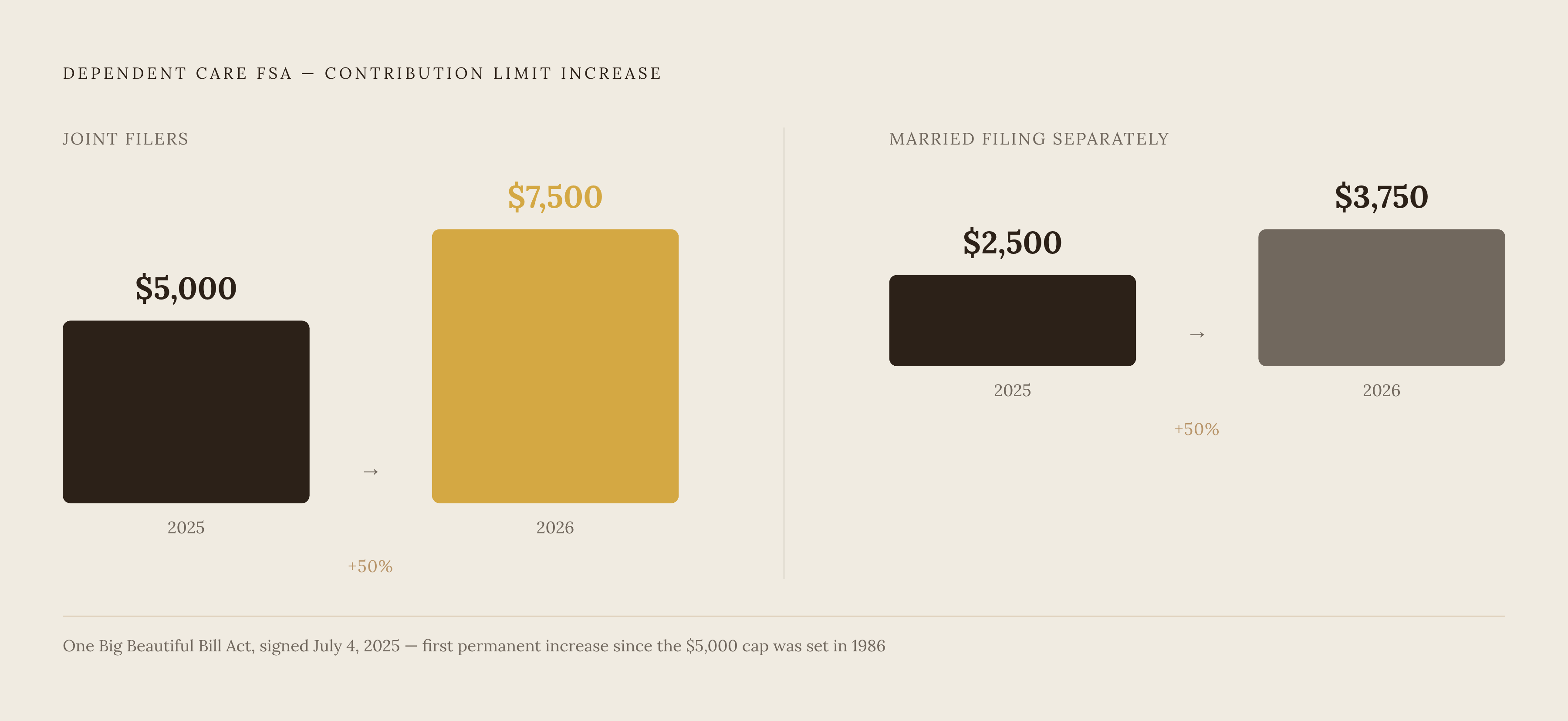
For 2025, the cap is $5,000 per household for most filers, or $2,500 for those married filing separately. That $5,000 figure has been the law since 1986, with only a temporary bump during the pandemic years, so 2026 marks the first lasting change in roughly four decades.
Under the One Big Beautiful Bill Act, signed July 4, 2025, the 2026 limit rises to $7,500 for single filers and married couples filing jointly, and $3,750 for married filing separately. That's a permanent increase, not indexed to inflation going forward, but a real structural change all the same.
A caveat worth noting: employees need to check their own plan's actual limit rather than assuming the new ceiling applies automatically, since plan documents and employer configurations vary. Highly compensated employees, those earning $160,000 or more in 2025, may also face a lower plan-imposed cap to satisfy IRS nondiscrimination testing. Per UCnet, that group's contribution ceiling may be around $3,200 in 2026, well under the new statutory maximum.
For families managing adult care specifically, the jump from $5,000 to $7,500 carries more weight than the raw numbers suggest. Adult day programs and in-home aide services often run higher per-hour costs than child daycare, so the extra $2,500 of room closes a gap that child-only households may not feel nearly as sharply.
How the DCFSA interacts with the Child and Dependent Care Tax Credit after the 2026 changes
The same dollar of expense can't be claimed under both the DCFSA and the Child and Dependent Care Tax Credit. Whatever gets run through the FSA reduces, dollar for dollar, the pool of expenses left over for the credit.
As of 2025, the CDCTC tops out at 35% of up to $3,000 in expenses for one qualifying individual, or $6,000 for two or more. Starting in 2026, the same legislation that raised the DCFSA limit also reshapes the credit: the top rate climbs to 50%, phasing down to 20% as income rises, and that phase-down doesn't start until $103,000 AGI for single filers or $206,000 for joint filers, a dramatic shift from the previous $15,000 phase-down threshold.
But look closely at what those two numbers do next to each other. The new DCFSA ceiling, $7,500, now sits above the CDCTC's $6,000 expense cap for two or more dependents. Any DCFSA contribution above $6,000 still escapes payroll tax, which is real value, but it no longer has a corresponding credit opportunity waiting behind it, since the credit was already maxed out at a lower dollar figure. The headline $7,500 number is bigger, sure, but the incremental benefit above $6,000 is narrower than it first appears.
As a general rule, the DCFSA tends to win for employees at moderate-to-high marginal tax rates, since contributions dodge both income tax and payroll tax at once. The CDCTC tends to look better at lower incomes, where the credit percentage runs higher, or for anyone without DCFSA access to begin with. Plenty of families dealing with a disabled parent or spouse and steep care costs end up using both: maxing the DCFSA at whatever the plan allows, then claiming any remaining eligible expenses under the credit.
Plan mechanics that adult caregivers need to get right before they elect
One rule trips up more families than any dependency test or income bypass: the use-it-or-lose-it deadline. Unlike a health FSA, a Dependent Care FSA carries no carryover option. Whatever sits unspent at the end of the plan year is simply gone.
That makes the election decision at open enrollment less forgiving than it looks on paper. Adult day care schedules shift, in-home aides get swapped out, a parent's health status changes mid-year in ways that alter actual costs. Electing too conservatively leaves money on the table; electing too aggressively risks forfeiting funds nobody gets back. Given everything covered above, the disability standard, the residency carve-out for day programs, the dependency bypass, the work-related test, getting the qualifying-individual analysis right before the election locks in is essential. It's the difference between a benefit that actually offsets real care costs and a payroll deduction that quietly disappears come December.