Tax Treatment of Medicaid Wages Paid to a Family Caregiver
Family caregivers on Medicaid face murky tax rules with real financial consequences.

Family caregivers who get paid through Medicaid face a tax question that has no single, simple answer. The income might be excludable from federal taxable income, fully taxable, subject to Social Security and Medicare withholding, exempt from it, or all three depending on which rule applies to which dollar. Getting this wrong costs real money, either in taxes paid on income that didn't need to be taxed, or in credits left unclaimed because a caregiver assumed exempt income couldn't help them at all.
Most people entering these arrangements are focused on program enrollment, background checks, and getting payroll set up correctly with the state's fiscal intermediary. Nobody's thinking about what Box 1 of a W-2 is going to say the following February. That gap in attention is where the two most common misconceptions take root: "I'm just family, so this is tax-free," and its opposite, "It's wages, so it's taxed like any other paycheck." Neither is correct on its own, and the truth sits in a layered structure of federal income tax rules, FICA rules, and tax credit rules that each operate independently of the others. AARP has found that family caregivers spend more than $7,200 a year of their own money on caregiving, on average, which means the tax treatment of paid caregiving isn't a minor detail. It's one of the few places where a caregiver can actually recover some of what the role costs them.
This piece works through three legal questions in sequence: whether the income is excludable under federal tax law, whether payroll taxes apply regardless of that exclusion, and how to report all of it correctly. One boundary matters before any of that: everything here concerns Medicaid waiver wages specifically. Private family-pay arrangements, VA caregiver stipends, and direct personal care agreements outside Medicaid follow different rules entirely, and none of what follows should be assumed to apply to them.
How Medicaid actually pays a family caregiver and why the payment source determines the tax treatment
A prominent health policy research organization estimated in 2025 that 5.1 million enrollees in a public health coverage program use home care, and that program paid for a large share of all home care spending in the country. That scale means these tax rules aren't a niche curiosity affecting a handful of families. They touch millions of households where a relative is the one providing the care.
The mechanism that makes family caregiving possible under Medicaid is called self-direction. Instead of a home health agency assigning a worker, the enrollee (or their representative) chooses who provides care, and in many states that person can be a spouse, adult child, or other relative. The state's fiscal intermediary handles the payroll mechanics, but who processes the check has nothing to do with whether the income is taxable. That determination rests on separate federal rules the fiscal intermediary doesn't decide.
Several program types carry this self-direction option, and which one a caregiver is enrolled in matters enormously for tax purposes. HCBS Medicaid Waivers authorized under Section 1915(c) of the Social Security Act are the vehicle explicitly named in IRS guidance, making caregivers under these waivers the most directly eligible for the income tax exclusion discussed in the next section. Section 1915(j) programs authorize participants to hire and manage their own attendants, including relatives. Section 1915(k), called Community First Choice, lets many states allow self-direction in the selection of personal attendants. Structured Family Caregiving programs, available in a subset of states including Connecticut, Georgia, Indiana, Louisiana, Massachusetts, Missouri, Nevada, North Carolina, Ohio, Rhode Island, and South Dakota, work differently still: the caregiver lives with the recipient and receives a daily stipend that is generally tax-free by the program's own design, rather than through the exclusion mechanism covered below.
Then there are programs that sit outside Section 1915(c) altogether, such as Medicaid Personal Care and Community First Choice in some states. These weren't explicitly named in the original federal guidance, which created real uncertainty. Some states, Washington among them, resolved that uncertainty by seeking Private Letter Rulings directly from the IRS rather than assuming the exclusion applied.
Paying a spouse for caregiving was historically blocked early on under federal Medicaid rules, on the theory that spousal care is simply an ordinary marital duty, not a compensable job. That has loosened in many states, which now permit spousal payment through at least one waiver or State Plan program. But spousal arrangements carry their own FICA treatment, which gets picked up later in this piece. Pay rates for all of this vary widely by state and program, and knowing roughly what a caregiver will earn annually determines how close they sit to the FICA thresholds discussed further down.
What IRS Notice 2014-7 actually says and where its authority comes from
The rule at the center of all this is IRS Notice 2014-7, issued in 2014. It states that the IRS will treat certain Medicaid waiver payments as "difficulty of care" payments, excludable from gross income under Section 131 of the Internal Revenue Code.
Where did this come from? Not from any effort to address family caregivers of aging parents directly. Section 131 was originally written for foster-parent payments involving children with disabilities. The IRS reasoned, in extending it, that HCBS waiver programs serve an analogous purpose: keeping people out of institutional care by supporting care at home. That's a fairly generous piece of statutory interpretation, because it means the entire tax benefit millions of family caregivers now rely on rests on an analogy the IRS drew between two different populations rather than a rule Congress wrote with this exact situation in mind.
The statutory hook is Section 1915(c) of the Social Security Act specifically. Notice 2014-7 names payments under that authority, for care provided in the individual provider's home, as the category the exclusion covers. In plain terms, that means qualifying income does not count toward the caregiver's federal taxable income, even though it was earned through real, documented work.
What the notice does not do matters just as much as what it does. It does not resolve FICA taxation, a separate question addressed in its own section below. It does not cover every Medicaid program a caregiver might be enrolled in. And it does not make all Medicaid caregiver pay automatically tax-free just because Medicaid is the payer. The next section lays out exactly where the boundaries sit.
The three conditions that determine whether a caregiver's payments qualify for the exclusion
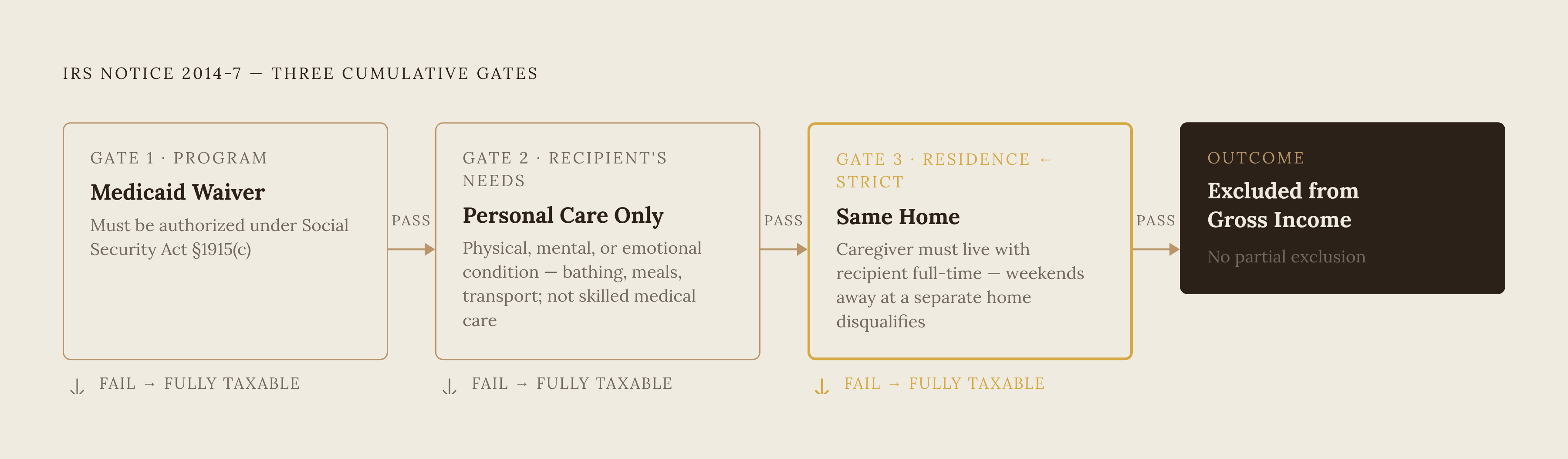
Three conditions have to be true at the same time. Miss any one of them, and the payments become fully taxable, with no partial exclusion available.
The first condition is program type. Payments have to come from a Medicaid waiver authorized under Section 1915(c). Caregivers in programs outside that authority should confirm their state's specific status rather than assume coverage, since, as noted above, some states needed individual rulings to extend the exclusion.
The second condition concerns the care recipient's needs. The recipient has to require assistance because of a physical, mental, or emotional condition, and the services provided have to qualify as personal care rather than skilled medical care. Personal care covers things like eating, bathing, dressing, toileting, transferring, maintaining continence, personal hygiene, light housework, laundry, meal preparation, transportation, grocery shopping, telephone use, medication management, and money management. Skilled services that only a licensed health professional may legally perform fall outside this definition entirely.
The third condition is the one that trips up the most caregivers in practice: shared residence. The caregiver and the recipient have to live in the same home, whether that's the caregiver's home or the recipient's. The IRS has offered a specific example to clarify the boundary: a provider who spends weekends and holidays at a separate home of their own does not meet the requirement, even if they sleep at the recipient's home most nights of the week. That's a strict reading. Partial or mostly-there residency doesn't count.
Two clarifications matter here. If multiple caregivers share the home with the recipient, each one can independently exclude their own Medicaid payments, so shared caregiving doesn't dilute the benefit. And respite care, or any service provided outside the shared home, doesn't qualify even when every other condition is met, since the location of the care itself is what the third test is checking.
The caregiver does not need to be a blood relative for any of this to apply. The exclusion works identically for unrelated caregivers who satisfy the three conditions. Biological or legal ties to the recipient simply aren't part of the IRS's analysis, which focuses entirely on program type, the recipient's needs, and where everyone sleeps at night.
Given how much weight the shared-living condition carries, documentation becomes the caregiver's best protection. Records establishing co-residency, lease agreements, mail, utility bills in both names, anything that proves the living arrangement, are the single most useful thing a caregiver can keep on file if the exclusion is ever questioned.
Why the income tax exclusion does not end the FICA question
Here's where the "it's wages, so it's taxed like any other paycheck" instinct turns out to be partly right. Notice 2014-7 says nothing about FICA. Social Security and Medicare taxes run on an entirely separate legal framework, and the income tax exclusion covered above doesn't resolve them one way or the other.
The default assumption matters here: even payments excluded from gross income for federal income tax purposes are generally still treated as wages for FICA purposes. That surprises caregivers who assume "tax-free" means tax-free across the board. It doesn't, unless one of two exceptions applies.
The first exception involves family-member exemptions written into the tax code independent of anything tied to a public health coverage program. Wages paid to a child under 21 by a parent are exempt from FICA. Wages a child pays to a parent for domestic services are exempt. Wages paid to a spouse for household work performed in the home are exempt from both FICA and FUTA, though spousal wages remain subject to income tax even when they escape payroll tax. The second exception is a dollar threshold: if a caregiver's total wages from one household fall below a set amount in a given year, FICA doesn't apply at all. That threshold is $2,800 for 2025, rising to $3,000 for 2026.
Whether a specific arrangement actually qualifies for one of these exemptions depends heavily on how the state's program legally classifies the employment relationship, which means the fiscal intermediary's own treatment of the caregiver carries real weight in the analysis.
If FICA is withheld, that's not purely a cost. The caregiver is building credit toward future Social Security benefits during years when federal income tax owed might be zero, which is a long-term trade worth understanding rather than resenting.
One more requirement follows from this: if the care recipient functions as a household employer, that status may require them to file Schedule H with their own federal return, handle withholding directly, and meet employer-side obligations. The framework parallels what's commonly called the "nanny tax," and it's easy for families to overlook that the recipient, not just the caregiver, has paperwork obligations here.
How the Tax Court's Feigh decision changed the EITC and child tax credit math for caregivers
A 2019 Tax Court case reshaped how excluded Medicaid income interacts with two of the most valuable credits available to lower-income households. The case is Mary K. Feigh and Edward M. Feigh v. Commissioner of Internal Revenue, decided May 15, 2019 (152 of a federal tax court's reporter series. No. 15).
The facts were straightforward. Mrs. Feigh received Medicaid waiver payments for caring for the couple's disabled adult children. For the 2015 tax year, the Feighs claimed the Earned Income Tax Credit and the Additional Child Tax Credit. The IRS disallowed both, on the theory that income excluded under Notice 2014-7 couldn't simultaneously count as earned income for credit purposes.
The Tax Court disagreed, and the reasoning stands on its own terms. An administrative notice from the IRS, the court held, cannot strip away a statutory benefit that Congress created through legislation. Notice 2014-7 has the authority to exclude income from taxation. It does not have the authority to reclassify that income so it stops counting as earned income for credit eligibility, because that determination belongs to Congress, not to an IRS notice. The IRS acquiesced formally, issuing an Action on Decision dated March 30, 2020, confirming that excluded Medicaid waiver payments count as earned income when computing the EITC and, where applicable, the Additional Child Tax Credit.
What does this mean in practice? Excluded payments, the ones with zero taxable income, can still count as earned income for EITC purposes. That catches most caregivers off guard, since the intuitive assumption is that zero taxable income means zero credit eligibility. It doesn't work that way here.
For married couples where both spouses receive qualifying waiver payments, each spouse can make an independent election on whether to include their own payments in the earned income calculation. That opens a genuine optimization question: including the payments as earned income might unlock the Additional Child Tax Credit for a caregiver with no other earned income, but it might also reduce the EITC amount in certain income ranges. There's no universal answer, only a calculation that has to run both ways before filing.
Caregivers who never claimed the EITC or ACTC using Medicaid waiver payments in prior years may still have a path to recover that money, through amended returns, provided the year in question is still open under the federal refund statute of limitations.
California adds its own layer. Feigh itself didn't change California's EITC administration directly, but a 2021 decision from the California Office of Tax Appeals, Matter of Akhtar, extended the same reasoning to state law. A state tax authority now allows payments excluded from federal gross income to be counted as earned income for a state earned income credit, under a separate state provision. Caregivers filing in California need to apply the state-specific version of this rule rather than assuming the federal outcome transfers automatically.
How to report qualifying and non-qualifying payments correctly on a federal return
Reporting mechanics split cleanly along the line drawn in the third section: does the caregiver meet the shared-residence test, or not?
When payments qualify for the exclusion, W-2 reporting should reflect that. The excluded amount shouldn't appear in Box 1 (wages), and if the entire payment is excludable, Box 1 is left blank. Some fiscal intermediaries flag this by reporting the amount in Box 12 using Code "II," which signals the Notice 2014-7 exclusion directly on the form. When a caregiver instead receives a 1099-MISC or 1099-NEC, the mechanics look different but land in the same place: the full amount goes on Schedule C, line 1, and the excludable portion gets deducted in Part V, Other Expenses, with "Notice 2014-7" written next to the line. Even though Schedule C is the form being used, the payments aren't self-employment income in this scenario and aren't subject to self-employment tax. Some caregivers, particularly in states running self-certification systems, receive no tax form at all. In those cases, personal payment records become the only substantiation available, both for the current year's return and for any amended returns down the line.
When payments don't qualify, because the caregiver doesn't live with the recipient, the picture is simpler and less favorable. A W-2 gets reported as ordinary wage income on Form 1040. A 1099, or a self-employment arrangement, goes on Schedule C with allowable business expense deductions, and self-employment tax gets calculated and paid through Schedule SE at the standard rate.
The EITC and ACTC election discussed in the Feigh section happens directly on the return itself. Given that including versus excluding the payments as earned income can shift the outcome in either direction depending on income level and family size, running both scenarios before filing isn't optional, it's the only way to know which produces the better result.
If the care recipient qualifies as a household employer and FICA applies to the arrangement, Schedule H attaches to the recipient's own return to report and pay employment taxes, separate from anything the caregiver files.
A handful of errors occur repeatedly in caregivers' tax filings and either trigger IRS correspondence or cost caregivers money outright. Treating all Medicaid waiver pay as automatically tax-free without checking the co-residency test is one. Reporting excluded amounts in Box 1 of a W-2, or mistakenly subjecting them to self-employment tax, is another. Failing to make the earned-income election for EITC purposes when doing so would generate a refund is a third, and a costly one given how much larger the EITC can be than the ACTC in some cases. Missing the amended-return window for prior years, now that the Feigh ruling has clarified what was previously ambiguous, rounds out the list.
Where to find benefits caregivers qualify for but haven't claimed yet
Everything above assumes a caregiver already knows which Medicaid program they're enrolled in and understands its tax treatment. That's a big assumption. Plenty of caregivers don't know the full menu of programs they might qualify for, and some never formally enroll in anything at all, providing unpaid care without realizing paid pathways exist.
Why does this gap persist? Because the system is genuinely complicated, not just for families but for practitioners too. IRS Notice 2014-7, the Feigh election, FICA exemptions that hinge on family relationship and dollar thresholds, program-specific eligibility rules, and state-by-state variation in how programs get classified all stack on top of each other. Caregivers navigating that alone, without a tax professional who specializes in this exact intersection, routinely miss both benefits they could be receiving and credits they've already earned.
The Credit for Other Dependents is a separate credit. Caregivers who are financially supporting the person they care for may qualify for a nonrefundable credit of up to $500 per qualifying dependent. This sits entirely apart from the EITC analysis covered above, and a caregiver doesn't need to be receiving Medicaid wages at all to claim it, only to meet the dependent support test.
Amended returns are the other piece that deserves attention. Caregivers who didn't claim the EITC or the Additional Child Tax Credit using Medicaid waiver payments in prior years, before the Feigh precedent settled the question, may still be able to go back and claim that money for years that remain open under the statute of limitations. That's not a small correction. For a caregiver earning modest wages through a waiver program, an EITC claim spanning several open tax years can add up to a meaningful sum, and it's sitting there unclaimed simply because the rule wasn't clear, or wasn't known, at the time the original return was filed.