Advance Directives and Durable Power of Attorney for Aging Parents
Proper documents prevent costly guardianships when aging parents lose capacity.

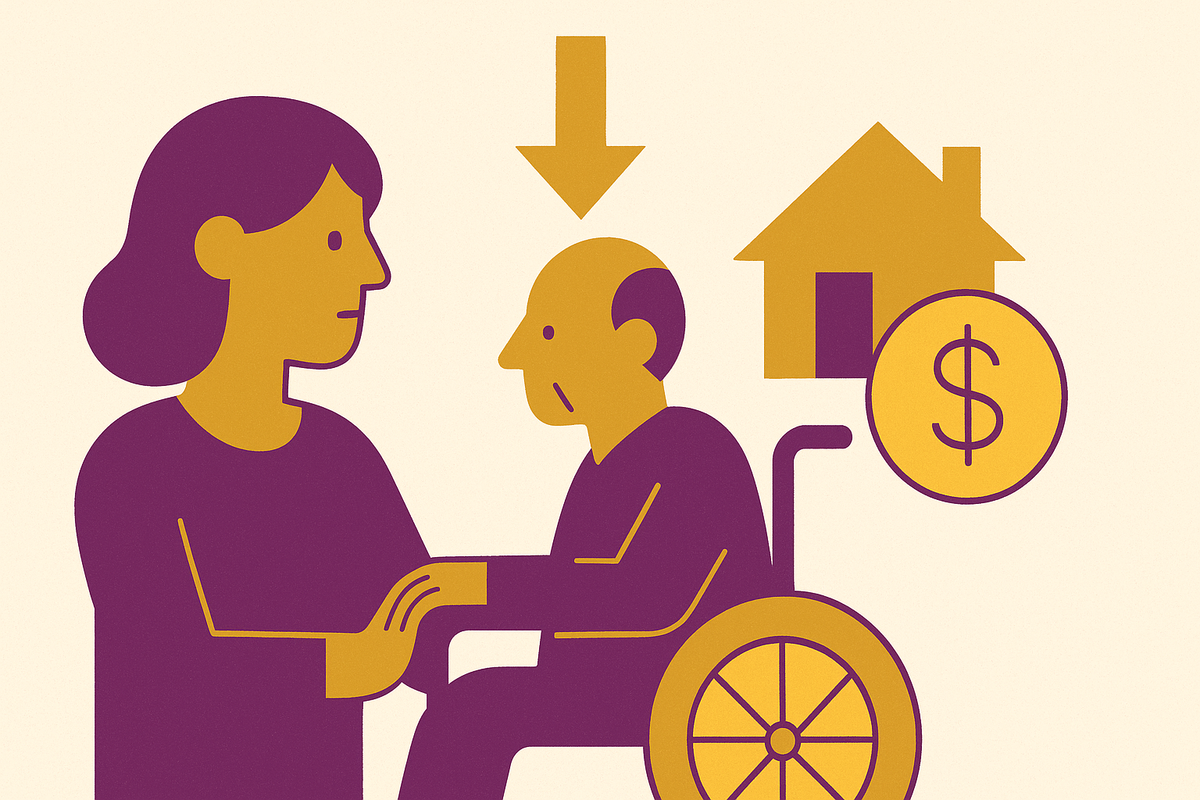
A California family learned how a springing power of attorney fails at the exact moment it is needed. The parent's dementia was visible to everyone in the household, but the document required a physician's certification of incapacity before the agent could act, and the physician was reluctant to put that certification in writing. The nursing home bill came due. The agent, named years earlier with every good intention, had no authority to pay it. That gap between what the family could see and what the paperwork required became the whole crisis.
This is what happens, in some form, whenever an aging parent loses capacity without documents in place. Financial institutions have to protect account holders too, so without proper documentation in hand, bills go unpaid and assets sit frozen. A Medicaid application can stall the same way: an adult child trying to gather a parent's income records, asset statements, and insurance documentation may find every door locked without a power of attorney, and the family ends up absorbing costs the parent might otherwise have qualified to have covered.
The fallback is guardianship or conservatorship, and it is exactly the outcome these documents exist to prevent. Texas contested guardianships frequently escalate past five figures once family members disagree. None of this reflects a family failing to plan well enough in some abstract sense. It reflects what happens by default when no one has formally named who's in charge, and the entire rest of this piece is about how to make sure that default never gets triggered.
What advance directives cover
An advance directive is not a single form but an umbrella term covering documents that record a person's medical wishes for a time when they can no longer state them directly. Completing the right paperwork instead of the wrong one starts with knowing what sits inside that umbrella and what sits outside it.
Two documents do most of the work. A living will is a written set of instructions about specific treatments, the kind of document that answers a question like whether a parent wants mechanical ventilation in a specific scenario. A healthcare power of attorney, sometimes called a healthcare proxy, names a person who can make medical decisions on someone else's behalf. If there's no living will, a proxy gives an agent legal authority but no written record of what the principal actually wants, so the agent has to guess at intention under pressure.
People confuse the POLST, which stands for Physician Orders for Life-Sustaining Treatment, with an advance directive constantly, and the confusion matters. A POLST is not an advance directive. A healthy older adult doesn't need a POLST. What a healthy older adult needs is an advance directive, because the POLST only becomes appropriate once a decline has already progressed to a certain clinical point.
A living will is not a medical order, so it cannot direct an EMT in an emergency. A paramedic arriving at a parent's home has no legal basis to withhold resuscitation just because a living will exists in a drawer somewhere, unless a separate physician's order, like a POLST, backs it up. That gap between a documented wish and an enforceable order is precisely why the healthcare power of attorney matters so much. An advance directive, whatever form it takes, only activates once a person can no longer communicate their own wishes. It never overrides what a person with capacity chooses to say for themselves in the moment.
Durable power of attorney versus the healthcare proxy
An advance directive handles medical decisions. It says nothing about who pays the mortgage, signs a tax return, or manages a brokerage account once a parent can no longer do those things. That's the job of a durable power of attorney, and treating the two documents as interchangeable is one of the most consequential mistakes a family can make in this process.
A financial durable power of attorney authorizes an agent to manage bank accounts, pay bills, sell property, file taxes, and handle applications for government benefits. None of that authority comes from a healthcare power of attorney, which covers a completely separate set of powers: making treatment decisions, communicating with providers, and directing care. The two documents are complementary rather than redundant, each covering ground the other leaves untouched, and a family that executes only one has left half the problem exposed.
The word "durable" carries real legal weight in both documents. A durable power of attorney stays in force even after the principal becomes incapacitated, which is the entire point of having one. The California family from the opening section ran into a variation on this problem: a springing power of attorney, which only activates once a physician certifies incapacity in writing. When that certification doesn't come quickly, or doesn't come at all because a physician hesitates to put a diagnosis on paper, the agent is left holding a document with no force behind it during exactly the window when it's needed most.
Both documents have to be executed properly to hold up. Requirements differ from state to state, and a document drafted and signed under one state's formalities can be rejected by a hospital or financial institution operating under another state's rules. That execution requirement is a detail easy to skip past, but it governs whether any of what's described above actually functions when a family needs it to.
Why most older adults still don't have these documents
Knowing these documents matter turns out not to be the obstacle. Research at the Indiana University Health Primary Care Geriatrics Clinic found that advance directive completion rates among older adults sat below the national average, even in a population already in regular contact with geriatric care, and that education and provider communication were the two levers that moved completion rates once patients understood the actual benefit. The gap is a combination of psychological avoidance and structural failure in how healthcare is delivered, and education campaigns by themselves haven't closed it.
Structural barriers compound that reluctance. Medicare reimburses clinicians for advance care planning conversations, which should remove the financial disincentive for providers to raise the subject. But time constraints inside a packed clinic schedule, workflow gaps that never build the conversation into a visit, and the simple discomfort of the topic mean these discussions get skipped in routine care far more often than the reimbursement structure would predict.
The disparities compound further. People from racial and ethnic minority groups, people with lower incomes, and people with public or limited insurance complete advance directives at significantly lower rates than higher-income, non-Hispanic White adults do. One might argue this reflects differing preferences about end-of-life planning across communities, but the evidence points elsewhere: the gap tracks fragmented care and limited provider engagement, not a different set of values. A patient who sees a different provider at every visit, or who has fifteen minutes with a physician who has twelve other patients that hour, has fewer chances for the conversation to happen.
Educational interventions on their own have shown limited staying power. A one-time prompt, a pamphlet, a single conversation, tends to decay unless a structural reinforcement, something built into the system itself, keeps the message active. That finding means the solution isn't more awareness campaigns: building the prompt into the system itself.
What Moves Families to Complete These Documents Before a Crisis Hits
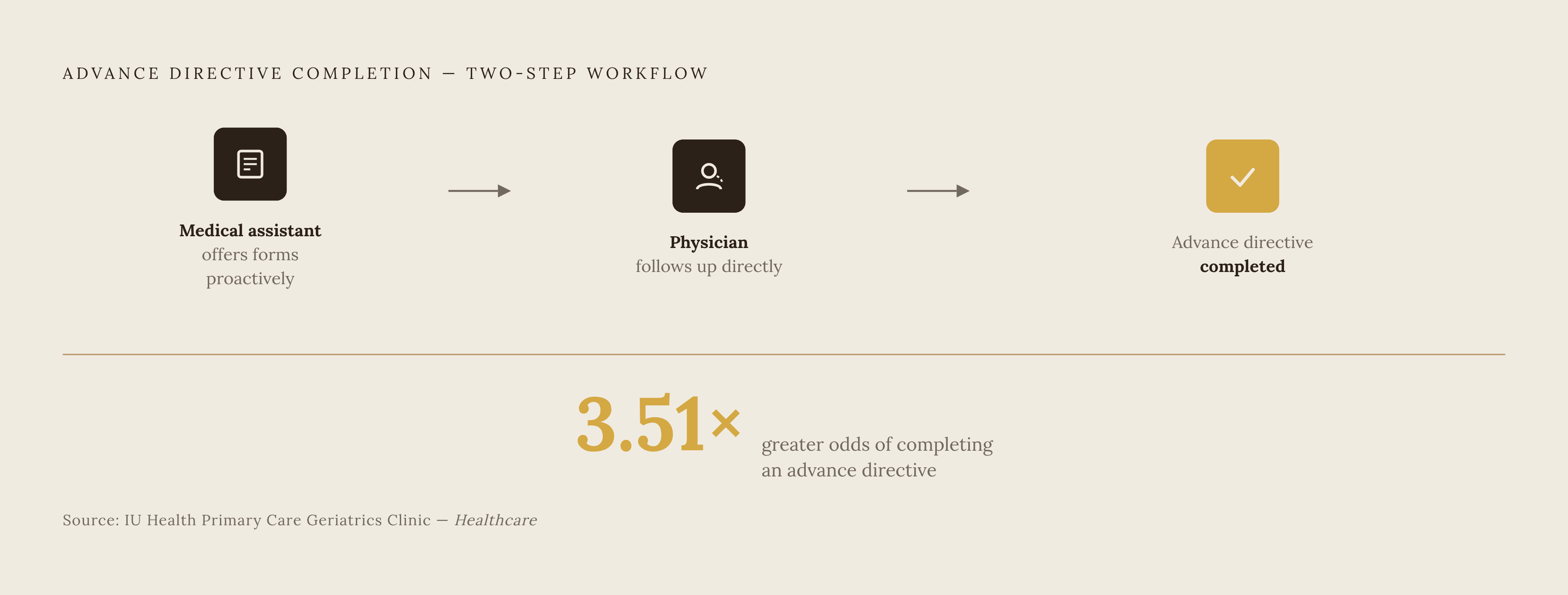
The Indiana University Health quality improvement study offers the clearest evidence of what works in practice. Medical assistants who proactively offered advance directive forms during geriatric clinic visits, followed by a direct physician conversation, raised the odds of a patient completing an advance directive 3.51 times, findings published in the journal Healthcare show. Older adults weren't resistant once the purpose of the document was explained to them in plain terms. The barrier wasn't will. It was that nobody had structured the moment for them to act.
What makes this intervention notable is how little it demanded of clinic staff. The mechanism combined a structured workflow, where offering the form became a routine step rather than an exception, with patient education and direct provider communication. That combination is what let it scale across a clinic without placing a heavier burden on any single physician.
The honest caveat matters here. Momentum was hard to sustain over time, and results decayed between measurement points. A single prompt or a single good conversation isn't enough on its own. The most durable gains came from making the ask a standard part of every visit, not from a one-time campaign that fades once the novelty wears off.
For families approaching a reluctant parent, one framing shift makes a measurable difference: presenting the conversation as a way to give the parent control over their own wishes. These documents exist to protect what a parent has already decided, keeping that decision from being overridden by a default state law or by a disagreement among family members later on. That framing, control rather than decline, is also the bridge into the next decision families face: who actually gets named as the agent.
Choosing the right agent, the decision families most often get wrong
Completing the documents is the necessary first step, but naming the wrong agent, or naming two agents in a structure that invites conflict, can produce damage close to what happens with no document at all: family conflict, legal challenges, and decisions that contradict what the parent wanted.
The sharpest risk here involves co-agents, where two people are appointed to act together on the same document. It can feel fair to name two siblings jointly rather than choosing between them, but that structure creates a real vulnerability: if the co-agents disagree on a treatment decision or a financial move, they may have no way to resolve it except through a court. That outcome is precisely the adversarial, expensive process these documents were drafted to avoid. Splitting authority between two people with equal standing creates a structural deadlock whenever those two people see a situation differently, regardless of how well they otherwise get along.
A healthcare agent has to make difficult treatment calls under real emotional pressure, hold steady against family disagreement, and communicate clearly with physicians and nurses in real time. A geographically distant child with a level head may serve better than a nearby relative who struggles to make hard calls under stress.
The better structure names one primary agent and one separate successor agent who steps in only if the primary can't serve. That preserves a single, clear line of authority at every moment. For parents without a trusted family member available, or who worry about financial exploitation by someone close to them, a professional fiduciary, a nonprofit agency, or an attorney can serve as agent instead. That option goes unmentioned far more often than it should, and it removes the family-dynamics problem for caregivers managing a parent with no nearby relative able to take on the role.
Standard boilerplate forms, the kind you can get free online, often don't account for common dispute scenarios or specific family conflict risks. And whoever is named needs more than a signature on a form: the agent should hold a copy of the documents, know exactly where the originals are kept, and understand the parent's wishes in enough detail to apply them to situations the written document never anticipated.
The practical steps to get both documents in place
You don't need a crisis to complete an advance directive and a durable power of attorney, and the steps are manageable once a family understands the state-specific rules governing execution and distribution.
Both the healthcare power of attorney and the financial durable power of attorney must be executed according to the laws of the state where the parent lives. If the estate is complex, family dynamics are difficult, or you want protections beyond what a standard form covers, an elder law attorney can draft documents tailored to the specific circumstances.
Once signed, the originals need to live somewhere accessible, not locked inside a safe-deposit box the agent can't open on short notice. Copies should go to the named agent, the parent's primary care physician, and any specialist or hospital likely to be involved in the parent's care. It's worth checking whether the parent's state offers that registry and filing if it does.
None of this is a one-time task to file away and forget. Documents should be reviewed after a major health change, after a move to a new state, and whenever the named agent's own circumstances shift through death, divorce, or relocation. What worked at 70 may no longer fit at 80.
For families working through Medicaid eligibility, having a valid financial durable power of attorney in place before applying removes one of the biggest obstacles in the process: the agent can retrieve income and asset documentation, sign the application itself, and respond to agency requests without the delays that come from waiting on authority that doesn't yet exist. Families navigating that eligibility process can also turn to AI-assisted tools built to surface which benefit programs a parent actually qualifies for and walk through the enrollment steps. The paperwork, done early, is what keeps every later step, medical and financial alike, in the family's hands.
Sources
- Quality Improvement Project: Advance Directive Completion in Older Adults at the IUHPC Geriatrics Clinic
- Enhancing Advance Directive Completion Among Older Adults in the Geriatrics Clinic in Indiana, USA: A Quality Improvement Initiative
- Race and Educational Disparities in Advance Directive Completion: Encouraging Trends in the United States
- What Happens If You Don’t Have a Durable Power of Attorney?
- Durable Power of Attorney vs Medical Power of Attorney: What You Need to Know