Medicaid Spend-Down Rules and How They Affect Caregiver Inheritance
Caregiving adult children lose inheritance protections under Medicaid's spend-down rules.

Medicaid pays for long-term care only after a family's countable assets and income fall below strict federal and state ceilings, and those ceilings are what force a spend-down. For families where an adult child has spent years as the unpaid caregiver, the spend-down process does not just reduce a parent's estate. It specifically erodes the inheritance that child expected, often the very house they live in and maintain.
Medicaid's asset and income floors and the spend-down problem
Medicaid long-term care eligibility runs on two separate financial tracks, and a family has to clear both before the program pays a dollar toward nursing home or assisted living costs. The first is asset spend-down: a one-time reduction of countable resources, savings accounts, brokerage holdings, a second car, the cash value built up in a life insurance policy, down to roughly $2,000 for a single applicant in most states in 2026. The second is income spend-down, which works on a recurring monthly basis. Each month, the applicant must spend an amount equal to their income minus the state's Medically Needy Income Limit before Medicaid coverage activates for that month, and the cycle repeats as long as the person remains on the program.
State variation in these limits is substantial enough to change how a family plans. California stands out as a special case: it reinstated a $130,000 asset limit effective January 1, 2026, after a period during which California had eliminated asset limits for Medicaid long-term care. That reinstated limit is itself scheduled to fall sharply to $21,000 for an individual starting July 1, 2027. California families who built plans around the no-limit years now face a tightening window.
Marriage offers one structural cushion that single applicants and their children do not get. A community spouse, the husband or wife who is not entering long-term care, is protected by the Community Spouse Resource Allowance, which can reach a six-figure ceiling in 2026. That allowance lets a married couple keep a meaningful portion of their joint assets out of the countable pool. Adult children sit entirely outside that protection. No equivalent allowance exists for a son or daughter, even one who has lived in the parent's home for years and provided the care that kept the parent out of a nursing facility in the first place. The spend-down rules were built around a single applicant or a married couple. They were not built with the caregiving child in mind at all, and that gap drives everything covered in the rest of this piece.
The caregiver child's financial exposure in this system
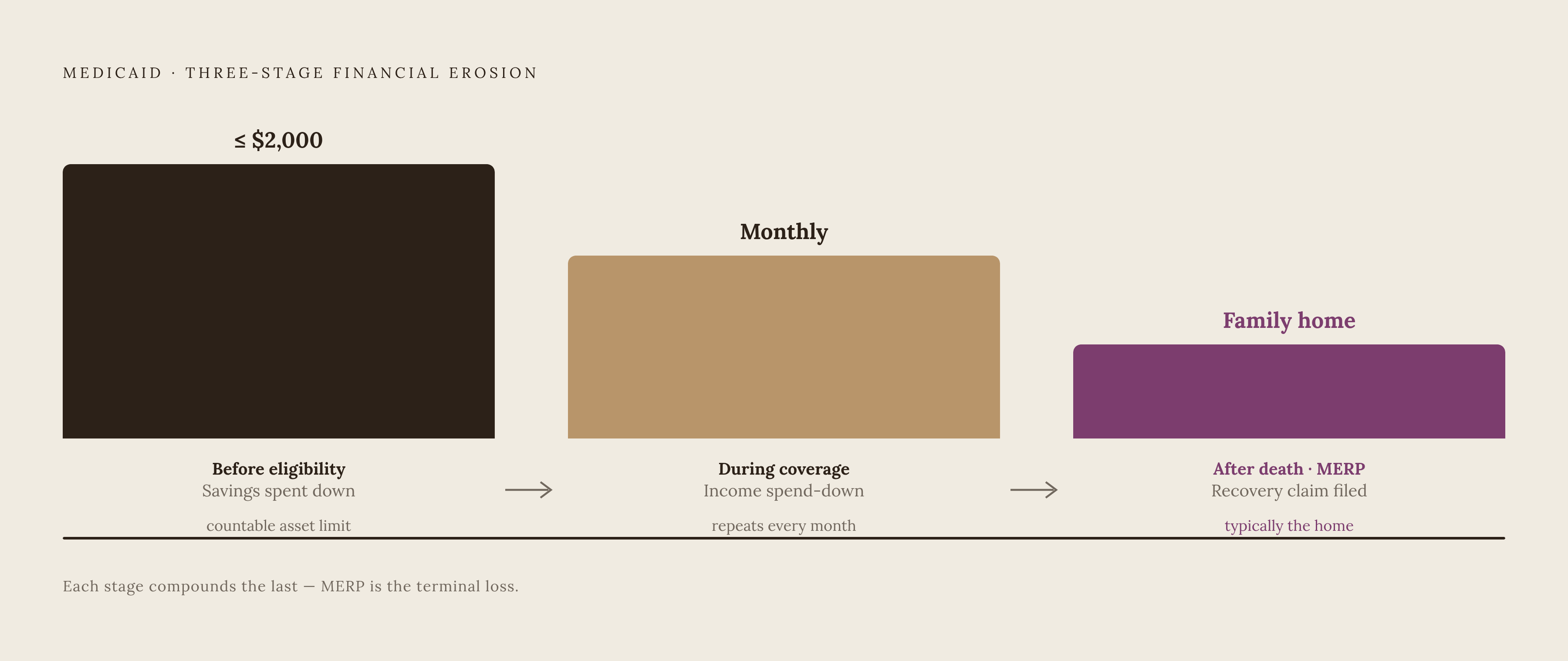
Among everyone touched by Medicaid's financial rules, the adult child who provides years of unpaid care and expects to eventually inherit the family home is the one most systematically disadvantaged by how the system is structured. When her mother dies, she discovers that the state has filed a Medicaid Estate Recovery claim against the house, the one asset she assumed would be hers. Nothing about that outcome required bad faith on anyone's part. It is simply what the rules produce by default.
The exposure runs through three distinct points, and each one can take something away from the caregiver before the estate ever reaches them. Before eligibility, the parent's assets have to be spent down to near zero. The savings the child may have helped protect and manage are gone before Medicaid starts covering a single day of care. After death, whatever is left in the estate, usually just the house, is subject to MERP, which the state files against the estate specifically to recoup what it spent.
A fourth wrinkle complicates things further: what happens if the parent receives an inheritance while already on Medicaid. Federal law requires the recipient to report the inheritance to the state Medicaid agency, generally within 10 calendar days. Disclaiming the inheritance is not a workaround. Federal law requires Medicaid recipients to accept an inheritance they are entitled to, and a disclaimer is treated as a disqualifying transfer under look-back rules, producing a penalty period exactly as though the money had been given away voluntarily. The caregiving child, in effect, watches the estate shrink from both directions at once: spent down before Medicaid coverage begins, and recovered again after the parent dies.
The five-year look-back and its escape routes
Most families confronted with this math arrive at the same first idea: transfer the parent's assets or the house to the caregiving child before applying for Medicaid. The five-year look-back period exists specifically to close off that option, and understanding how it operates in detail is what separates the families who preserve something from those who lose it all.
Any transfer made for less than fair market value during the five years before a Medicaid application creates a penalty period, a stretch of time during which the applicant is ineligible for Medicaid despite otherwise qualifying financially. The rule captures more than the obvious case of a parent writing a check to a child. It applies to selling the family home to a child for less than it is worth, and it applies to a Medicaid recipient disclaiming an inheritance, which gets treated exactly as if the money had been accepted and then given away.
What makes the look-back period especially dangerous for honest families is that it does not distinguish motive. Families get blindsided by this precisely because they did nothing to conceal anything. They assumed that transparency would protect them, and it does not.
California's recent history illustrates how much this timeline can shift under a family's feet. California had been in the process of eliminating its 30-month look-back period altogether, but as of 2026 the state is reimplementing it, closing a brief window during which California caregivers had more flexibility to transfer assets than families anywhere else in the country. The look-back period does not make planning impossible. It sets the clock that any planning has to respect, and the protections covered in the next three sections exist because they are built to operate within that clock rather than around it.
The Child Caregiver Exemption: the most direct protection for the family home
One rule in Medicaid law was written expressly to recognize what a caregiving adult child has done for a parent, and it is the most direct tool available for protecting the family home. The Child Caregiver Exemption can shield the home from both the look-back penalty and MERP, but only when its requirements are met with precision. Families that assume the exemption applies automatically because the caregiving clearly happened are often the ones who lose it.
The exemption allows a Medicaid long-term care applicant to transfer their home to a qualifying adult child without triggering a look-back penalty. The exemption removes assets from the countable pool before the spend-down calculation and shields the home from recovery after death by transferring it with a single deed. Elder law practitioners treat it as the centerpiece of caregiver-focused planning.
Qualifying requires meeting several conditions at once, and all of them must be satisfied. The child must have lived in the parent's home for at least two years immediately before the parent began receiving Medicaid long-term care. Stepchildren, in-laws, grandchildren, nieces, and nephews do not qualify under this exemption, regardless of how much care they provided.
Documentation is where eligible families most often lose this exemption, because the care, even when it happened, was never recorded in a form Medicaid will accept. Medical conditions and the specific limitations they caused are typically included as well. Records establishing the child's residence at the home, utility bills, tax filings, mail sent to that address, all strengthen the application and should be gathered well before they are needed.
Personal Care Agreements: how the spend-down process itself can flow to the caregiver
A Personal Care Agreement takes a different approach from the Child Caregiver Exemption, and the two work well together because a PCA addresses compensation during the care period rather than the disposition of the home at the end of it. Structured correctly, a PCA redirects money that would otherwise disappear into monthly care costs or a nursing home's revenue, turning it instead into documented, Medicaid-compliant payment to the family member actually doing the work.
The mechanism is a written contract between the care recipient and the caregiving family member, laying out specific duties, scheduled hours, and an hourly rate set at or below the local fair market rate for comparable professional care. Once that agreement is in place, payments made under it are treated by Medicaid as documented compensation for services rendered. They satisfy the spend-down requirement without creating a look-back penalty.
A PCA can only pay for services performed after the agreement is signed. It cannot reach back and compensate a caregiver for years of care already given before the contract existed. Families who try to use a PCA retroactively, paying a child a lump sum for past caregiving, run directly into Medicaid treating that payment as an unearned gift rather than compensation, with all the look-back consequences that follow. A PCA solves two problems in a single instrument. It compensates the caregiver fairly for ongoing work, and it accomplishes the spend-down Medicaid requires anyway, so the money goes to the person who earned it rather than disappearing into an institution's billing.
Medicaid Asset Protection Trusts for caregiving families
A Medicaid Asset Protection Trust extends protection beyond the home into a family's broader financial picture, savings, investments, other real property, shielding those assets from both the spend-down requirement and MERP. The tradeoff is timing: the five-year look-back period means a MAPT only works for families who start planning well before a care crisis arrives, not after one.
A MAPT is an irrevocable trust that removes assets from an individual's countable estate by transferring legal ownership of them into the trust itself. Once the five-year look-back period has run its course from the date of funding, assets properly held inside the trust are no longer counted toward Medicaid's asset limits. The trust can name the caregiving adult child as beneficiary, which preserves the inheritance that child was counting on, structured through the trust rather than through a will exposed to estate recovery.
The constraint that makes MAPTs unforgiving is the same look-back mechanism covered earlier in this piece. A family that waits until a parent is already showing signs of needing nursing home care to look into a MAPT will typically find that it is too late for the trust to do any good, because the clock has not had time to run. A MAPT cannot retroactively protect assets that have already been spent down, and because it is irrevocable, the person who sets it up gives up direct access to whatever goes into it.
One might argue that a MAPT is simply the correct tool for any family with assets worth protecting, but access to it is not evenly distributed. Drafting a MAPT properly requires an elder law attorney, and an improperly structured trust may fail to achieve Medicaid protection at all, or create its own look-back complications on top of the ones it was meant to solve. That legal cost puts MAPTs out of reach for many of the lower-income caregiving families who would benefit most from exactly this kind of protection, which is worth keeping in mind heading into the final piece of this picture: what happens to a family that had no trust, no personal care agreement, and no exemption in place when the parent dies.
Estate recovery after death: MERP claims, exemptions, and reform
Even a family that has managed the spend-down carefully still faces one last mechanism capable of taking what remains: Medicaid Estate Recovery. MERP files claims against the estate of a deceased Medicaid recipient, and because the spend-down rules have usually already eliminated everything else of value, the family home is frequently the only asset left for the state to pursue.
Following the death of a long-term care Medicaid recipient, the state Medicaid agency files a claim against whatever estate remains, seeking to recover what it paid out for that person's care over the years. In most cases, the home is the only significant asset still standing at that point, making it the recovery target by default. This is why the Child Caregiver Exemption, covered earlier, carries so much weight: if it was successfully applied before the parent's death, the home has already left the estate and MERP has nothing to reach.
Beyond the federal exemption, some states have built their own caregiver waivers that exempt or defer estate recovery specifically for heirs who served as caregivers. But how consistently do these waivers actually reach the families who qualify for them? Not very. Eligible caregivers frequently fail to obtain a waiver they technically qualify for because of a lack of awareness that the waiver exists, paperwork that is genuinely cumbersome, and procedures complicated enough to deter even caregivers who would otherwise clear every bar the state has set.
There is also a meaningful distinction between the types of waivers states offer: a permanent waiver eliminates the recovery claim entirely, while a temporary waiver only delays it, leaving the claim to resurface later. Advocates working on this issue have pushed for permanent waivers over temporary ones precisely because a delay is not protection, it is postponement. Legislative movement on the federal level reflects a similar push. Neither bill changes what a family facing MERP today can do about a claim already filed. But together they mark where the policy argument is heading: toward a system that recognizes, in law rather than in exception, what caregiving children have already been doing for years without it.
Sources
- Medicaid Nursing Home Spend Down: Unlock 2026 Safely
- Child Caregiver Exemption: Who Qualifies and How It Works in Massachusetts - GuthroLaw
- NY Medicaid Eligibility: Caregiver Child Exemption - A Guide to Home Transfers
- Medicaid Caregiver Child Exemption - The Law Office of Paul Black
- What happens when one spouse goes to a nursing home
- Personal Care Agreement: Pay a Family Caregiver, No Penalty
- Medicaid Asset Protection Trusts in Southeast Michigan: Updates for 2026
- Medicaid Asset Protection Trust (MAPT): How It Works in 2026