Home Modification Grants for Seniors Under USDA and HUD Programs
Two federal programs help seniors modify homes, but eligibility rules determine which one fits.

Most older adults say they want to stay in their own homes as they age, and most of the homes they live in were never built to make that possible. It is a housing-stock problem, built into millions of structures decades before anyone living in them needed a ramp or a walk-in shower, and no amount of personal savings changes what a house was built to do. That is the problem USDA Section 504 and HUD's Older Adults Home Modification Grant Program (OAHMP) were created to address, and understanding how each one works is what lets a senior or a caregiver find the right door instead of the wrong one.
Falls among adults 65 and older send millions of people to the emergency room every year, and the annual medical cost tied to nonfatal older-adult falls has climbed to roughly $80 billion. Assisted living runs tens of thousands of dollars a year, and within a few years that cost outpaces what most home modification projects run, which makes early investment in a safer home the economically sound choice for families and for the government programs that end up paying the alternative bill.
The Federal Response: Two Programs With Different Designs
The federal government funds senior home modification through two main channels, USDA's Section 504 program and HUD's OAHMP, and they are not two sizes of the same offer. Treating them as interchangeable versions of one benefit is how seniors end up applying to the wrong program and waiting months to learn they were never eligible.
The clearest structural difference sits in how the money moves. Section 504 sends funds, as a loan or a grant, straight to a qualifying homeowner through a local USDA Rural Development office. OAHMP works differently: HUD never cuts a check to a senior. It funds local and regional organizations, nonprofits, state and local governments, and public housing authorities, and those organizations deliver the actual repair services to eligible older adults in their coverage areas. The other depends on a layer of local organizations choosing to apply for HUD money and choosing to serve a given area.
Both programs target people 62 and older, and both are built around income limits. Beyond that, they split. The sections that follow treat each program in turn, starting with Section 504, because its loan-grant structure is easy to misread.
USDA Section 504 and Its Two Tracks
Section 504's formal name is the Single Family Housing Repair Loans and Grants program, and it runs through USDA Rural Development offices. A homeowner who qualifies for both the loan and the grant can combine the two up to a defined project ceiling, which matters because the two tracks are not simply a generous option and a stingy fallback. They serve different financial situations by design.
The loan is the program's workhorse. It is available to a wider income band, carries a 1% interest rate, and can be used for repair, improvement, and modernization work, including HVAC repairs when a failing heating or cooling system creates a genuine health or safety hazard. Karen Watts, founder of prop-tech firm DomiSource, said: "Section 504 USDA grants are reserved for seniors who truly can't repay. The loan carries the bulk of the program's volume, and the grant exists for the subset of applicants who cannot take on debt at any interest rate, no matter how low.
A rule change took effect in 2026 that reshaped who can reach which track. The same notice also eliminated the special, higher grant maximum that had previously applied in federally declared disaster areas. Disaster-damaged homes now use the same standard lifetime grant cap as any other application, and any source still citing the old, higher disaster-area figure is working from guidance that no longer applies.
Grant money is meant to remove health and safety hazards: wheelchair ramps, grab bars, walk-in tubs, widened doorways, faulty wiring, failing plumbing. Cosmetic upgrades, luxury finishes, and work on a second home or rental property are excluded, a restriction that applies to the loan as well as the grant, not the grant alone. A senior who may sell or transfer the property soon should raise that question with the local Rural Development office before signing anything.
A separate, earlier policy shift also shapes who can apply today. That cut led directly to the formal rescission of an age-requirement waiver that had applied to applicants in Presidentially Declared Disaster Areas. As a result, all Section 504 Home Repair Grant applicants in those disaster areas must now be 62 or older at the time of application, though complete applications received before the June 7, 2024 notice could still be processed under the older waiver.
Who Section 504 Reaches and Who It Structurally Excludes
Section 504's eligibility rules shut out renters, urban and most suburban seniors, and anyone above the very-low-income threshold from the grant track, and these groups, who together make up the majority of older Americans rather than a small set of exceptions, are excluded because the program is working exactly as designed, aimed at a narrow slice of the senior population and built to stay that way.
Three restrictions do most of the work. And low-income seniors above the very-low threshold gained access to the low-interest loan under the August 2026 rule change, but remain excluded from the grant no matter how modest their resources are otherwise.
An asset test adds a further filter on top of the income rules. In many parts of the country, demand for the grant simply outpaces the annual allocation available to fund it.
What all of this means for the seniors it excludes is straightforward: Section 504 cannot help them, and the restrictions are geographic and categorical, fixed regardless of individual appeal or workaround. Those seniors, renters, city and suburban homeowners, and anyone whose income sits above the very-low threshold, need a different program built on different rules. That is what HUD's OAHMP is designed to be.
OAHMP: Reaching the Seniors Section 504 Cannot
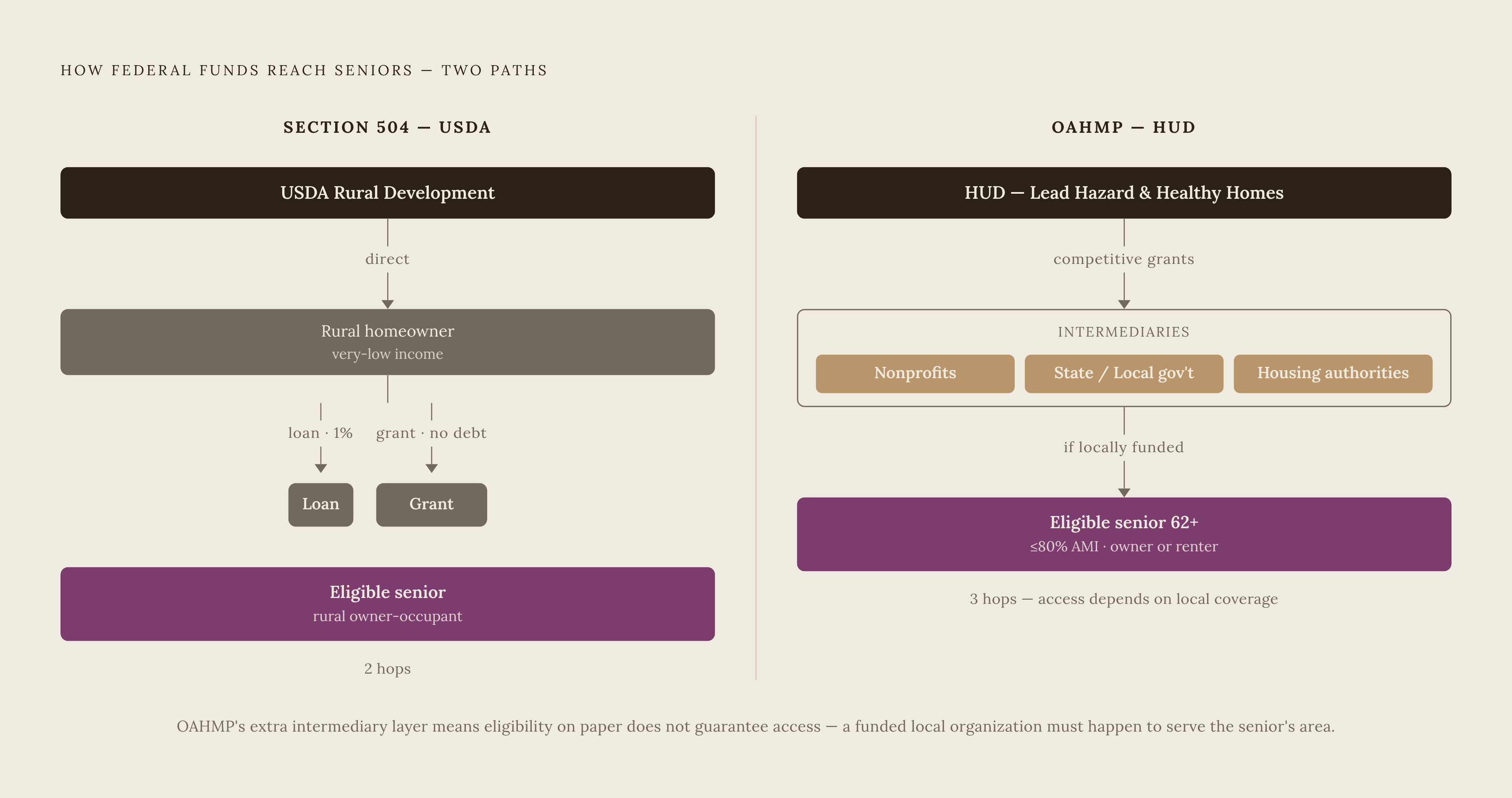
OAHMP exists specifically to reach seniors in cities and suburbs, and seniors who rent rather than own, the people Section 504 cannot serve. It does this through intermediary organizations rather than direct federal grants, and that structural choice has a real consequence. A senior's practical ability to use the program depends entirely on whether a HUD-funded organization operates in their area, not just on whether they meet the program's eligibility rules on paper.
HUD awards OAHMP funds to experienced nonprofits, state and local governments, and public housing authorities. Those local entities then deliver home modification services directly to eligible older adults in their service areas, and no senior applies to HUD itself. The program is administered by HUD's Office of Lead Hazard Control and Healthy Homes (OLHCHH), which both distributes the grant funds and provides training resources to the organizations that carry out the work on the ground.
Eligibility for an individual senior requires being at least 62 years old, having household income at or below 80% of the local area median income, and having the work take place at the applicant's primary residence. The distinction that matters most, though, is that OAHMP covers renters in areas where the local grantee has chosen to structure its program to include rental housing. That single feature is what separates OAHMP from Section 504 more than any other rule, since Section 504 excludes renters without exception.
The FY 2026 funding round makes tens of millions of dollars available, with individual award amounts reaching into the millions of dollars over 36-month grant periods, and HUD expects to make dozens of awards, a meaningful increase over earlier funding rounds. Reaching the right agency is only the start, though. Wider eligibility rules do not guarantee a funded grantee exists nearby, and that gap between eligibility and actual access is the subject the next section takes up directly.
What the HUD Evaluation of Early OAHMP Grantees Revealed
HUD's own evaluation of the program's first cohort of grantees offers the clearest evidence of what OAHMP accomplishes and where it runs into trouble. The evaluation found real improvements in seniors' day-to-day functioning alongside a reduction in emergency-related contact with the health care system, which is the outcome the program was built to produce. It also surfaced a specific operational problem: regulatory compliance requirements were heavy enough that some grantees chose to avoid certain types of modifications altogether rather than work through the paperwork and process needed to do them.
Among the Cohort 1 grantees funded in FY 2021, homeowners reported improvements in functional abilities such as bathing and dressing, along with fewer emergency department visits, hospitalizations, and emergency response calls after modifications were completed. Nearly every client interviewed after their modification reported a benefit from the work. That pattern lines up with a broader body of research outside the program itself: a 2025 systematic review published in Healthcare examined a large set of studies and found that 65% of them showed home modifications contributing to fewer falls, better functional independence, and improved quality of life. The two findings point in the same direction, one at the level of individual OAHMP grantees and one across a much wider research base.
The evaluation's harder finding concerns who the program's own rules keep out. The homeownership restriction written into OAHMP's federal eligibility rules excluded renters in practice wherever a grantee had not built rental housing into its program design, and it excluded older adults living on Tribal lands. Both groups were part of what the program was meant to reach, and the evaluation names that exclusion as a real limitation. A program built to go where Section 504 cannot still runs into its own boundary lines, and the evaluation is candid about where those lines fall.
Coverage Gaps Neither Program Fills
Section 504 and OAHMP together cover a great deal of ground, and large groups of seniors still fall outside both of them. None of these are edge cases invented for the sake of argument. They are predictable results of how each program is built.
The money behind both programs raises its own questions about whether the gaps will close or widen. Section 504 grant funding was cut by the Consolidated Appropriations Act, 2024, and unobligated carryover funds were rescinded at the same time, shrinking the pool available to very-low-income rural applicants. On the HUD side, the FY 2026 budget request did not ask for additional OAHMP funding, a signal that the program's federal investment may hold flat rather than grow even as the FY 2026 award round itself expands.
One might argue that two federal programs covering overlapping but distinct populations is a reasonable design, and in many respects it is. But what happens to the senior who fits into neither program's eligibility rules, or who fits the rules but lives somewhere no funded organization operates? No single federal grant pays every senior's repair bill, and the patchwork nature of the coverage means the task of figuring out which door to knock on, Section 504, OAHMP, or neither, falls on the individual senior or their caregiver, often at the exact moment an urgent repair need appears. That burden is the practical cost of a system built from two differently shaped programs rather than one unified one, and it is the reason the next section exists: to turn the rules just described into a workable starting point.
How to Identify Which Program Applies
The two programs run on different eligibility logic and different delivery structures, so the fastest way to find funding is to match a senior's specific situation, where they live, whether they own or rent, and how low their income runs, against the rules each program actually enforces, rather than applying to whichever program comes up first in a search.
Start with geography and tenure. A senior who owns a home in a rural area, as defined by USDA, is a candidate for Section 504. A senior in that same situation who also qualifies as very-low-income and cannot take on any loan, even at 1% interest, should ask the local Rural Development office about the grant track specifically, since the grant and the loan are evaluated against different financial tests. A senior in a rural area whose income is low but not very-low should ask about the loan, since the August 2026 rule change opened that track to a wider income band even though it left the grant untouched.
A senior who rents, or who owns a home in a city or suburb, falls outside Section 504 by definition and should turn to OAHMP instead. The first practical step is a call to the local Area Agency on Aging to ask whether a HUD-funded OAHMP grantee currently serves that area, and, if a renter is asking, whether that grantee's program is structured to include rental housing. That single question, asked early, saves the time that would otherwise go into an application that eligibility rules were always going to reject.
Anyone uncertain which category they fall into should still make both calls, the local Rural Development office and the local Area Agency on Aging, since the two programs' income thresholds, geographic rules, and tenure requirements differ enough that a senior's actual eligibility is not always obvious from the outside. Given what the Section 504 funding cuts and the flat OAHMP budget signal about future capacity, applying early and asking directly about current waiting lists is a reasonable step for any senior whose home has become a safety risk.
Sources
- Healthy Homes - Grant Opportunities
- 504 Single Family Repair Loans and Grants Purpose of the Program: •
- Opportunity Listing - Older Adults Home Modification Grant Program
- HUD Awards Older Adults Home Modification Grants
- Evaluation of the HUD Older Adult Home Modification Grant Program: Cohort 1 Interim Report
- HUD Evaluates Older Adult Home Modification Grants