Medicare-Funded Home Health Services That Reduce Caregiver Burden
Medicare covers skilled home health services that free families from medical caregiving tasks.

Tens of millions of Americans now identify as family caregivers, a number that has climbed sharply over the past decade. That works out to roughly one in four adults in the country, with the large majority caring for adults and a smaller share caring for children with illness or disability. A large share of these caregivers belong to what gets called the sandwich generation: people raising kids and caring for an aging relative at the same time, a pattern that appears even more often among caregivers under 50.
The financial picture is not abstract for these households. One in five family caregivers reports serious financial strain, a figure that has held steady across surveys taken five years apart. And the load does not fall evenly. Women who have an aging parent, spouse, or partner take on the caregiver identity at a noticeably higher rate than men do, and lower-income adults are far more likely to be caregivers than those in middle- or upper-income brackets. She is close to the median.
What happens when that kind of load goes unaddressed for years? Burnout, obviously, but burnout here has a downstream cost that outlives the caregiver's exhaustion: it often pushes the care recipient into a nursing facility earlier than their actual medical condition would require. It is a systemic outcome that outlives one household. It is a systemic outcome, and an expensive one, because institutional placement is the costliest form of long-term care available.
Here is the piece of the puzzle that gets missed most often. Many caregivers are performing tasks, wound checks, medication schedules, mobility supervision, that a licensed professional could legally take over, often at no cost to the family. Most caregivers never learn that the service is sitting right there, already paid for. It is that most caregivers never learn it is sitting right there, already paid for.
The Medicare home health benefit
Medicare covers more than 66 million people nationwide, and out of that population, about 3.5 million beneficiaries use home health services in a given year, making it one of the program's most heavily used benefits. That scale alone suggests something structurally significant is happening, yet the benefit remains poorly understood by the very families who stand to gain from it.
Start with what it is not. Home health, in Medicare's technical sense, has nothing to do with the colloquial idea of "home care," meaning a companion who sits with someone, cooks meals, or handles errands. It is a medically oriented, skilled-services benefit, built around clinical need rather than convenience or companionship. Medicare's own guidance states that home health tends to cost less and prove more convenient than a hospital stay or a stint in a skilled nursing facility, and the benefit exists to help people recover from an illness or injury, hold steady in a chronic condition, or slow the pace of decline.
Usage of the benefit grew substantially from 2002 to 2019, but the Commonwealth Fund's research from July 2026 found that awareness has not kept pace with usage, with many families not understanding the benefit even when their loved one qualifies. Many families simply do not know the benefit exists, even after their loved one already meets every condition required to qualify.
That gap in awareness tends to produce two competing, and equally wrong, assumptions. The first: "Medicare doesn't cover home care at all," a belief that is understandable, but still false, given that Medicare covers more than 66 million people in the United States and approximately 3.5 million Medicare beneficiaries receive home health services each year, making it one of Medicare's most widely used benefits. The second: "Medicare will pay for whatever help I need at home," which overshoots just as badly. The real benefit sits in the narrow space between those two assumptions, and understanding exactly where that space begins and ends is the whole point of what follows.
The four eligibility conditions a beneficiary must meet to qualify
The first is homebound status. This one trips up more families than any other, mostly because people picture homebound as meaning never leaving the house under any circumstance. That falls short of the standard. It means leaving home takes considerable effort, assistance, or physical strain, not that the person is confined indoors permanently. A parent who attends a monthly doctor's appointment with help from a family member, or who occasionally leaves for a religious service, has not automatically disqualified themselves. What matters is whether ordinary movement out of the house is genuinely difficult.
The second condition is a skilled care need. The person must require skilled nursing or therapy services on an intermittent basis, meaning custodial help alone, bathing or dressing assistance with no clinical component, will not satisfy the requirement by itself.
The third is a physician order paired with a face-to-face encounter. A doctor, or under the 2026 final rule, certain other allowed providers, must certify the need for home health and review the plan of care every 60 days, though there is no cap on how many of these 60-day periods can run in sequence. The 2026 change broadened which providers are permitted to conduct that encounter; it is a procedural adjustment rather than a shift in who can approve ongoing care.
The fourth is that services must come through a Medicare-certified home health agency, excluding a privately hired independent caregiver or a general staffing service. This is a firm line. Even excellent, medically competent care delivered outside a certified agency does not qualify for reimbursement.
One more definition matters here: "intermittent." The person being cared for does not need to be in acute medical crisis to qualify. Managing a chronic condition that requires continued skilled nursing, congestive heart failure with regular monitoring, for instance, can be enough, provided the need stays medically justified over time. Four requirements must all be satisfied simultaneously. Intermittent" is legally defined: skilled nursing or aide services must be needed for less than 8 hours each day and 28 or fewer hours per week under 2026 guidelines, and may extend to up to 35 hours per week for a limited time if a provider determines it is necessary.
The six covered services and the caregiving tasks each one offloads from family caregivers
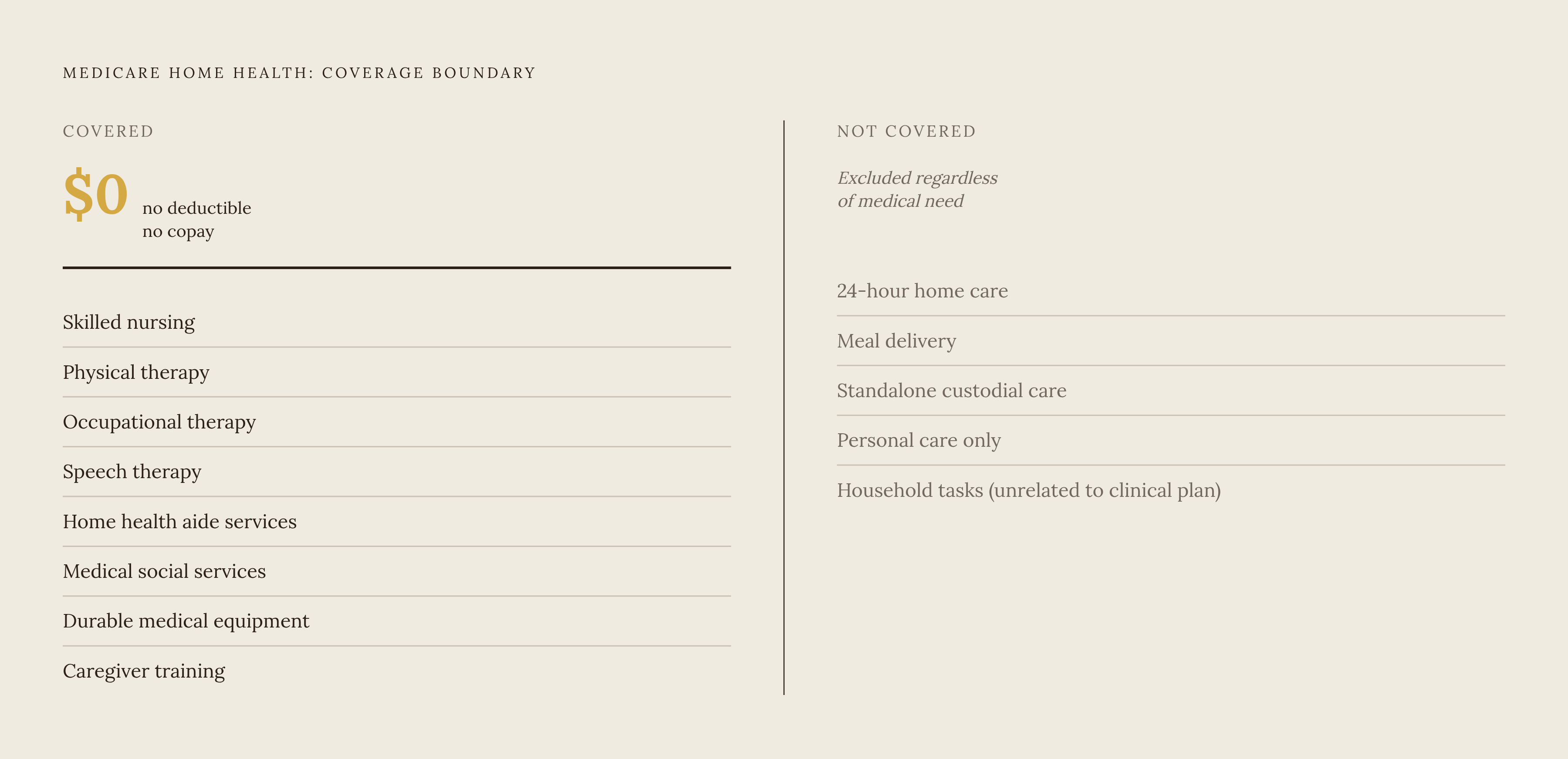
Before getting into the individual services, one fact deserves to sit at the top of this section, because it tends to surprise families more than anything else in the benefit: once someone qualifies, Medicare pays the full approved cost of home health services, with no deductible and no copay. Not a reduced rate. Not a percentage. The full cost.
Skilled nursing care is usually the most clinically demanding piece. Registered nurses or licensed practical nurses handle wound care, IV therapy, injections, medication management, and vital sign monitoring. For a family member with no clinical training, tasks like these are not just time-consuming, they are frightening, carrying real risk if done wrong. Handing that work to a trained nurse removes one of the sharpest sources of caregiver anxiety.
Physical, occupational, and speech therapy make up the next category. Physical therapy addresses mobility, strength, and fall prevention. Occupational therapy focuses on daily living skills, adaptive equipment, and home safety modifications. Speech-language pathology covers communication disorders and swallowing difficulties, including cognitive-linguistic problems that follow a stroke or other neurological event. Medicare covers these only when the treatment is specific, safe, effective, and complex enough to genuinely require a trained therapist rather than general encouragement.
Home health aide services cover personal care such as bathing, grooming, and light housekeeping directly tied to the medical plan of care. Aide services are covered only on a part-time or intermittent basis, and only when the beneficiary is already receiving skilled nursing or therapy. Medicare will not pay for an aide as a freestanding service. If nursing or therapy stops, aide coverage stops with it.
Medical social services bring in a licensed social worker to help with care planning, connect the family to community resources, offer counseling tied to the illness, and navigate financial assistance options. This is ordered by a physician when social or emotional factors threaten to interfere with treatment or recovery, and it quietly absorbs a kind of logistical and emotional coordination work that otherwise lands entirely on the family caregiver's shoulders.
Durable medical equipment rounds out the more familiar categories: wheelchairs, walkers, hospital beds. It is a smaller piece of the benefit conceptually, but access to the right equipment meaningfully reduces the physical strain of helping someone move around a home.
The sixth service is newer and far less widely known: caregiver training. Family caregivers can now receive instruction in specific skills, such as medication administration, tailored to the care recipient's particular condition, and the patient does not even need to be present for the session. It requires a doctor's recommendation, and the patient is responsible for 20% of the Medicare cost for these sessions. Given how recently this was added, most families caring for a loved one right now have never heard it exists. Home health aide services were rated among the most valuable services per beneficiary experience, alongside nursing care, according to the Commonwealth Fund study based on 20 interviews conducted in October 2025.
Gaps in what Medicare home health will not pay for, that caregivers must plan around
The limits matter as much as the coverage, and they deserve honest treatment rather than a footnote. Medicare will not cover 24-hour care in the home, home meal delivery, or household tasks unrelated to the clinical plan, cleaning, laundry, general errands. Custodial or personal care, help with bathing, dressing, or the basic activities of daily living, is not covered on its own; it only rides along with skilled nursing or therapy visits, never as a standalone offering. And Medicare covers more than 66 million people in the United States, with approximately 3.5 million beneficiaries receiving home health services each year, making it one of Medicare's most widely used benefits. The aide has to be employed by a Medicare-certified agency, full stop.
The gap is most visible after something like a fall or a surgery. Medicare will send a nurse or a physical therapist into the home to manage recovery, but it will not pay for the aide who bathes the patient, cooks dinner, or stays overnight to keep watch. That is not an oversight in the way the benefit was written. It reflects the program's original design, built around skilled, medically necessary care rather than open-ended custodial support.
So what fills that gap for families who need more than Medicare offers? Medicaid is the primary answer nationally, covering nearly two-thirds of home care spending in the country as of 2023, and reaching more than 5 million people through Medicaid-covered home care services each year, though what is available and who qualifies varies a great deal state by state. Knowing exactly where Medicare's coverage ends is what allows a caregiver to ask the right next question, rather than assuming no help exists at all.
Evidence that home health services reduce burden and keep people out of institutions
Skepticism about whether any of this actually works is fair, so start with the outcome data rather than the policy argument. In the Commonwealth Fund's study, based on 20 interviews, almost all beneficiaries and caregivers interviewed gave their home health services top ratings, describing physical therapy and nursing care as most valuable and pivotal to recovery.
That qualitative picture lines up with a claims-based analysis from 2023, conducted by a third-party actuarial firm and cited by the Caregiver Action Network, which found that Medicare beneficiaries using home health services cost the program 42 percent less than similar beneficiaries who did not use the benefit, a difference amounting to roughly $3,600 per member per month. The same report projected that if medically necessary home health were delivered to everyone who meets the criteria, Medicare could save billions annually by cutting down on emergency room visits, inpatient stays, and skilled nursing facility admissions.
Why would a home visit from a nurse save that much money? The mechanism is not mysterious once you sit with it: home health keeps people stable enough to avoid the hospital in the first place, and it shifts recovery out of expensive institutional settings and into the home, particularly when aide support runs alongside the skilled visits. For a caregiver wondering whether pursuing this benefit is worth the paperwork, the answer sitting inside this data is direct. Getting a qualified loved one enrolled is not a bureaucratic box to check. Getting a qualified loved one onto the benefit measurably reduces the likelihood of a hospitalization or nursing facility admission, the two outcomes caregivers most dread.
The policy headwinds threatening access to the benefit right now
None of this sits on stable ground, though, and caregivers should know that going in. CMS finalized a 1.3% aggregate payment cut, about $220 million, for home health agencies in 2026, under the CY 2026 Home Health Prospective Payment System Final Rule (CMS-1828-F), issued November 28, 2025. That figure is smaller than what was originally proposed, but it is still a net reduction, not a wash.
MedPAC pushed for something considerably more aggressive in its March 2025 recommendation, advising Congress to cut the 2025 base payment rate for home health agencies by a full 7 percent for calendar year 2026. Reimbursement reductions since 2019 have already been linked to agency closures and staffing shortages, and further cuts tend to shrink the number of agencies willing to take on new Medicare patients at all.
What does that mean for a caregiver trying to get a parent enrolled next month? Longer waits before services actually begin, fewer agencies with room for new patients, and, in some cases, fewer visits scheduled per week even for beneficiaries who qualify cleanly on paper. The Commonwealth Fund's July 2026 findings identify expanding the home health workforce and improving coordination between agencies and providers as priorities, noting declining utilization and access challenges as key drivers. None of this means the benefit is disappearing. It does mean the margin for delay has gotten thinner than it used to be.
Referral and service start-up steps for caregivers
Start with the referral itself, because this is the step most families assume happens automatically and it does not. A physician, or under the 2026 broadened face-to-face policy, other allowed providers, has to order home health services and certify that eligibility conditions are met; this does not happen automatically after a hospitalization, and caregivers often need to ask for it explicitly. This rarely happens on its own after a hospital discharge. Caregivers often have to raise it directly with the discharge planner or the physician, by name, using the words "home health referral."
From there, the sequence is fairly mechanical, even if it does not feel that way in the moment. Confirm that the homebound standard and a genuine skilled care need both apply, using the actual definitions rather than assumptions about what "homebound" means. Ask explicitly whether the physician is willing to complete the face-to-face encounter and sign the certification. Request a list of Medicare-certified home health agencies serving the area, since coverage depends entirely on using a certified agency and not a private hire. And once services start, track the 60-day certification periods, because renewal is not automatic and a lapse in paperwork can interrupt care that is otherwise still medically justified.
Given the payment pressures agencies are currently under, timing carries more weight than it once did. A referral requested the week a physician mentions a client's declining mobility stands a better chance of finding an agency with capacity than one requested a month later, after word spreads that a particular agency has stopped accepting new patients. The benefit still works largely as designed. Whether a specific caregiver can reach it in time depends increasingly on how quickly the referral conversation actually starts.
Sources
- Why Medicare Needs to Incentivize More Access to Home Health
- Home health care services – MedPAC
- Medicaid Home Care (HCBS) in 2025 | KFF
- Improving Medicare Home Health: Beneficiary Experiences, Priorities | Commonwealth Fund
- Medicare Updates for 2026: What Home Health Professionals Need To Know
- Calendar Year (CY) 2026 Home Health Prospective Payment System Final Rule (CMS-1828-F) | CMS
- How 2025 Medicare Changes Affect In-Home Care Coverage
- Does Medicare Cover In-home Caregivers? - Medicare.org