SNAP Eligibility Rules for Households With a Senior or Disabled Member
Elderly or disabled household members unlock income exemptions and unlimited medical deductions.
SNAP runs on a different rulebook for households with a senior or a disabled member, and the differences are not cosmetic. A gross income exemption, deductions with no ceiling, and a higher asset limit combine to make some households eligible even when a standard applicant with the same paycheck would be turned away at the door. Working through each rule in sequence shows exactly who qualifies and how the benefit gets calculated, which matters more now that recent legislative changes have redrawn some of these lines.
Who counts as elderly or disabled under SNAP
Age 60 is the line. Anyone in the household who has reached that birthday counts as elderly under the federal definition that governs the current program year. Disability is a stricter category, and it trips people up because it is not a matter of self-report or diagnosis. A household member qualifies as disabled only by meeting one of several defined benefit-based criteria, not by describing themselves as unwell or by having a doctor's note in hand.
The qualifying paths include federal disability or blindness payments under the Social Security Act, meaning SSI or Social Security disability and blindness benefits, along with state disability or blindness payments issued under SSI rules. Someone drawing a Railroad Retirement Act annuity also qualifies if they carry Medicare eligibility or SSI disability status alongside it. Veterans' survivors have a path too: a surviving spouse or child of a veteran who receives VA benefits and is considered permanently disabled meets the bar.
Here is the detail that actually changes outcomes for families: this is a household-level trigger, not an individual one. Only one person in the home needs to meet the elderly or disabled definition, and every special rule discussed below, the income exemption, the deductions, the asset limit, extends to the whole household. A working-age adult living with an elderly parent inherits these rules just by sharing a SNAP case with that parent. That single fact matters because everything downstream depends on clearing this threshold first, so check carefully before assuming a household doesn't qualify for special treatment.
The gross income test exemption
Most SNAP applicants must pass both the gross and net income tests to qualify. The gross income limit is 130 percent of the federal poverty line, while the net income limit is 100 percent of the federal poverty line, calculated after deductions markellpc.com. Fail either one, and the application stops there.
Households with an elderly or disabled member skip the first gate entirely. Only the net income test applies to them, regardless of how large their gross income looks on paper.
Why does that matter in dollar terms? For a single person, the gross limit is $1,696 a month while the net limit is $1,305 SNAP Income Limits By State (2026) | Propel SNAP Eligibility 2026. Anyone whose income falls between those two numbers gets rejected under standard rules, full stop, but qualifies under elderly or disabled rules once deductions bring net income down far enough SNAP Income Limits By State (2026) | Propel SNAP Eligibility 2026. Scaled up to a family of four, the same gap widens: a gross limit of $3,483 against a net limit of $2,681⟧c15⟧ SNAP Income Limits By State (2026) | Propel SNAP Eligibility 2026.
But gross income is the wrong test for their household. The exemption doesn't erase the net income test, it only removes the first hurdle, and that shifts everything onto deductions. A household that clears the gross test exemption still has to get net income under the limit, which raises an obvious question: what actually counts as a deduction, and how far can it stretch? Why seniors assume they're ineligible: Social Security income is counted as gross income, and a check can look like too much on its face, but the gross test is the wrong test for their household.
Standard deductions every household uses to reach the net income limit
Net income means gross income minus every deduction the household can legitimately claim, and for elderly or disabled households, that net figure is the only number that decides eligibility. Standard deductions are available to all SNAP households for FY2026.
There's an earned income deduction equal to 20 percent of all wages SNAP ABAWD Ages 55-64 2026 | BenefitsUSA Blog. There's an excess shelter deduction covering housing and utility costs that exceed half of net income, though for most households this is capped at $744 a month SNAP Eligibility | Food and Nutrition Administration. And there's a dependent care deduction for work-related childcare costs.
Those four tools work fine for a working-age household with a paycheck SNAP Income Limits By State (2026) | Propel SNAP Eligibility 2026. They work less well for a retiree living on Social Security or SSI. Both of those count as gross income, but neither counts as wages, so the earned income deduction simply doesn't apply to someone with no earnings at all. That gap is why the two deductions unique to elderly and disabled households carry so much weight SNAP Income Limits By State (2026) | Propel SNAP Eligibility 2026. Standard deductions alone might close the distance for some seniors, but for many, the real leverage sits elsewhere. The standard deduction is $209/month for households of 1–3 members SNAP ABAWD Ages 55-64 2026 | BenefitsUSA Blog.
The medical expense deduction: exclusive to elderly and disabled households, and widely missed
This deduction exists only for elderly and disabled households, and it has no ceiling. Every non-reimbursable medical expense incurred by the qualifying member, above a $35 monthly floor, can be subtracted from gross income.
What counts is broader than most applicants expect. Medicare Part B premiums, which run $202.90 a month for most people in 2026, qualify, along with any Part D or Medigap premiums stacked on top SNAP ABAWD Ages 55-64 2026 | BenefitsUSA Blog. Prescription co-pays, doctor-recommended over-the-counter medicine, visits to physicians, dentists, eye doctors and specialists, hospital bills, lab work, and even mileage driven to appointments all count. Some states go further and allow deductions for prescribed alternative therapies like acupuncture, or home modifications such as wheelchair ramps.
All non-reimbursable medical expenses incurred by an elderly or disabled household member above $35/month can be deducted from gross income, with no cap on the deduction. Everything above that is fully deductible, though the expenses have to belong to the elderly or disabled member specifically; medical costs run up by other household members don't count toward this deduction. Because itemizing every receipt is a burden, some states offer a Standard Medical Deduction, a flat amount often in the $120–$175 range, available to anyone who can show more than $35 in monthly medical costs without having to document each one. Asking a caseworker whether the state offers this option is worth the five minutes it takes ncoa.org.
And yet the deduction goes badly underused. Why does the gap persist? Applicants often don't know the deduction exists, don't know which costs qualify, or find the itemizing process discouraging enough to skip it, which is exactly the problem the Standard Medical Deduction is meant to solve where it's offered.
Run the numbers on just one piece of this. Medicare Part B alone costs $202.90 a month SNAP ABAWD Ages 55-64 2026 | BenefitsUSA Blog. Subtracting the $35 floor still leaves a substantial deduction, one that can meaningfully lower countable net income for a single-person household before any other medical costs even enter the picture. Adding in Part D premiums, a couple of prescriptions, and a specialist visit or two makes the deduction grow considerably larger SNAP Income Limits By State (2026) | Propel SNAP Eligibility 2026 SNAP ABAWD Ages 55-64 2026 | BenefitsUSA Blog. That is money coming off the top of gross income before the net test even runs, and it is sitting unclaimed in a large share of cases.
The uncapped shelter deduction: how senior and disabled households get full credit for housing costs
The standard excess shelter deduction caps out at $744 a month for most households, and any shelter cost above that ceiling earns no further credit. For a household with an elderly or disabled member, that ceiling does not apply. Every dollar of shelter cost exceeding half of net income counts toward the deduction, with no upper limit.
Shelter costs cover rent or mortgage payments, property taxes, homeowner's insurance, and utility costs. Households without an elderly or disabled member lost it, which makes this one of the rare instances where the new law actually protected senior and disabled applicants while tightening things for everyone else.
What does an uncapped deduction mean in practice? A senior living alone in an expensive rental market, or paying steep heating bills through a hard winter, can deduct far more than $744 from countable income. That can mean failing the net income test or clearing it. And this deduction only matters because the household survived the gross income test in the first place; a household that never gets an exemption from that first gate never reaches the point where an uncapped shelter deduction has anything to work with. The two rules reinforce each other by design SNAP Income Limits By State (2026) | Propel SNAP Eligibility 2026. Under the OBBBA change signed July 4, 2025, only households with a member age 60 or older or a disabled member may still use the Standard Utility Allowance without documenting actual utility expenses (households without an elderly or disabled member lost this convenience); this is a case where senior/disabled status now provides a protection others lost.
Asset limits for elderly and disabled households
Countable resources matter too, separate from income. The standard asset limit for FY2026 is $3,000 for households without an elderly or disabled member. Households with a qualifying member get a higher ceiling, $4,500, and that number is set to climb again to $4,750 effective October 1, 2026 themoneyoverview.com.
Countable assets generally mean cash, checking and savings balances, and similar liquid resources. The primary home, most vehicles, personal property, and retirement savings are exempt regardless of household type, though withdrawals from retirement accounts can sometimes count as income depending on how often they happen.
But here's a wrinkle that changes things. Over 40 states have adopted what's called Broad-Based Categorical Eligibility, which removes the asset test altogether. In those states, the $4,500 figure, or the coming $4,750, is simply moot; savings balances and car values play no role in the eligibility decision at all themoneyoverview.com. There's a separate pathway too. If every member of a household receives SSI, the household can be deemed categorically eligible for SNAP without a separate asset review, though it still has to clear the program's non-financial rules. Reader action: the asset test is state-dependent, so readers should confirm whether their state uses BBCE before worrying about the dollar limits.
Work requirements after the recent federal budget legislation: who is still exempt and who is newly affected
Before the OBBBA, the ABAWD time-limit rules, the ones that cap benefits at three months in three years absent qualifying work activity, applied to adults 18 through 54 snapbenefitcalculator.com.
The law changed that. Effective for state implementation by November 1, 2025, it raised the upper ABAWD age from 54 to 64, which pulls more than a million older adults into a category where they now have to document work activity to keep receiving benefits past three months.
Exemptions still exist. Anyone with a qualifying disability is fully exempt from ABAWD rules, as are people who are pregnant, and anyone with a dependent child under 14 in the household. The time limit now technically applies to adults 18 through 64 who don't fall into one of those categories snapbenefitcalculator.com. Disability status is the cleanest protection available.
Geographic relief has gotten harder to come by as well. Waivers, once a common tool for high-unemployment areas, are now generally limited to places with unemployment above 10 percent markellpc.com. So what does all this add up to for someone weighing their own situation? Disability status now carries more weight than age alone when it comes to work-requirement exemptions. A 62-year-old with a qualifying disability is protected. A 62-year-old without one, doing the same work as before, now faces requirements that didn't exist for them a year earlier.
Tracing a household through the eligibility calculation
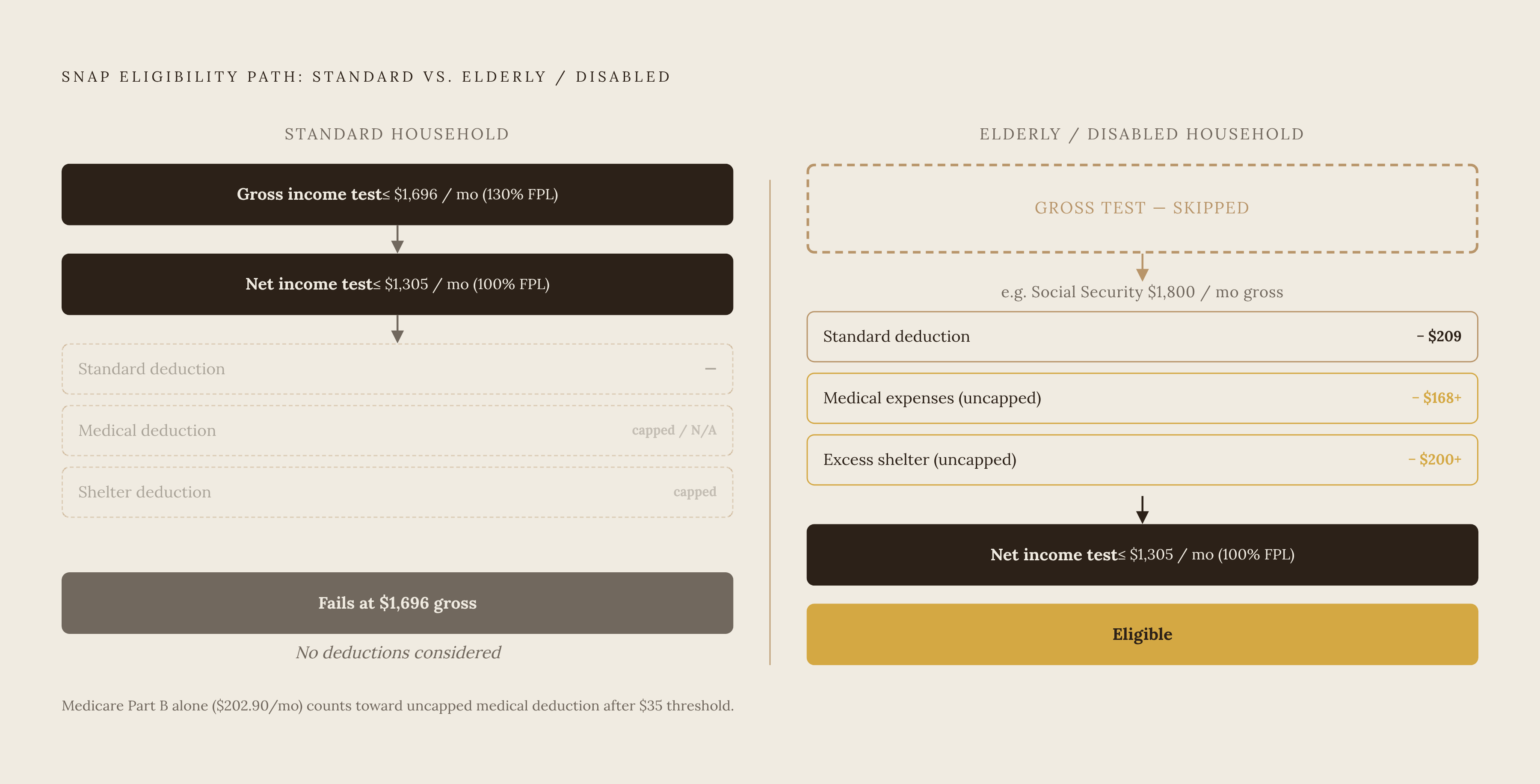
Putting the pieces together produces a clear sequence. Confirm first that at least one household member meets the elderly or disabled definition. If so, skip the gross income test and move straight to the net income calculation. From gross income, subtract everything allowable: the standard deduction of $209/month for 1–3 people, the earned income deduction of 20 percent of wages if any, excess shelter costs with no cap, and qualifying medical expenses above $35/month. Compare what's left to the net limit, $1,305 for one person or $2,681 for a household of four SNAP Income Limits By State (2026) | Propel.
Watch how the mechanisms stack for a hypothetical senior whose Social Security check alone exceeds the gross income limit. Under standard rules, that income disqualifies the household before deductions even enter the conversation. Under elderly and disabled rules, the gross test never applies, Medicare premiums and other medical costs come off the top with no ceiling, and shelter costs above half of net income get credited. Three separate mechanisms working together can turn a household that looks ineligible on a pay stub into one that qualifies on paper.
What does qualifying actually deliver? That is not a windfall, but it is recurring food money that arrives every month, and for a household running tight margins between rent, medications, and groceries, it closes a gap that otherwise doesn't close on its own.
None of these figures hold perfectly across state lines, though. Verifying details with a state SNAP agency or local office is the only way to know what actually applies to a specific case.
One more thread: household composition itself carries its own consequences. In households where a family caregiver lives with and supports a senior or disabled relative, the household's composition itself is what triggers every rule discussed above. The caregiver may not realize that sharing a home, and a SNAP case, with that relative changes the entire eligibility picture. Recognizing the framework is frequently the hardest part, harder than the math itself, and it's often the first real step toward benefits that were sitting there unclaimed the whole time.
Sources
- A Quick Guide to SNAP Eligibility and Benefits
- SNAP Income Limits By State (2026) | Propel
- SNAP for Seniors and People with Disabilities (FY2026) | SnapEligibility
- SNAP Income Limits by State 2026: Complete Chart | BenefitsUSA Blog
- Food stamp households with an elderly or disabled member only have to pass the net income test - The Money Overview
- Maximizing the SNAP Medical Expense Deduction for Older Adults