IRS Medical Expense Deduction for Caregiver Household Costs
Most families with high home care costs miss a five-figure tax deduction.

Families paying $2,000 to $6,000 a month for in-home care are, in most cases, sitting on a tax deduction they never claim. The rules governing who qualifies, what kind of care counts, and how much of the bill actually clears the bar are scattered across dependency tests, chronic illness certifications, and a threshold that most people misunderstand. This piece maps those conditions one by one, so a family can look at its own spending and know, with some precision, what's deductible and what isn't.
The 7.5%-of-AGI threshold: how the deduction functions
Start with the mechanism itself, because everything else in this piece hinges on it. Only unreimbursed medical expenses that exceed 7.5% of adjusted gross income are deductible, and that's only true if the taxpayer itemizes on Schedule A of Form 1040. No itemizing, no deduction, regardless of how much was spent or how clearly it qualifies.
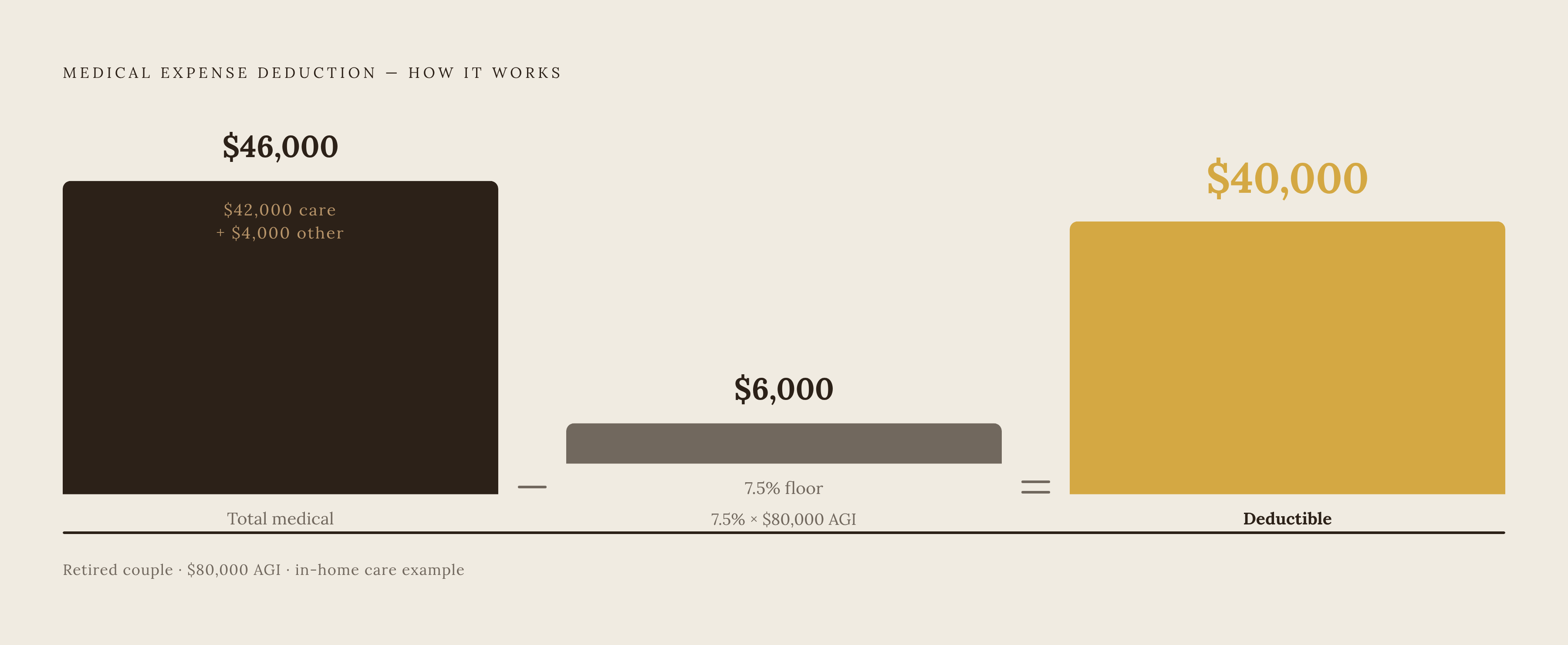
Here's what that looks like with real numbers, drawn from an example HomeCareHub uses to illustrate the math. A retired couple with $80,000 in AGI pays $42,000 for a caregiver helping a spouse with Alzheimer's. Their threshold, 7.5% of $80,000, comes out to $6,000. Adding another $4,000 in other medical costs (prescriptions, doctor visits, whatever else qualifies) pushes the total medical spending well past the $42,000 already mentioned. Subtracting the $6,000 floor leaves a deductible amount of $40,000. That's a five-figure deduction sitting on the table for a couple who might not have known to look for it, not a rounding error. That's a five-figure deduction sitting on the table for a couple who might not have known to look for it.
But the threshold only matters if itemizing beats taking the standard deduction. For 2026, the standard deduction benchmarks are $16,100 for single filers, $24,150 for head of household, and $32,200 for married couples filing jointly. So the question becomes: does the couple's total itemized amount, medical expenses plus mortgage interest, state taxes, charitable gifts, and so on, clear that bar?
For most families paying for full-time or near-full-time home care, the answer is yes, almost automatically. A single month of care at $4,000 already exceeds the AGI threshold in the example above by a wide margin, and twelve months of that spending will, on its own, frequently exceed the standard deduction for a married couple. This is the practical reason the deduction matters at all: home care is an expense large enough on its own to push someone over the line. It's often large enough to make itemizing worthwhile all by itself.
Who can be the care recipient: dependents, near-dependents, and the exceptions caregivers miss
The deduction doesn't just require qualifying expenses. It requires a qualifying person to have received them. The standard path is straightforward: a taxpayer can deduct medical expenses paid for themselves, a spouse, or anyone claimed as a dependent.
Claiming a parent or relative as a dependent, though, means passing three tests. First, the gross income test: the dependent's gross income has to fall under $5,300 for 2026. Second, the support test: the caregiver must provide more than half of that person's total annual support. Third, a relationship or residency requirement, though a parent is unique here. Unlike other relatives, a parent qualifies on the relationship alone and doesn't need to live in the same household as the caregiver.
Now, here's where the gross income test gets interesting, and where a lot of adult children assume they're disqualified when they're not. Only the taxable portion of Social Security counts toward that $5,300 limit. A parent living mainly on Social Security, even one whose total income sounds substantial on paper, often passes the test easily, because most or all of that income never enters the calculation.
There's a second exception buried in IRS Publication 502 that catches even more caregivers off guard. A caregiver can deduct medical expenses paid for someone who would have qualified as a dependent, except that person's gross income was too high, or they filed a joint return with a spouse. The adult child still has to have provided more than half of that person's total support, but the income disqualification that would normally block dependent status doesn't block the medical deduction. It's a narrow exception, but for families supporting a parent who has some pension or investment income pushing them over $5,300, it's often the exception that makes the whole deduction possible.
The "chronically ill" certification: the gateway most families don't know they need
Passing the dependent tests, or the near-dependent exception, only gets a family halfway there. For ongoing in-home care to count as a medical expense at all, the person receiving it has to meet a specific legal definition: "chronically ill," as defined under IRC Section 7702B(c)(2). This is the gateway that most families never learn about until an accountant asks for it, or an audit demands it.
There are two ways to satisfy this definition, and they don't overlap. The first is the functional limitation test: the person must be unable to perform at least two of six recognized activities of daily living without substantial help, and that limitation has to be expected to last at least 90 days. The six ADLs are eating, toileting, transferring, bathing, dressing, and continence. Two out of six, for at least three months. Two out of six, for at least three months, is the bar.
The second path relies on the cognitive impairment test instead of ADLs. It's the cognitive impairment test, and it applies when someone requires substantial supervision because of severe cognitive impairment, Alzheimer's being the clearest example, since without that supervision they'd be in danger. Someone can pass this test while still dressing and feeding themselves without assistance. The danger isn't physical incapacity; it's judgment.
Either way, the certification can't come from a casual conversation. It has to be issued by a licensed health care practitioner (a physician, a registered nurse, or a licensed social worker), it has to be in writing, and it needs to be renewed annually. A verbal comment during a checkup, however clearly documented in a doctor's own notes, isn't sufficient for IRS purposes. Families need the actual certification, on paper, filed with their tax records. Without it, the personal care hours discussed in the next section don't qualify as medical expenses at all, no matter how medically necessary they seem in practice.
Which household caregiver costs qualify, and how to handle mixed-duty arrangements
Once the chronically ill certification is in place, the next question is which costs actually count as care. Skilled and nursing care is at the clear end of the spectrum: medication administration, wound care, monitoring a chronic condition, even bathing and toileting when performed as part of medical treatment. Care delivered by a licensed nurse or a trained medical professional is about as unambiguous as this deduction gets.
Personal care from a non-nurse aide is murkier, but still deductible, provided the certification and a written plan of care are both in place and the services qualify as long-term care: bathing, dressing, help with feeding, transfer and mobility assistance, dementia supervision, incontinence care. These are the tasks most home care agencies bill for daily, and most of them clear the bar once the paperwork behind them exists.
The complication, and it's a significant one, occurs when a caregiver's duties blur together. If the same aide who helps a parent bathe and dress also does the laundry, runs to the grocery store, or handles general housekeeping, only the care portion of that time is deductible. The household services portion isn't a medical expense under this deduction, though it may separately qualify for a Dependent Care FSA or the dependent care credit, discussed later in this piece.
This is the point where careful families protect themselves and careless ones lose the whole deduction. Keeping a simple log of hours by task, care versus housekeeping, protects the deduction if the IRS ever questions how hours were allocated. Agencies that provide itemized invoices splitting personal care hours from homemaker hours make this trivial. Agencies that lump everything into one line item create a real problem: without a clear division, the IRS has the latitude to disallow the entire amount rather than just the non-qualifying slice. That's not a minor technicality. A family that itemizes loses only a small fraction of a caregiver's hours to housekeeping, while a family that doesn't itemize loses the entire deduction because nothing was itemized.
Meals provided to an in-home caregiver as part of their compensation may be partly deductible. The calculation takes the household's total food cost, divides it by the number of people in the household, and allocates the caregiver's proportional share. It's a small piece of the puzzle, but it adds up over a year.
Home modifications that qualify as medical expenses, and how to handle improvements that raise home value
Care is also about the physical space where care happens. It's also about the physical space where care happens, and the IRS treats home modifications as medical expenses under specific conditions. The dividing line comes down to one question: does the modification increase the value of the home?
If it doesn't, it's fully deductible. The IRS maintains a fairly specific list here: entrance ramps, widened doorways, grab bars and support rails in bathrooms, lowered kitchen cabinets, porch lifts, and modified stairways. These are modifications that exist purely to accommodate a medical need and that, in most cases, wouldn't appeal to a buyer who doesn't share that need. Because they don't raise resale value, the full cost clears as a medical deduction.
Capital improvements that do raise home value work differently. Only the portion of the cost that exceeds the resulting increase in property value is deductible. So a modification whose cost is substantially larger than the resulting increase in home value only yields a deduction for the leftover portion, not the full cost. This requires some kind of valuation, typically an appraisal before and after, to establish the number the IRS will accept.
Pools and hydrotherapy equipment occupy a more contested corner of this deduction. Whether such costs qualify turns on the same value-increase analysis that applies to other capital improvements, and the burden falls on the taxpayer to demonstrate the equipment exists for medical treatment rather than general use.
Long-term care insurance premiums: age-based limits for 2026
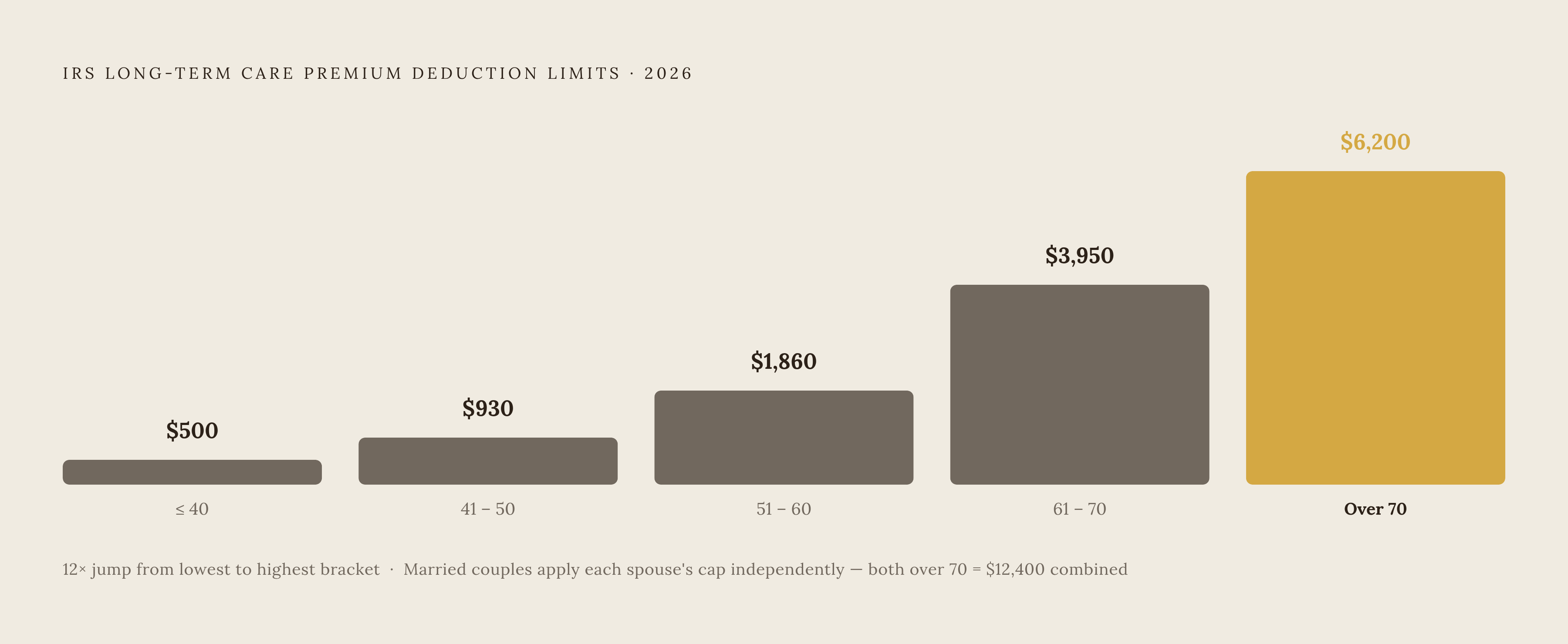
Insurance premiums for a qualified long-term care policy also count as a medical expense under IRC Section 213, but they're capped by age, and the caps step up meaningfully as a person gets older. For 2026, someone age 40 or under can deduct up to $500 in premiums per person. Between 41 and 50, that cap rises to $930. Between 51 and 60, it climbs to $1,860. And for anyone 70 or older, the limit reaches $6,200, a 3% increase over the 2025 figure.
These limits apply per person, not per policy or per household, which matters for married couples. Each spouse applies their own age-based cap independently, so a couple where both partners are over 70 could deduct as much as $12,400 combined, assuming their premiums are that high to begin with.
For anyone receiving long-term care insurance payouts rather than just paying premiums, the per-diem benefit exclusion for 2026 is $430. That's a separate mechanism from the premium deduction, but it's part of the same corner of the tax code and worth knowing if a policy pays out on a per-day basis.
Three related tax mechanisms that interact with, but are distinct from, the medical deduction
The medical expense deduction doesn't operate in isolation. Three other mechanisms touch the same spending, sometimes overlapping, sometimes competing, and confusing them is one of the more common mistakes families make.
The Dependent Care FSA is the first. For 2026, the One Big Beautiful Bill raised its contribution limit to a higher figure (with a reduced limit if married filing separately), up from $5,000, the first change to that number since 1986. But a DCFSA pays for care that enables the taxpayer and spouse to work, not medical treatment itself. It's not a vehicle for doctor visits or prescriptions. Eligible adult dependents under this program are limited to a spouse or dependent who is physically or mentally incapable of self-care and lives with the taxpayer at least eight hours a day. And critically, there's no double-dipping: any expense reimbursed through a DCFSA can't also be claimed for the Child and Dependent Care Credit.
Speaking of which, that credit is the second mechanism, and it changed meaningfully under the same legislation. The top rate rose from 35% to 50%, but that increase applies only to the lowest-income households. As income rises, the rate steps down toward a 20% floor, so most families claiming this credit won't see anywhere near the headline 50% rate. The expense caps themselves didn't move: $3,000 for one dependent, $6,000 for two or more. For most taxpayers sitting at that 20% floor, the credit maxes out at $600 for one dependent or $1,200 for two.
Third, there's the Credit for Other Dependents, a smaller, more automatic mechanism. When a parent is claimed as a dependent but doesn't qualify for the Child Tax Credit (which, obviously, a parent never would), a nonrefundable $500 credit applies per qualifying relative. It's easy to miss if a family assumes dependent status only matters for the medical deduction, though the amount is not large.
And finally, HSAs and medical FSAs sit adjacent to all of this. Pre-tax dollars from either account can cover qualifying out-of-pocket medical costs, which effectively lowers the after-tax cost of expenses that would otherwise need to clear that 7.5%-of-AGI threshold before producing any tax benefit. This is a different animal entirely from the Dependent Care FSA. One covers health costs. The other covers the cost of care that frees someone up to work. Conflating the two is an easy mistake, and one that can lead a family to misfile an expense in the wrong bucket.
Documentation: what the IRS expects and what families typically lack
None of the above matters without paperwork to back it up, and this is where a surprising number of otherwise well-organized families come up short.
The chronically ill certification needs to be written, signed by a licensed health care practitioner, and dated within the preceding 12 months. A verbal confirmation given during an office visit, even if it's accurate and well-documented in a doctor's chart, doesn't satisfy the requirement on its own.
Alongside that certification, auditors look first for a written plan of care, prescribed by a licensed health care practitioner. This is, in practical terms, the single document that most efficiently establishes that the care being paid for is medical rather than custodial or convenience-based. Families who have the certification but not the plan of care are still exposed.
For caregivers hired directly rather than through an agency, a written contract specifying duties, hours, and pay rate is necessary, and it is especially necessary when the caregiver is a family member. The IRS has reason to scrutinize payments made within a family more closely than payments made to a third-party agency, so the paper trail needs to be, if anything, more thorough in those cases, not less.
Agency invoices that fail to separate personal care hours from homemaker hours, already raised in the mixed-duty section above, are the single most common documentation gap. Agencies that split personal care hours from homemaker hours on their invoices make this deduction defensible. Agencies that don't, leave families holding a lump-sum bill that the IRS can, and does, disallow in its entirety rather than pro-rating down to the qualifying portion. That's the quiet failure point in this whole process: not the rules themselves, which are knowable, but the invoice sitting in a family's file that never separated the two.