ABLE Account Tax Advantages for Disability-Related Caregiving Costs
Millions more adults can now save tax-free for disability care costs.

ABLE accounts exist because federal benefits law contains a trap: save more than $2,000 and a person with a disability can lose SSI and Medicaid in the same month. Congress built a workaround in 2014, modeled on 529 college savings plans and codified under IRC Section 529A, that lets people save and spend for disability-related costs without triggering that penalty. The number of ABLE accounts opened to date represents only a fraction of those who are eligible, suggesting most families still haven't opened one. Two things changed that calculus heading into 2026: a permanent age-eligibility expansion and a set of tax provisions that Congress locked in for good last summer. This piece walks through both, along with what actually counts as a qualified expense for caregiving costs specifically, since that's where a lot of the account's real value hides in plain sight.
Who qualifies in 2026 under the expanded age threshold
Eligibility for an ABLE account hinges on one fact only: when the disability began, not how old the person is now. That distinction trips up a lot of people who assume these accounts are for children or young adults exclusively.
Through 2025, the rule required the qualifying disability to have started before age 26. Starting January 1, 2026, that threshold jumps to age 46, permanently, under the ABLE Age Adjustment Act, a provision folded into SECURE 2.0 back in 2022. A 55-year-old whose MS diagnosis or service-connected injury occurred at age 40 becomes eligible to open an account for the first time in 2026, a change that significantly expands the population of adults who can qualify based on age of onset, opening the door for many who were previously locked out entirely. That's not a small tweak, it opens the door for millions of people who were previously locked out entirely.
Who does this pull in? Veterans with disabilities acquired during service in their 30s. People diagnosed with certain cancers or autoimmune conditions in mid-life. Anyone whose qualifying condition emerged in that 26-to-45 window who was previously locked out entirely, regardless of how disabling the condition became later.
Certification works one of two ways: either the person already receives SSI or SSDI, which satisfies the requirement automatically, or they self-certify with medical documentation showing the disability began before age 46. There's no income limit to open an account, and each person is limited to one ABLE account, no matter how many states offer programs.
Because this expansion sits in permanent law rather than a temporary rule with a sunset date, families and their planners can build multi-year strategies around it without worrying it disappears. For family caregivers, this matters in a specific way: a caregiver supporting a spouse, sibling, or parent whose disability started at 35 now has a savings and spending tool that simply didn't exist for that person a year earlier.
The 2026 contribution limits and the ABLE to Work add-on
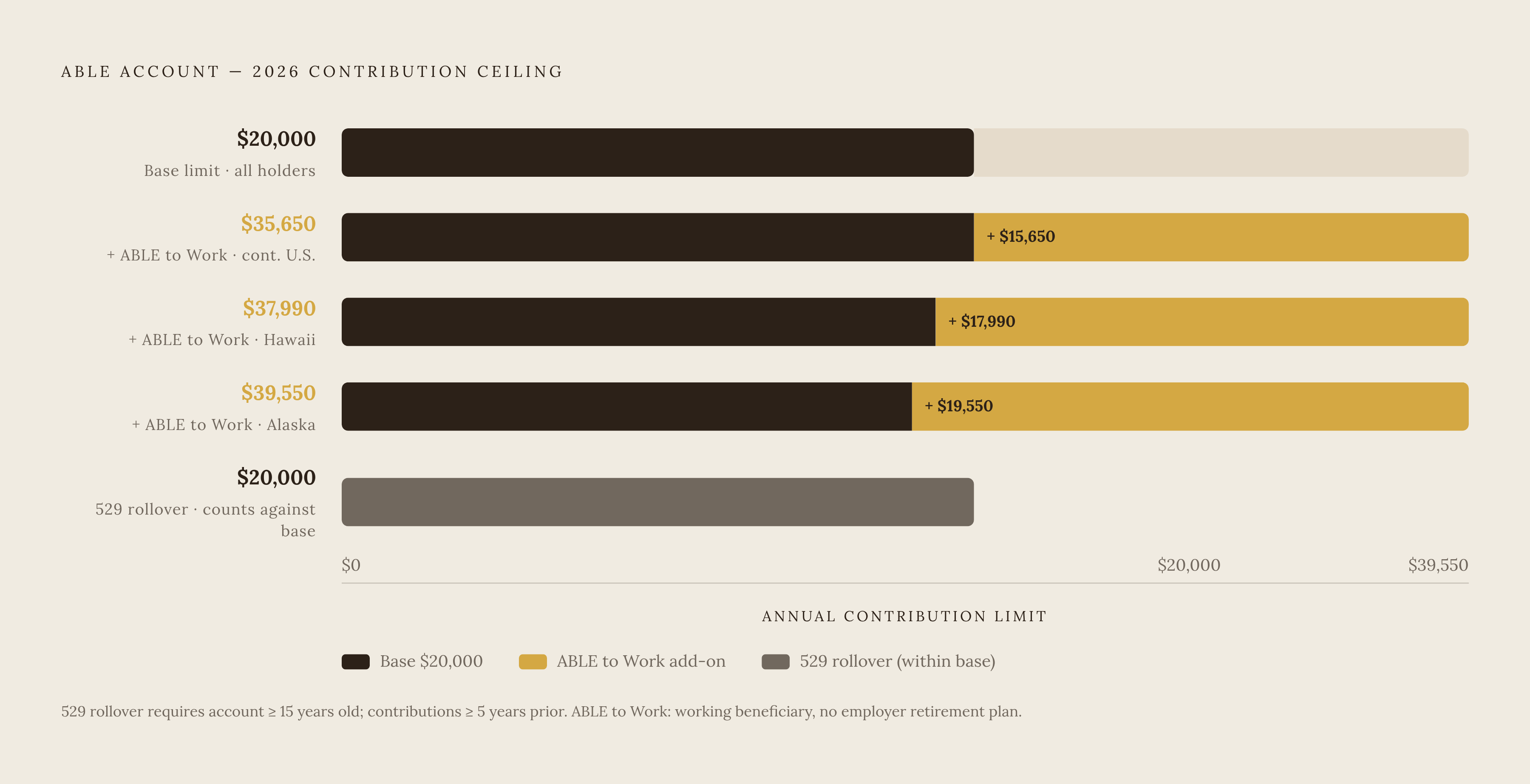
Day Pitney reports that the base annual contribution limit for 2026 is $20,000, up from $19,000 in 2025. Parents, grandparents, friends, a Special Needs Trust, a Pooled Trust, even a 529 plan through the rollover mechanism described below can all put money in. All of it counts against that same $20,000 ceiling, combined across every contributor.
Then there's ABLE to Work, now a permanent feature thanks to the OBBBA. Here's how it functions: an ABLE account owner who works and earns income, but who does not participate in an employer-sponsored retirement plan (no 401k, no 403b, no 457b, and no employer contributing on their behalf), can contribute additional money beyond the $20,000 base, up to the amount of their earnings or the federal poverty line for a one-person household, whichever is lower. A national resource organization tracking these accounts reported that poverty line threshold at $15,650 in the continental states, $19,550 in Alaska, and $17,990 in Hawaii as of 2025 figures (2026 figures should be confirmed once published). The "no employer retirement plan" condition is really the whole ballgame here. Plenty of beneficiaries working part-time or lower-wage jobs won't have access to a workplace 401k anyway. Many of them clear this bar without even trying.
There's also a rollover option from 529 college savings plans, made permanent under the same law. The 529 account has to have existed for at least 15 years, and only contributions made more than five years prior are eligible to roll over. The rollover counts toward the annual $20,000 limit, and the ABLE account has to belong to the same beneficiary as the 529, or a member of that person's family. This is a real fix for a real problem: a family that set aside college savings for a child who, it turns out, can't or won't use those funds for a four-year degree, now has a legal path to redirect that money into a vehicle that spends tax-free on disability costs instead.
Every state ABLE program sets its own total-balance cap, typically tied to that state's 529 maximum, and once an account hits that ceiling, contributions simply stop. This is separate from, and usually far above, the $20,000 annual limit. Why does this matter to a caregiver? Because the higher the allowable total balance, the more years of caregiving costs, respite care, home modifications, and assistive tech an account can eventually absorb tax-free.
The three-layer tax advantage: growth, the Saver's Credit, and state deductions
Layer one is the simplest: money that goes into an ABLE account isn't federally tax-deductible going in, but it grows tax-free, and withdrawals used for qualified disability expenses come out completely free of federal income tax. No tax on the gains, ever, as long as the money is spent correctly. Pulling money out for something that isn't a qualified expense causes the earnings portion to get hit with income tax plus a 10% penalty. Over the life of an account, for a family that consistently deposits and consistently spends on qualified costs, that adds up to a meaningful sum of investment return that never touches the IRS.
Layer two: the Saver's Credit, and this one caught even some financial advisors off guard when the OBBBA made it permanent. The ABLE account's own beneficiary, not the parent, not the caregiver, but the person the account belongs to, can claim this credit for contributions made to their own account. The credit runs at 50%, 20%, or 10% of eligible contributions depending on adjusted gross income and filing status. The credit is calculated on eligible contributions up to a set ceiling, and the maximum possible credit per individual is determined by that ceiling and the applicable percentage. It's filed on Form 8880, and it's nonrefundable: it can zero out a tax bill but won't generate money back beyond that. To qualify, the beneficiary needs to be at least 18 by year-end, can't be claimed as a dependent, can't be a full-time student, and has to fall within the income limits. Stacking this against layer one compounds the effect: the same dollar that grows tax-free going in can also shrink the beneficiary's tax bill in the year it's contributed.
Layer three is state-level, and it's the one that varies the most. Some states let contributors deduct ABLE contributions from state taxable income, usually only when contributing to that state's own program rather than an out-of-state plan. This isn't universal, so anyone contributing needs to check their specific state's rules before assuming a deduction exists. Whether a caregiver contributing to a family member's in-state ABLE account can claim a state deduction on their own return depends entirely on that state's specific rules.
Putting the three layers together, money going in can carry a tax benefit (state deduction, where offered), money sitting in the account carries a tax benefit (tax-deferred growth), and money coming out carries a tax benefit (tax-free on qualified expenses). That's a structure no ordinary savings or brokerage account offers.
Qualified disability expenses for caregiving costs
The IRS definition of a qualified disability expense, or QDE, is deliberately wide. If the expense relates to the beneficiary's disability and supports their health, independence, or quality of life, it generally qualifies, and it doesn't have to be medically necessary in the strict clinical sense. Qualified disability expenses cover a broad statutory list including education, housing, transportation, employment training and support, assistive technology, personal support services, health and wellness, financial management, legal fees, oversight and monitoring, and funeral and burial costs.
For caregiving specifically, a handful of these categories deserve a closer look, because they're the ones families tend to overlook.
Personal support services and caregiving fall squarely within the QDE list. Paid aides, personal attendants, direct support workers, all of it qualifies. Oversight and monitoring goes further still: This category explicitly covers hiring caregivers, personal attendants, or supervisors whose job is to keep the individual safe. That means paying a family member to provide care, or contracting with a home care agency, both fall within the bounds of a qualified expense.
Respite care sits inside that same oversight and monitoring category, and it's arguably the most underused benefit on this list. Respite care means someone comes in temporarily so the primary caregiver can rest, run errands, or handle something else. Many families never connect the dots between "hiring someone for a weekend so I can sleep" and "this is a qualified ABLE expense," but it can qualify as a disability-related expense supporting the beneficiary's health and independence.
Caregiver transportation to medical appointments qualifies too, but with a catch: it has to be medically necessary, not just convenient. If the person with a disability can't attend an appointment alone or can't communicate with providers without a caregiver present, that transportation cost counts, provided a treating provider documents the necessity in writing. That documentation piece matters. Without it, the expense sits in a gray zone.
Housing counts as well. ABLE-paid housing doesn't reduce SSI benefits in the exact same automatic way that housing paid through another kind of disability trust sometimes does, though there's a separate SSI income-timing nuance around this covered in the next section.
Assistive technology and smart home devices round out the list, and this is where the QDE definition stretches further than most people expect. Voice-activated devices like Amazon Echo or Google Home, smart locks, automated window blinds, video monitoring systems, all of it can qualify as assistive technology when the purpose is supporting independence for someone with limited mobility.
One practical note: a nationwide ABLE resource organization recommends keeping receipts and expense records for up to seven years. That's not a suggestion to take lightly, since the IRS can ask for that documentation well after the money's already spent.
Most families think of ABLE spending in terms of medical bills alone. The actual list covers nearly every line item that shows up in a real caregiving budget, from the aide who comes twice a week to the smart lock on the front door.
How ABLE accounts protect SSI and Medicaid eligibility
The mechanism that makes all of this work is straightforward. Under federal SSI rules, According to TurboTax guidance, the first $100,000 sitting in an ABLE account is excluded from the $2,000 resource limit that would otherwise disqualify someone from benefits. Medicaid eligibility, meanwhile, stays intact regardless of the ABLE balance. Without this exclusion, any savings above $2,000 in a regular bank account knocks a person off SSI. ABLE creates a legally protected space that the SSI asset test simply doesn't see, up to that six-figure threshold.
SSDI is untouched by any of this. ABLE account balances have no effect whatsoever on SSDI payments, since SSDI eligibility runs on work history and disability status, not assets.
What happens above $100,000? SSI cash payments get suspended, not terminated, once the balance crosses that line. Accounting for the standard $2,000 allowance for other assets, suspension effectively kicks in around a $102,000 ABLE balance, assuming no other resources. Medicaid, notably, may continue running during that suspension period, as long as the excess ABLE balance is the specific reason SSI paused, though families should confirm how their state applies this rule. That's a meaningful safety net for families accumulating larger balances.
Distributions used for housing expenses count toward the SSI income limit in the month they're received, for anyone using ABLE funds toward rent or a mortgage. That's separate from the resource-limit exclusion described above, and it means families paying housing costs out of an ABLE account need to think about the calendar, not just the balance.
Some states can seek Medicaid reimbursement from remaining ABLE funds after the beneficiary's death. This payback provision varies by state, and families planning around larger balances should talk to a special needs planner before assuming the account passes to heirs untouched.
For most caregiving families, though, the practical reality is simpler than all of this sounds. Keep the balance well under $100,000, spend regularly on qualified expenses, and the benefit-preservation feature works exactly as designed, with no unwanted side effects.
The OBBBA (July 2025) and ABLE's permanent provisions
Before last summer, three of ABLE's best features were sitting on borrowed time. The ABLE to Work additional contribution, the 529-to-ABLE rollover option, and the beneficiary's Saver's Credit were all scheduled to expire at the end of 2025. That expiration date makes long-term planning genuinely difficult. Why build a ten-year savings strategy around a tax benefit that might vanish in eighteen months?
The One Big Beautiful Bill Act, signed into law July 4, 2025, answered that question by making all three provisions permanent, with no sunset date attached to any of them. Senator Eric Schmitt's ENABLE Act was folded into the OBBBA and became the vehicle for this change. The law also extended the inflation-adjustment mechanism governing the annual contribution base amount. That is why the limit climbed from $19,000 to $20,000 for 2026 and why it's built to keep rising rather than sit frozen.
Combine that with the SECURE 2.0 age expansion taking effect the same month, January 2026, and the picture becomes clear: broader eligibility, higher contribution ceilings, and permanent tax treatment, all landing at once. That's arguably the most capable version of the ABLE program since it launched in 2016.
Why should a planner or a caregiver care about permanence specifically, beyond the obvious? Because uncertainty has a cost of its own. A financial planner or special needs attorney can't responsibly recommend a decade-long strategy built on a provision that might sunset. Permanent law removes that hesitation. A family caregiver who held off opening an account because the rules seemed temporary or shaky now has something stable enough to actually plan fifteen or twenty years around.
Other tax credits caregivers may stack alongside an ABLE account
ABLE accounts don't operate in isolation, and caregivers footing the bill for paid care shouldn't overlook the Child and Dependent Care Credit while they're at it. This credit applies when a caregiver pays someone else, an aide, a day program, an agency, to care for a person with a disability who can't care for themselves independently. Eligible expenses cap at $3,000 for one qualifying individual or $6,000 for two or more, and the credit itself runs between 20% and 35% of those expenses depending on the caregiver's adjusted gross income.
This is a different credit for a different taxpayer. The Saver's Credit discussed earlier belongs to the ABLE account's beneficiary, claimed on that person's own return. The Child and Dependent Care Credit belongs to the caregiver, claimed on the caregiver's return, for money the caregiver spent out of pocket on someone else's care. Nothing prevents a family from using both in the same tax year, provided each meets its own separate eligibility rules. That's the broader point running through all of this: ABLE accounts solve one specific problem, the savings-versus-benefits trap, extremely well, but they were never meant to be the only tool in a caregiving family's tax toolkit. They're one layer in a stack that a careful family, or a good tax preparer, can build out fully.
Sources
- Tax Benefits for People with Disabilities
- ABLE accounts can help people with disabilities pay for disability-related expenses | Internal Revenue Service
- What are ABLE Accounts? Tax Benefits Explained
- ABLE Accounts: Tax Facts for People with Disabilities - ABLE National Resource Center
- Special Needs Planning: Insights & Updates February 2026 - ABLE Accounts in 2026: Who Qualifies, What
- ablenrc.org
- ablenrc.org
- ablenrc.org