Self-Employment Tax Deductions for Unpaid Caregivers Who Earn Medicaid Wages

Getting paid to care for a parent, spouse's parent, or disabled family member through a Medicaid waiver program sounds like a straightforward transaction. Getting paid to care for a parent, spouse's parent, or disabled family member through a Medicaid waiver program is not a straightforward transaction. The tax treatment of that income depends on worker classification, a specific IRS notice about "difficulty of care" payments, and a home-sharing rule with edge cases the IRS has litigated in detail. This piece walks through both halves of that picture: when self-employment tax disappears entirely, and when it doesn't, what deductions actually shrink the bill.
The reader here isn't a home care agency employee who applied for a caregiving job. This is someone who was already caring for a parent or spouse unpaid, and is now navigating a state waiver program that pays them for hours they used to log for free.
Worker classification and which tax rules apply
The IRS's default position surprises a lot of caregivers: in most cases, a caregiver is considered an employee of the person receiving care, not an independent contractor. That's because the care recipient (or their representative) typically controls what tasks get done and when, and the work happens inside their home. Control over the "how" and "where" of the job is the classic test for employee status, and caregiving usually fits that mold.
So when does a caregiver fall outside that default? The IRS applies a facts-and-circumstances test. Does the caregiver decide how the work gets done, without direction from the care recipient? Do they bring their own tools and supplies? Do they market their services to the general public, taking on multiple clients rather than one family? Answer yes to those, and the caregiver starts looking more like an independent business, not an employee.
IRS guidance on family caregivers makes this concrete through illustrative scenarios. A spouse caring for an injured spouse and receiving a 1099-MISC with the payment reported in Box 3 owes no self-employment tax, because they're not operating a trade or business, they're caring for one person under unusual circumstances. Someone caring for grandchildren under a state program, with no other clients, is in the same boat. But someone running a sole proprietorship adult day-care operation, serving multiple paying clients, one of whom happens to be a relative? That's a trade or business, full stop, and SE tax applies.
The form of payment matters too, though it's a signal, not a determinant. Stipends usually arrive with no withholding and get reported on a 1099; wages come with taxes already withheld and land on a W-2. That distinction affects whether the caregiver owes quarterly estimated payments down the line.
Some family relationships carry a built-in FICA exemption. Employers generally don't withhold or pay Social Security and Medicare tax on wages paid to a spouse, a child, or a parent, though the exact age cutoffs and conditions vary by relationship and program type. That doesn't mean the income is invisible to the IRS, though: it's still subject to federal income tax, just not the FICA piece.
Then there's the household employer threshold, which catches families off guard more often than it should. Paying a non-exempt caregiver $2,800 or more in 2025 triggers household employer payroll obligations for whoever is doing the paying, and that threshold rises to $3,000 in 2026 under the Social Security Administration's updated domestic-employee coverage figure. Cross that line, and the family (or the program on their behalf) is supposed to be withholding and remitting payroll taxes, not just handing over a check.
Why does any of this matter before talking about deductions? Because misclassification is expensive. A caregiver who should be a W-2 employee but gets a 1099 instead, based on how the IRS factors actually point, exposes both the caregiver and the family to back taxes, interest, and penalties if the IRS or a state agency ever looks closely. Getting classification right is the foundation everything else in this article rests on. It's the foundation everything else in this article rests on.
The SE tax rate and how it compounds on top of income tax for a 1099 caregiver
Once a caregiver is correctly classified as self-employed, or receives a 1099 that implies self-employed status, the math gets less forgiving. Self-employment tax runs 15.3%: 12.4% for Social Security, 2.9% for Medicare, applied to net self-employment earnings.
Why does that number feel so much heavier than what a W-2 employee pays? Because a W-2 worker splits payroll tax with their employer, each side paying 7.65%. A 1099 caregiver has no employer to split it with. They're both employee and employer in the eyes of the tax code, so they pay the entire 15.3% themselves.
There's a cap on part of that burden. For 2024, the Social Security portion (12.4%) applies only to the first $168,600 of combined wages and net self-employment earnings; income above that threshold owes just the 2.9% Medicare share. And for caregivers with substantial household income from other sources, an Additional Medicare Tax of 0.9% kicks in above $200,000 for single filers or $250,000 for married filing jointly.
The filing threshold is low enough to catch almost everyone. Net self-employment earnings of $400 or more trigger SE tax liability. That's not a typo, and it's not a large number. A caregiver drawing a modest daily stipend can cross that line within weeks.
Consider what this looks like in practice. A caregiver classified as a 1099 independent contractor earning $60,000 a year in caregiver income faces roughly $8,478 in SE tax alone, on top of whatever income tax applies to that same $60,000. It's a number that catches most caregivers off guard, because nobody warned them the 15.3% was coming on top of, not instead of, regular income tax. It's a number that catches most caregivers off guard, because nobody warned them the 15.3% was coming on top of, not instead of, regular income tax.
There's one partial offset baked into the system: self-employed taxpayers can deduct the employer-equivalent half of their SE tax when calculating adjusted gross income. It belongs in fuller detail later, but it's easy to misread. This deduction lowers income tax exposure. It does nothing to the SE tax bill itself.
So the question becomes: is there a way to avoid the 15.3% altogether, rather than just chipping away at it? For a specific category of caregiver, yes. That's what Notice 2014-7 was built for.
IRS Notice 2014-7, SE tax elimination, and the home-sharing requirement
IRS Notice 2014-7, issued in January 2014, treats certain Medicaid waiver payments as "difficulty of care" payments, excludable from gross income under Section 131 of the Internal Revenue Code. The provision was originally written for foster parents caring for foster children with disabilities. The IRS extended its logic to individual caregivers working under Medicaid waiver programs for disabled or elderly individuals. When it applies, the SE tax obligation doesn't shrink. When it applies, the SE tax obligation vanishes.
Three conditions have to be true at once. The payments have to come from a qualifying Medicaid waiver program, typically a waiver that funds services allowing recipients to remain in their homes rather than in institutional care. The caregiver and the care recipient have to share the same home, whether that's the caregiver's home or the care recipient's. And the program has to be funded through Medicaid specifically, not Medicare, not private pay, and not a state-only program that never touches Medicaid dollars.
Payment format doesn't matter here. Whether the caregiver gets a 1099 or a W-2, the exclusion applies the same way as long as the program and living arrangement check out. What matters is the source of the money and where the caregiver sleeps, not the paperwork the fiscal intermediary happens to generate.
IRS and Taxpayer Advocate guidance set a numeric ceiling on how many people one caregiver can claim this exclusion for: up to 10 qualified individuals age 18 and under, or up to 5 if the individual is 19 or older.
The edge cases are where this gets genuinely interesting, and where a lot of caregivers get it wrong in both directions. A caregiver who moves into an elderly mother's home, with no separate residence of their own, qualifies. Simple enough: the mother's home becomes the caregiver's home too.
But what about a caregiver who works five days a week at the care recipient's home, sleeps there four nights, but keeps a separate home where weekends and holidays happen? That caregiver does not qualify. The IRS reasoning is specific: having a separate home where the caregiver regularly carries out "the routines of private life" (holidays, weekends, personal mail, the rest of an ordinary domestic existence) breaks the shared-home requirement, even with four nights a week spent under the care recipient's roof.
Compare that to a caregiver living seven days a week in the care recipient's home with no other residence. That one qualifies, cleanly. And if multiple caregivers live in that same home alongside the care recipient, each of them can claim the exclusion independently.
Respite care providers get caught by the same logic from the other direction. Someone who serves disabled individuals in the recipients' own homes, without living there themselves, doesn't qualify, because there's no shared residence to point to. And payments from a non-Medicaid, state-only program aren't automatically excluded or automatically taxable; eligibility turns on the specific design of that program, which means it has to be checked case by case rather than assumed.
When all three conditions hold, the payments are no longer self-employment income. They're not subject to SE tax, and the 15.3% liability that loomed so large in the previous section disappears. But for caregivers who don't live with the person they're caring for, or who draw payments from a source that isn't Medicaid, that full 15.3% exposure remains on the table, which raises the next question: how does any of this actually get reported to the IRS?
Reporting Medicaid waiver payments correctly
Reporting depends entirely on which side of the exclusion a caregiver lands on, and getting the mechanics wrong is its own separate risk from getting the eligibility wrong.
When the exclusion applies and the caregiver receives a 1099-NEC or 1099-MISC, the payment still has to show up as income on Schedule C, full amount, no shortcuts. Then that same amount gets entered again as an expense in Part V, Other Expenses, with the notation "Notice 2014-7" written next to the line. Income and expense cancel each other out. No taxable income results, and no SE tax is owed, but the paper trail exists exactly as the IRS expects it to.
When the exclusion applies and the caregiver receives a W-2 instead, the picture gets murkier, because fiscal intermediaries don't all handle this the same way. Some issue W-2s that already show $0 in Box 1, reflecting the exclusion at the source. Others report the full payment amount and leave the caregiver to sort out the exclusion on their own return. Which format a given caregiver receives depends on the state and the specific intermediary processing payroll, so a caregiver should check the W-2 line by line rather than assume.
The most common mistake, flagged by both the IRS and Taxpayer Advocate guidance from May 2026, is assuming every Medicaid waiver payment is automatically tax-free without ever checking the home-sharing condition. Caregivers who don't share a home with the care recipient but assumed the exclusion applied anyway may have underreported income they actually owed tax on. The reverse mistake happens too: caregivers who did qualify but reported their payments as fully taxable, overpaying for a benefit they were entitled to.
That second group has a path to recover money. Filing Form 1040-X, citing Notice 2014-7, can claim a refund on overpaid taxes from a prior year, subject to the standard IRS amended-return deadlines. Taxpayer Advocate guidance recommends attaching documentation proving the shared residence and confirmation that the waiver program itself qualifies.
Even income excluded from gross income under Notice 2014-7 still counts as earned income for purposes of the Earned Income Tax Credit. Caregivers can choose to include all, not part, of these payments when calculating EITC or the Additional Child Tax Credit, even in a year where no income tax is owed. That makes filing a return worthwhile even for caregivers who technically owe nothing, because skipping the filing means skipping a credit they may be entitled to.
There's a longer-term cost tucked inside all of this, too. W-2 employees build up Social Security credits automatically through ordinary payroll withholding. A caregiver drawing stipend income who qualifies for the Notice 2014-7 exclusion, and therefore owes no SE tax, isn't accumulating those same credits. The tax savings today reduce what a caregiver owes right now. The gap it can leave in a caregiver's own Social Security record decades from now is a trade-off that should be named rather than glossed over.
SE tax deductions available when the Notice 2014-7 exclusion does not apply
For the caregiver who doesn't live with the care recipient, or whose payments come from a source outside Medicaid, the exclusion isn't an option. SE tax applies in full. What's left is a set of deductions that reduce the size of the bill, even though none of them make it disappear the way the exclusion does.
The first is the one already flagged earlier: the deduction for one-half of self-employment tax when calculating adjusted gross income. It's claimed as an adjustment to income on the caregiver's federal return, calculated first on Schedule SE, and it's available to every self-employed caregiver who owes SE tax, no conditions attached. This lowers income tax exposure. The SE tax itself, the 15.3%, stays exactly where it was.
The second deduction covers health insurance premiums. Under Section 2042 of the Small Business Jobs Act, self-employed caregivers can deduct premiums paid for themselves, a spouse, dependents, and any child under age 27, even a child who isn't claimed as a dependent. This deduction factors into the calculation of net earnings from self-employment, but it's capped: it can't exceed the net profit generated by the caregiving activity itself. A caregiver earning very little from the waiver program can't use this deduction to wipe out unrelated income.
The third category is ordinary business expenses reported on Schedule C, and this is where the deductions actually reach back and shrink the SE tax base itself. Mileage driven between the caregiver's own home and the care recipient's home (when they're not the same address) counts. So does the cost of professional training or certification tied to caregiving duties, and supplies purchased specifically for the job. The rule that governs all of it: the expense has to connect directly to the caregiving trade or business. Personal costs don't qualify just because the caregiver happens to also be self-employed.
Why does this category matter more than the other two? Because lowering net Schedule C earnings lowers the base the 15.3% rate gets applied to, dollar for dollar. A dollar of legitimate business expense removed from net earnings saves roughly 15 cents in SE tax, on top of whatever income tax savings follow. The health insurance deduction and the half-SE-tax deduction work on income tax. Business expenses are the one lever that touches the SE tax number directly.
One practical note that trips up caregivers who've never filed as self-employed before: nobody is withholding on their behalf. A caregiver receiving 1099 income who expects to owe SE tax needs to make quarterly estimated payments starting from the first payment received, not scrambling to catch up in April.
And even with every deduction stacked together, the math doesn't fully close the gap. A caregiver working full-time under a program like New York's CDPAP, earning somewhere between $20 and $27 an hour, will still carry a material SE tax liability if they fall outside the Notice 2014-7 exclusion. Deductions chip away at the edges. The exclusion, when it applies, is worth more than the entire deduction stack combined.
Applying the framework: which questions a paid caregiver needs to answer before filing
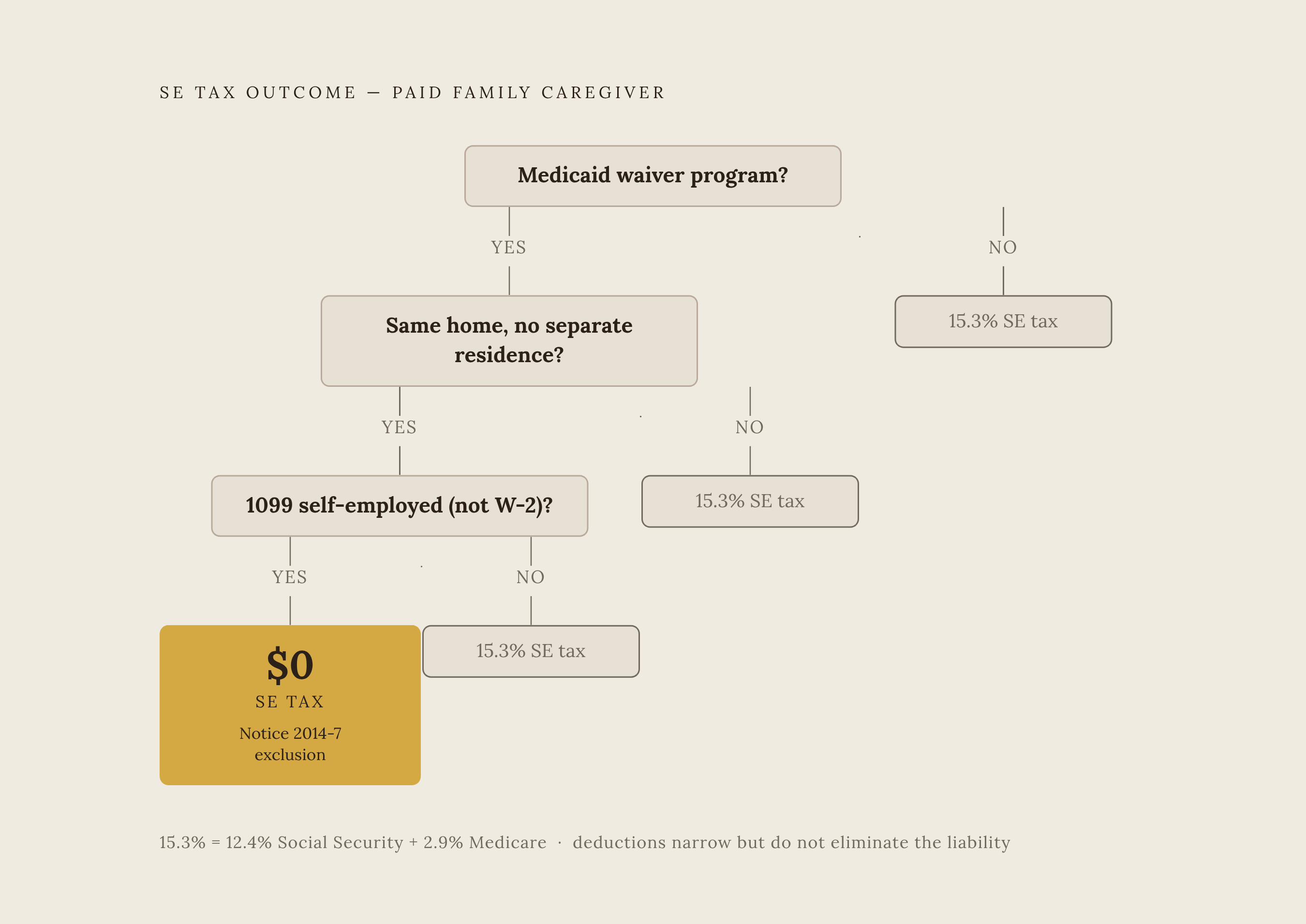
Everything above collapses into a short sequence of questions, and answering them in order determines which path a caregiver is actually on.
Start with classification. Is the caregiver an employee of the care recipient, based on who controls the work and how it gets done, or are they running something closer to an independent caregiving business with multiple clients? Get this wrong, and every downstream calculation is built on the wrong foundation.
Next: does the payment come from a Medicaid waiver program specifically, something like a state's HCBS waiver, as opposed to Medicare, private pay, or a state-only fund that never touches Medicaid dollars? This single fact determines whether Notice 2014-7 is even on the table.
Then whether the caregiver lives in the same home as the care recipient, and this is the one worth the most scrutiny given how many edge cases the IRS has already ruled on. Does the caregiver live in the same home as the care recipient, full-time, with no separate residence where weekends, holidays, and the ordinary routines of private life happen elsewhere? A few nights a week under the same roof isn't enough if a separate home still exists.
If the caregiver lives in the same home as the care recipient full-time with no separate residence, and the funding source checks out, the exclusion applies, and reporting becomes a matter of correctly offsetting income against expense on Schedule C, or verifying the W-2 already reflects it. If the answer is no, on either front, SE tax applies in full, and the deduction stack, the half-SE-tax deduction, health insurance premiums, legitimate business expenses, becomes the tool for managing what's owed, not eliminating it.
One might argue the paperwork is the hard part here. The hard part is not the paperwork. The hard part is recognizing, early, which of these two tracks a given caregiving arrangement actually sits on, because the difference between them spans far more than a few percentage points. It's the difference between owing nothing on the payments and owing 15.3% of them, before income tax even enters the conversation. It's the first thing worth confirming the moment a waiver program starts issuing payments. It's the first thing worth confirming the moment a waiver program starts issuing payments.
Sources
- Certain Medicaid waiver payments may be excludable from income | Internal Revenue Service
- Certain Medicaid Waiver Payments May Be Excludable From Income
- Self-employment tax (Social Security and Medicare taxes) | Internal Revenue Service
- Family caregivers and self-employment tax | Internal Revenue Service
- taxsharkinc.com