Claiming a Parent as a Dependent on Federal Taxes
Many caregivers don't claim this tax break despite qualifying for substantial savings.
Claiming a parent as a dependent on federal taxes is legal, well-documented, and used by far fewer caregivers than could actually benefit from it. A Pew Research Center survey found that roughly 1 in 10 Americans say they're caring for a parent 65 or older, and nearly half of adults between 40 and 59 are now part of the so-called sandwich generation, managing care for both kids and parents at once. Many caregivers report significant financial pressure from parental caregiving, and out-of-pocket spending on that care can be substantial. Against numbers like that, a dependent claim is real money, and the IRS rules governing it, while specific, are not complicated once laid out in full. It's real money, and the IRS rules governing it, while specific, are not actually complicated once laid out in full.
How the IRS categories work: why a parent is always a qualifying relative, never a qualifying child
The IRS recognizes exactly two categories of dependent: the qualifying child and the qualifying relative. Both are defined under a federal tax statute. §152 and explained at length in IRS Publication 501. A parent will never fall into the first category. Age alone rules it out, since the qualifying child test requires the dependent to be under 19 (or under 24 if a full-time student), and no parent clears that bar in reverse.
So a parent falls under qualifying relative, a category that also covers stepparents, in-laws, grandparents, aunts, and uncles. If any of those descriptions fits someone in a reader's life, the same four tests covered below apply to them too. Foster parents don't count as relatives under this rule; that's one notable carve-out. To claim a foster parent as a dependent, that person has to have lived in the taxpayer's main home for the entire year, as a full member of the household. It's a residency substitute for a relationship that doesn't legally exist in the IRS's eyes.
Both dependent categories, child and relative alike, require that the person being claimed must be a U.S. citizen, U.S. national, resident alien, or a resident of Canada or Mexico. That's baseline, and if a filer fails it, none of the four qualifying relative tests matter. Fail it, and none of the four qualifying relative tests matter. IRS Publication 501 remains the authoritative text on all of this, and anyone working through their own numbers should keep a copy open alongside whatever software or professional they're using.
Test one: the relationship requirement
For an actual parent, the relationship test is close to automatic. Parents and parents-in-law are among those recognized under the IRS's qualifying relative rules, so this test rarely trips anyone up on its own merits. A different assumption trips people up.
Caregivers frequently believe their parent has to live with them to be claimed. That belief comes from bleeding over the qualifying child rules, where a "lives with you" residency test genuinely does apply. It does not apply here. A parent can live in their own house across town, in a sibling's guest room, in an assisted living facility, or in a nursing home three states away, and none of that disqualifies the relationship test for a qualifying relative claim.
Why does this distinction matter so much in practice? Because it means the caregiver footing the bill for a parent's assisted living costs isn't automatically shut out of claiming them just because they don't share a roof. Support is what counts here, not proximity, and that gets its own dedicated test later on. Foster parents need the full-year household residency to substitute for a relationship the tax code doesn't otherwise recognize.
Test two: the gross income limit for 2025 and 2026, and the Social Security nuance that changes the math
The gross income limit for tax year 2025 is $5,200, rising to $5,300 for 2026, under Revenue Procedure 2025-32. For context, the 2024 figure was $5,050, so the ceiling has been climbing gradually along with inflation adjustments. A parent's gross income for the year has to fall under that number for this test to pass.
Gross income here includes wages, salaries, tips, gross rental income, taxable interest, dividends, and any Social Security benefits that happen to be taxable. That last category is where most elderly parents clear this test rather than fail it: most Social Security income isn't taxable, and untaxed Social Security doesn't count toward the $5,200 or $5,300 ceiling. A parent living on Social Security and a modest pension frequently lands well under the limit for this reason alone.
But that carve-out has a limit of its own. Once a parent's total income, Social Security included, crosses $25,000, a portion of those Social Security benefits can become taxable, and once they're taxable, they start counting toward the gross income test. A tax professional should weigh in on that scenario rather than assuming it away, particularly for a parent with a pension or investment income stacked on top of Social Security.
The gross income test looks only at taxable income, and it's easy to blur this distinction. The support test, covered next, looks at all income, taxable and nontaxable together. They are separate calculations built on separate definitions of income, and running them together is a common source of confusion. A parent whose only money is Social Security and a small pension under the threshold likely clears this test without issue. A parent with meaningful rental income, interest income, or a taxable pension may not.
Test three: proving you provide more than half of your parent's total support
This is the test that does the most damage to well-intentioned claims, mostly because "total support" means something broader and stricter than most caregivers assume. The standard: the caregiver has to provide more than 50% of the parent's total support for the year, and total support means every dollar spent on the parent's behalf from every source, not just what the caregiver personally contributed.
Support includes food, lodging (calculated at fair market value if the parent lives rent-free in the caregiver's home), clothing, education, medical and dental care, transportation, and recreation. It does not include income taxes the parent pays out of their own earnings, payroll taxes withheld from wages, life insurance premiums the parent pays on a policy they own, or funeral expenses.
Social Security becomes a trap rather than a help. If a parent receives Social Security and spends it on their own living costs, that spending counts as self-support. It adds to the total support figure the caregiver needs to beat. The math gets unforgiving fast. Consider a parent whose total annual living expenses are split between Social Security and a caregiver's contributions. If the caregiver covers more than half, the test passes comfortably. But shift the numbers only slightly so that Social Security covers more than half, and the caregiver fails the test outright, despite still paying a substantial sum. What matters is the percentage of total support contributed.
Government benefits complicate this further. Welfare or food assistance paid directly to a parent by the state counts as state support, not the caregiver's contribution. But if a caregiver receives a government benefit and then spends it on the parent, the IRS generally treats that money as the caregiver's own support, not the state's. It's a subtle distinction, and one that hinges entirely on who the check was made out to.
IRS Publication 501 includes a formal Worksheet for Determining Support, and anyone attempting this calculation should work through it directly rather than estimating. Because the IRS can request substantiation, keeping receipts, bank statements, and a running support log across the year is essential diligence. A claim that survives scrutiny requires receipts, bank statements, and a running support log across the year, and one that doesn't lacks them.
Test four, the joint return rule, and the citizenship requirement
The fourth test, confirming the dependent isn't a qualifying child of anyone else, is almost never a live issue for an actual parent. It exists in the framework because the same four tests apply across every qualifying relative category. For a parent specifically, it is a formality that resolves itself.
The citizenship and residency requirement, introduced earlier as the baseline shared across all dependents, belongs on the checklist here too: U.S. a national of that country, national, resident alien, or resident of Canada or Mexico.
The joint return rule carries more weight. If a parent is married and files a joint return with a spouse, the caregiver generally cannot claim that parent as a dependent. There's an exception that matters for a lot of lower-income elderly couples, though: if the parent files jointly purely to collect a refund, and has no actual tax liability once the return is calculated, the caregiver can still claim them. That exception gets missed constantly, largely because people assume "filed jointly" is a hard stop rather than a condition with a documented carve-out.
A parent can only be claimed on one return per year. If two siblings both try to claim the same parent, the IRS has historically rejected the second e-filed return. As of the 2025 filing season, that second filer can still successfully e-file, provided they include a valid IRS Identity Protection PIN. And separately, a caregiver who wants to claim a dependent parent can't simultaneously be claimed as someone else's dependent. The two statuses don't coexist on a single return.
When no single sibling provides more than half: the Multiple Support Agreement
What happens when three siblings each cover a third of a parent's expenses, and collectively that's well over half, but individually none of them clears the 50% line alone? The standard support test fails for every single one of them. But the IRS built a specific mechanism for exactly this situation.
Under the multiple support rule, anyone contributing at least 10% of a parent's total support, who together with others in the group covers more than half of that support, may be eligible to claim the parent as a dependent. The mechanism requires coordination: everyone contributing 10% or more has to agree, in writing, on which single person claims the dependent for that tax year. The person claiming the parent files IRS Form 2120, the Multiple Support Declaration, and every other qualifying contributor signs a written statement waiving their own right to the claim that year.
In practice, this lets siblings rotate the benefit year over year, each taking a turn claiming the parent as long as the paperwork tracks correctly. That raises a question that isn't really a tax question at all: who gets to claim the parent this year, and who decides? Splitting the dollar cost of care is one negotiation. Splitting a tax benefit that only one person can legally take is a separate one, and families that skip that conversation tend to have it later, under worse circumstances. A tax professional familiar with Form 2120 can help structure the rotation cleanly before disagreement sets in.
What claiming a dependent parent puts in your pocket: the credit and filing benefit stack
Passing all four tests doesn't unlock a single benefit. It unlocks a stack of them, several of which can be claimed together in the same tax year.
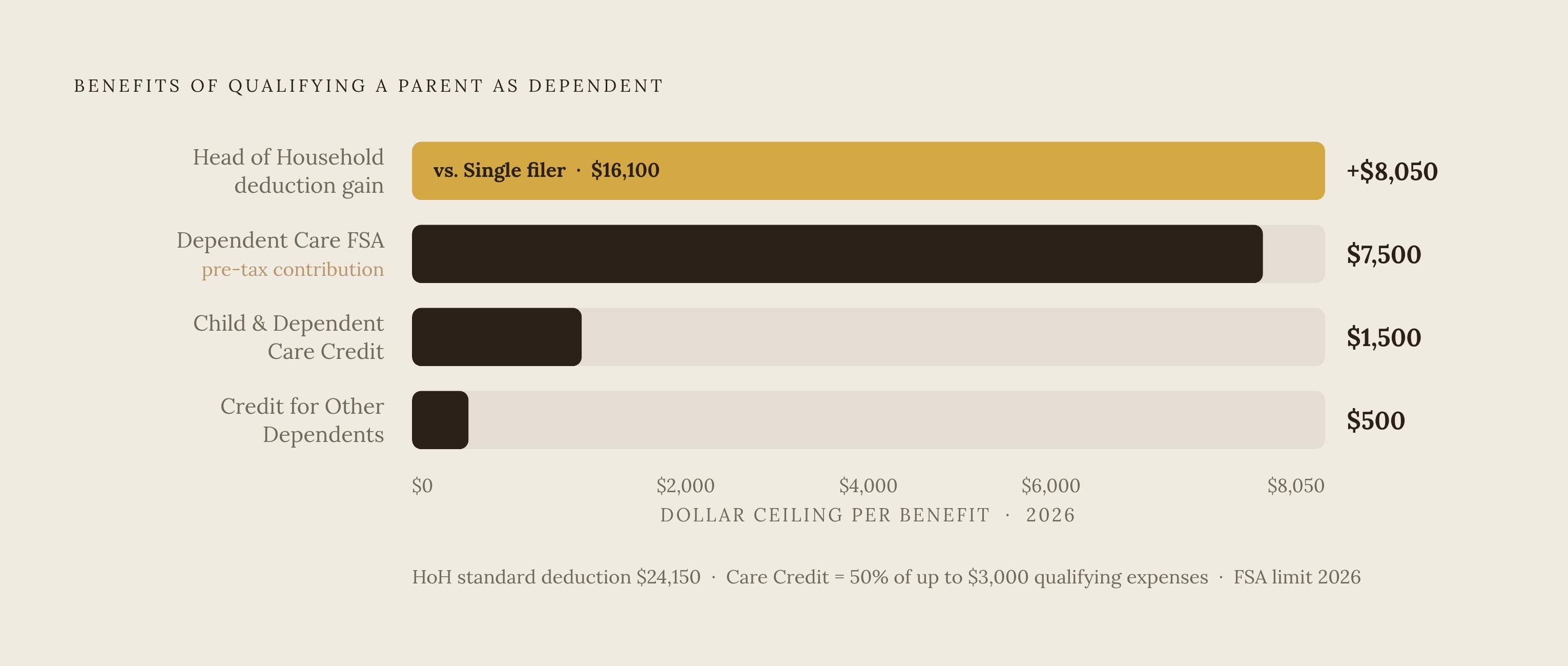
The Credit for Other Dependents delivers a $500 non-refundable credit per qualifying dependent parent. The One Big Beautiful Bill Act, enacted July 4, 2025, made this credit permanent, though permanence in tax law describes current statute, not a guarantee against future legislative change. The credit is a flat $500, not adjusted for inflation, and it phases out starting at $200,000 of modified adjusted gross income for single filers and $400,000 for married couples filing jointly, reduced by $50 for every $1,000 of income above those thresholds. It can be claimed alongside the Child and Dependent Care Credit, not instead of it.
Head of Household filing status is where the bigger structural benefit often sits. It's available to unmarried taxpayers who paid more than half the cost of maintaining a home for a qualifying person, and for parents specifically, there's a critical exception: the parent doesn't have to live in that home. A caregiver paying most of the cost of a parent's nursing home stay can still qualify for Head of Household even though the parent lives elsewhere. The number attached to that status is substantial: the 2026 standard deduction for Head of Household is $24,150, against $16,100 for Single filers, an $8,050 gap in income shielded from tax before credits even enter the picture. The 12% tax bracket also stretches further for Head of Household filers, extending to $67,450 of taxable income in 2026, a wider band than what Single filers get.
The Child and Dependent Care Credit applies when a caregiver pays someone else to look after a dependent parent while the caregiver works. For 2025, qualifying expenses cap at $3,000 for one dependent, $6,000 for two or more, and the credit itself runs between 20% and 35% of those expenses depending on adjusted gross income. The One Big Beautiful Bill pushes that maximum percentage to 50% starting in 2026, phasing down based on adjusted gross income, with the prior maximum of 35% applying at certain income levels. The expense caps themselves stay put. One caveat separates this credit from the two above it: it requires the parent to have actually lived with the taxpayer for more than half the year. That's a real exception to the general rule that co-habitation doesn't matter for dependent parents, and it's easy to miss precisely because the other benefits don't carry it.
A Dependent Care FSA works alongside employer-sponsored benefits, letting pre-tax contributions reduce federal taxable income directly. The 2026 contribution limit rises to $7,500 (or $3,750 for married filing separately), up from $5,000, marking the first permanent increase to that limit since 1986. One coordination rule matters here: expenses reimbursed through a Dependent Care FSA can't also be counted toward the Child and Dependent Care Credit. The two benefits apply to different dollars, not the same dollars twice.
For taxpayers who itemize, unreimbursed medical and dental expenses paid on behalf of a qualifying dependent parent are deductible, but only the portion exceeding 7.5% of adjusted gross income counts. On $100,000 of AGI with $10,000 in a parent's medical expenses, the math works out to a $2,500 deduction, since 7.5% of $100,000 is $7,500 and only the excess above that floor is deductible. This only helps, of course, if total itemized deductions exceed the standard deduction.
When you fall just short of qualifying: tax relief that does not require dependent status
Failing one of the four tests, usually the gross income limit or the support test, doesn't mean walking away empty-handed. Two paths stay open regardless.
The medical expense deduction survives even when dependent status doesn't. If a parent can't be claimed because they filed a joint return, or because their gross income exceeded $5,300 in 2026, the caregiver can still deduct medical expenses paid on that parent's behalf, subject to the same 7.5% AGI threshold and the same itemization requirement described above. The dependent test and the medical deduction test are, in this specific way, decoupled.
The Child and Dependent Care Credit can, in certain caregiving arrangements, remain available even without formal dependent status. The specifics vary enough by situation that anyone in this position should work directly with IRS guidance or a tax professional to confirm eligibility rather than assume either way. What's clear is that a failed dependent test leads to further options to check. It's a signal to check which of these adjacent, less-publicized reliefs still apply.