Medicaid Home and Community-Based Services Waivers by State
States design their own Medicaid home-care programs, each with different rules and waiting lists.
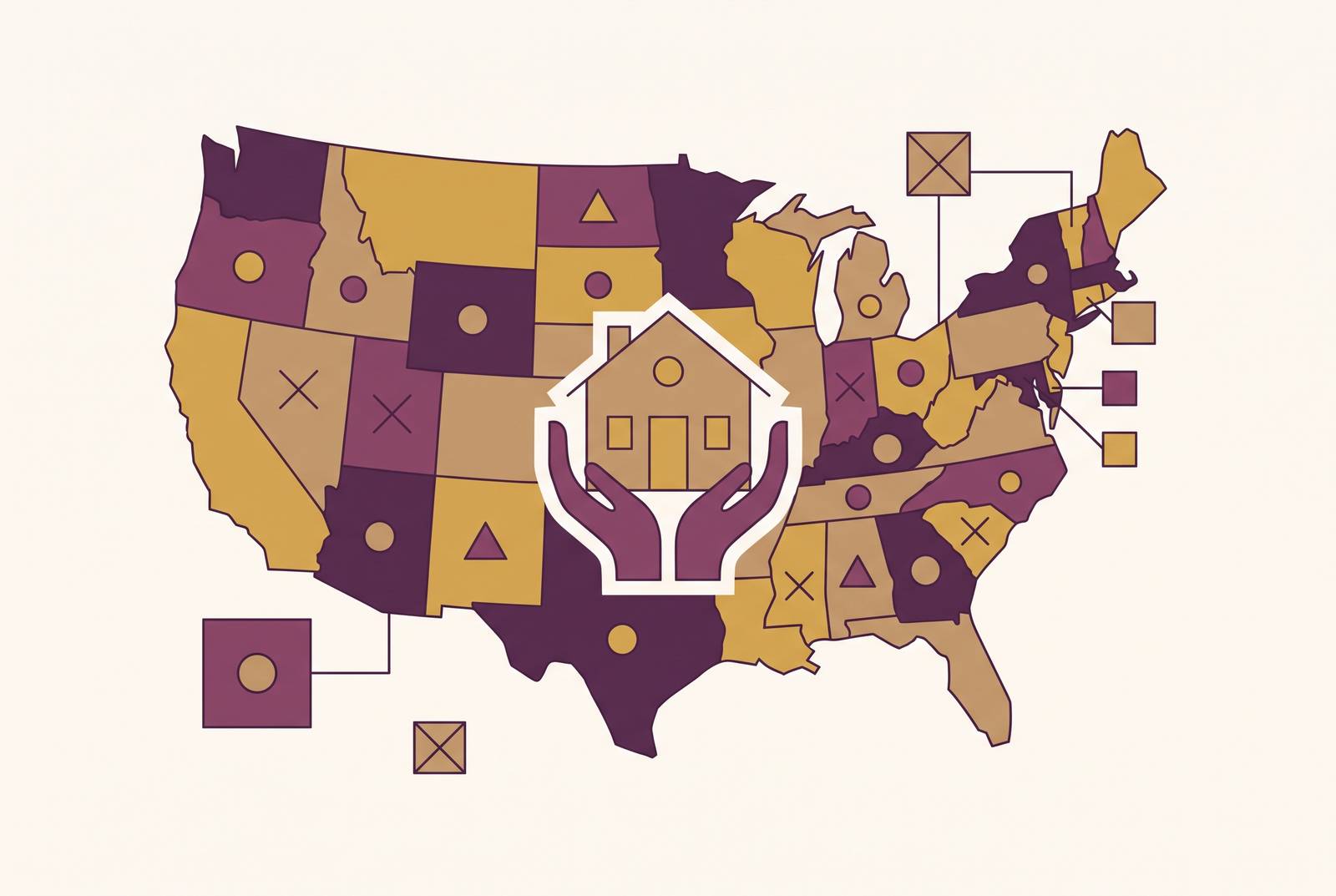
Medicaid's Home and Community-Based Services waivers let states pay for care in someone's own home or neighborhood instead of a nursing facility, and every state runs its own version, with its own name, its own waiting list, and its own rules for who gets in. This piece explains how the system works everywhere, then walks through what's known state by state, so a reader can actually find the program that applies to them.
Why HCBS waivers exist as a distinct Medicaid category
Start with a distinction that explains almost everything else in this article: nursing-facility care is a mandatory Medicaid benefit, but home and community-based care is largely optional. States are required to pay for the institutional option. They aren't required to pay for the home-based alternative, so each one has built its own.
The legal vehicle for most of that alternative is Section 1915(c) of the Social Security Act, added in 1981 kff.org. It lets a state ask CMS for permission to offer home-based alternatives to people who would otherwise need institutional placement kff.org. The word "waiver" is literal: the state waives certain standard Medicaid requirements, like statewideness or comparability of services, for a defined group of people, and CMS approves each one individually. CMS also requires that the waiver not cost more, per person, than institutional care would have. That budget-neutrality rule is part of why states cap enrollment rather than opening these programs to everyone who qualifies, a theme that resurfaces later in the waitlist and spending-cap sections.
These waivers also aren't permanent by default. A 1915(c) waiver is approved for an initial period and renewed after that, which is why program details change over time and why readers need current, state-level information kff.org. Add in the Olmstead v. L.C. Olmstead v. Supreme Court decision, which held that unjustified institutionalization of people with disabilities violated the ADA where community care is clinically appropriate, not opposed by the individual, and reasonably accommodatable by the state, gave the shift toward HCBS additional legal momentum. Olmstead didn't create HCBS waivers, but it gave states another reason to expand them.
There is no single benefit called "the Medicaid HCBS waiver." Each state runs its own named programs, often several, aimed at different populations, aging adults, people with intellectual or developmental disabilities, people with physical disabilities, medically fragile children. So the most useful thing this article can do is lay out the rules that hold everywhere, then send readers toward their own state's program names.
How HCBS spending grew from a footnote to the dominant form of Medicaid long-term care
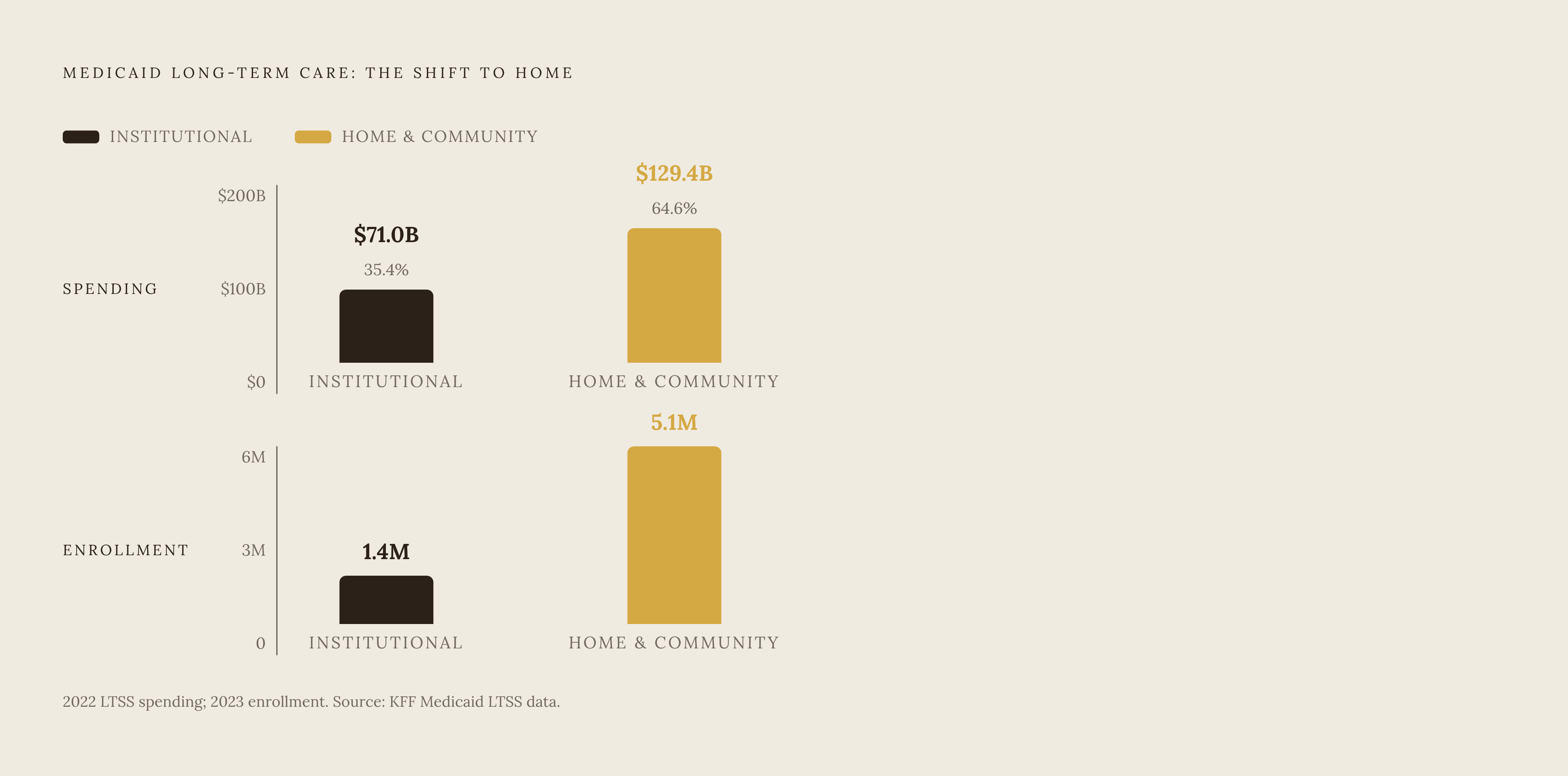
The numbers here tell a genuinely dramatic story. By 2023, that figure was 63.8% en.wikipedia.org. That's not incremental growth, it's close to a full inversion of where the money went.
In dollar terms, national Medicaid LTSS spending hit $200.4 billion in 2022, with $129.4 billion going to home and community-based services and $71.0 billion to institutional care medicaid.gov mcknightshomecare.com. Enrollment tells the same story from a different angle: 5.1 million people used Medicaid home care in 2023, compared with 1.4 million who used institutional long-term care.
And the shift is still accelerating. HCBS waiver enrollment grew 5.1% between 2021 and 2022, while institutional care enrollment grew just 0.8% over the same stretch congress.gov. For any family facing a long-term care decision, how much does it matter whether they understand how Medicaid Home and Community-Based Services Waivers work? Quite a lot, because HCBS has stopped being a niche program and become the default form Medicaid long-term care takes. Planning for aging or disability without understanding it is planning with an incomplete picture.
The different legal authorities states use to deliver HCBS
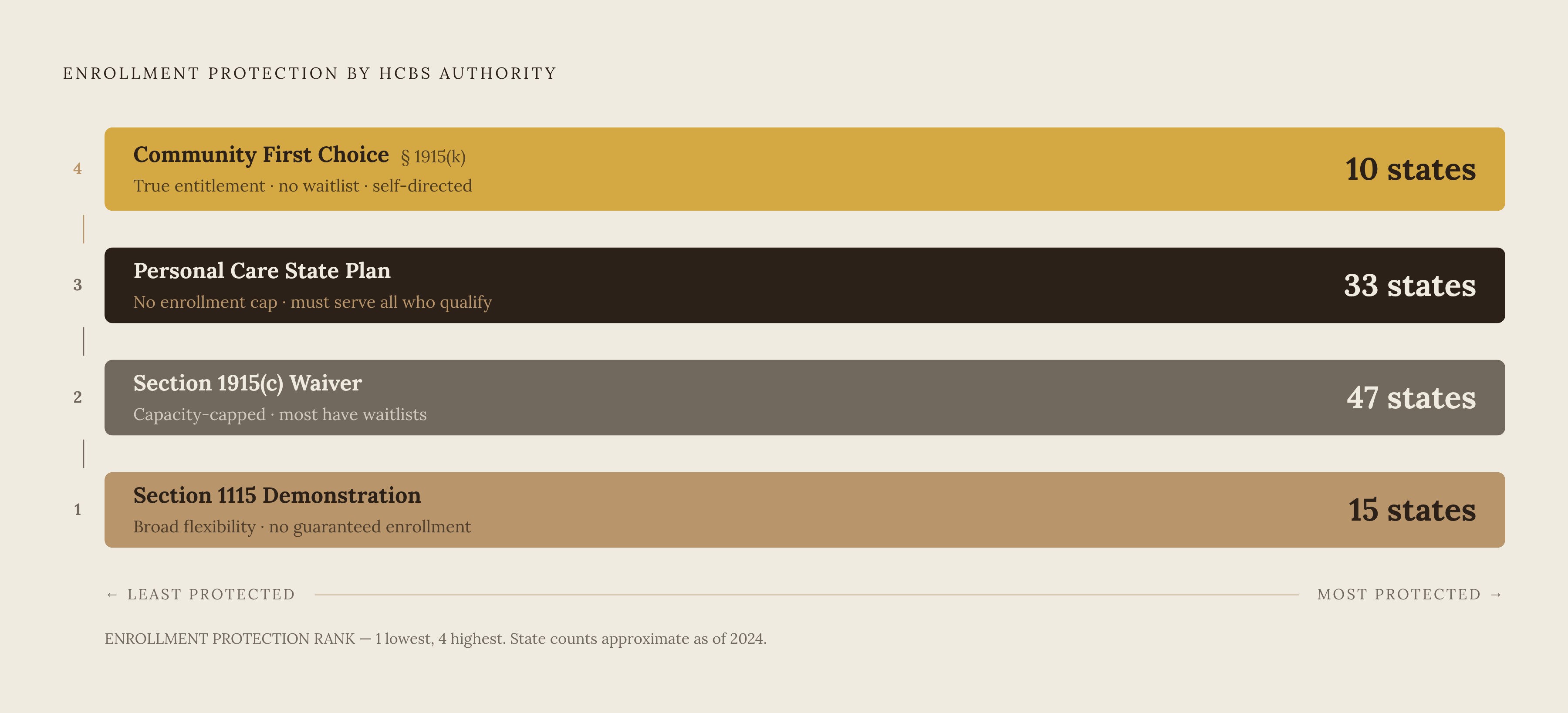
Understanding which tool funds a given program tells a reader something concrete: whether there's a cap on enrollment, whether there's a waitlist, and whether coverage is guaranteed once eligibility is established.
Section 1915(c) waivers, the most common vehicle used by 47 states, are state-designed, CMS-approved, and capacity-capped, which is why most have waiting lists kff.org. Section 1115 demonstration waivers offer broader flexibility, letting states test new payment or delivery models, and 15 states use this route for home care kff.org. Then there's the personal care state plan benefit, available in 33 states: if a service sits in the state plan rather than in a waiver, the state has to offer it to everyone who's eligible, with no enrollment cap kff.org. That's a meaningful difference. A waiver can turn someone away and put them on a list. A state plan benefit legally cannot.
Community First Choice, authorized under Section 1915(k), goes further still. It's a true entitlement for attendant services, no waiting list, available in 10 states, and it's almost always self-directed, so the person receiving care has real say over who provides it kff.org. Four states, Arizona, New Jersey, Rhode Island, and Vermont, deliver HCBS only through 1115 waivers and run no 1915(c) waivers at all, a reminder that the 1915(c) framework, however common, doesn't describe every state's system kff.org. Readers may also run across 1915(j) self-directed personal assistance programs or the 1915(i) state plan option, which has less stringent eligibility criteria than a standard waiver kff.org. The names matter less than the practical question they answer: is this a capped program with a line, or a guaranteed benefit?
The two tests every applicant must pass regardless of state
The first is functional eligibility. An applicant has to meet their state's Nursing Facility Level of Care standard, essentially proving they'd qualify for nursing home placement if community-based care weren't an option. The specific assessment tool and the exact criteria vary by state and even by waiver program within a state, so what counts as sufficient functional need in one program may not transfer automatically to another.
The second is financial eligibility, and this is where a lot of families assume, wrongly, that they don't qualify. Income and asset limits apply, and most states cap income at 300% of the SSI Federal Benefit Rate, which comes to $2,982 a month as of 2026 kff.org. The asset limit in most states is $2,000 for an individual kff.org. Spousal protection rules let a non-applicant spouse retain assets within a federally set range, with specific floors and ceilings varying by state, and home equity is generally exempt up to a federally set threshold that runs higher in states with expensive real estate. Financial eligibility for HCBS is complicated enough that a family who assumes they earn or own too much to qualify should actually run the numbers, because spousal allowances and spend-down provisions change the math considerably.
Not every pathway holds applicants to the nursing-facility standard. The 1915(i) state plan option, mentioned above, has less stringent functional criteria, so someone who doesn't meet the standard nursing-facility threshold may still find a program they qualify for kff.org. And most states set a somewhat higher income ceiling for home care programs than for other Medicaid categories, though the 300% SSI figure remains the federal cap. Every applicant must pass two separate tracks, both required, regardless of state.
Services covered by HCBS waivers
No federal rule dictates a specific list of services every waiver must include. Each state builds its own menu. That said, certain services show up across nearly every program: personal care assistance with bathing, dressing, grooming, and continence care, respite care that gives family caregivers a break, home modifications and assistive technology, meal preparation or home-delivered meals, adult day programs, supported employment, personal emergency response systems, and transportation.
These services can be delivered in more places than people often assume, the person's own home, a family member's home, an adult day center, an assisted living residence, a memory care community, or an adult foster care home. HCBS isn't confined to medical care, either. Non-medical personal assistance and physical home modifications sit at the core of the benefit, not at its edges.
Coverage also shifts substantially depending on who the waiver is built for. A program serving people with intellectual or developmental disabilities is likely to include supported employment, day habilitation, and community integration services that a waiver for aging or physically disabled adults simply won't have. So a service that's fully covered in one state's waiver may not exist at all in a neighboring state's program, which matters for any family or provider trying to plan across state lines.
One feature deserves particular attention: self-direction. Forty-nine states allow Medicaid enrollees to self-direct their home care in at least some circumstances. That can mean hiring and managing one's own aides, and in many states, it can mean paying a family member to serve as that paid caregiver. For families already providing unpaid care, this is often the single most consequential detail in the entire system, since it can turn an existing caregiving arrangement into a paid one, legally and through Medicaid.
Waitlist lengths across states
The scale of HCBS waitlists nationally stands out. As of a KFF report, 41 states had waiting lists for Medicaid HCBS, and the number of people waiting exceeded 600,000 in 2025 medicaid.gov mcknightshomecare.com. Every year since 2016, at least 500,000 people have been on a waiting list somewhere in the country medicaid.gov mcknightshomecare.com. This isn't a temporary backlog. It's a structural feature of how the program is funded.
The direction is getting worse, not better, in most places. In 2025, 29 states reported growth in the number of people on waiting or interest lists, while only 12 reported a decline mcknightshomecare.com. Twelve states reported entirely new waiting lists, and the largest share of those new lists targeted people with intellectual or developmental disabilities, specifically in Illinois, Louisiana, Missouri, Utah, and Wisconsin.
A few state examples put numbers to the pattern. Texas runs its STAR+PLUS Waiver with roughly 24,000 enrollment spots, and as of December 2025, about 15,850 people sat on the interest list kff.org medicaidlongtermcare.org. California's Assisted Living Waiver, approved for a set number of participants, has carried a statewide waitlist since 2019, with a substantial number still waiting as of October 2025. Indiana runs two waivers with tens of thousands of combined slots for 2025 and 2026, yet thousands of people remained on the Health and Wellness Medicaid Waiver Waiting List as of September 2026 kff.org. Kansas serves thousands through its IDD waiver, with thousands more still waiting behind them.
But how reliable are these numbers, really? Six states, Florida, Iowa, Oklahoma, Oregon, South Carolina, and Texas, don't fully screen for eligibility before placing someone on a waitlist. That means their published interest-list totals are inflated. Not everyone sitting on those lists would actually qualify if fully assessed, which matters both for state planning and for any individual trying to gauge realistic wait times.
States generally prioritize openings for people in crisis, those transitioning out of a nursing home, individuals at imminent risk of institutionalization, and applicants with the highest assessed need. So the practical advice follows directly from the mechanics: apply as early as possible, since placement date often determines position, ask explicitly whether the state screens for eligibility before or after adding someone to the list, and reapply if circumstances change. A hospitalization or an approaching nursing-home admission can sometimes accelerate access.
Not every state runs this way, either. Minnesota eliminated its Developmental Disabilities waiver waitlist back in 2016 through sustained state funding and county-based coordination medicaid.gov. Wisconsin's Family Care and IRIS programs function without enrollment caps or waiting lists, even though they're technically structured as waivers rather than legal entitlements. These examples matter because they show the waitlist problem is a funding choice, not an inevitable feature of home-based Medicaid care. California's Lanterman Developmental Disabilities Services Act creates a legal entitlement to developmental disabilities services for eligible individuals, separate from the ALW waitlist.
How 44 states cap or limit HCBS spending
Waitlists are a symptom. The underlying cause is spending control, and it's nearly universal. KFF's analysis found that 44 of 50 states use some limit on waiver enrollment, spending, or services to keep budgets predictable leadingage.org.
States manage that spending through a few recurring mechanisms. Over half, 26 states, now deliver 1915(c) waiver services through managed care plans, four more than in 2024 kff.org. But managed care hasn't spread evenly. Only 8 of the 47 states running I/DD waivers use managed care for any part of that population, suggesting states treat the intellectual and developmental disability population with more caution when it comes to handing delivery to a managed care plan kff.org. Separately, 16 of 47 states use intergovernmental transfers, local government funds routed up to the state Medicaid agency, to help finance their waiver programs kff.org medicaid.gov. That's a financing detail, but it affects something very real for enrollees: how stable and predictable a given state's HCBS funding actually is from year to year.
Then there's the policy environment shaping all of this going forward. The 2025 reconciliation law is projected to cut federal Medicaid spending by $911 billion over the next decade, according to KFF, with consequences reaching into home care workforce capacity, family caregiver support, and the coverage decisions states will be forced to make. States will face a genuinely hard choice between raising new revenue and cutting Medicaid spending elsewhere. The same law created a new category of 1915(c) waiver for people who don't need an institutional level of care, though take-up is expected to stay low given the spending cuts layered on top of it and the wait-time requirements tied to existing waivers kff.org.
What should a reader take from this? Qualifying for a waiver and actually getting enrolled in one are two different events, and the space between them is the waitlist. Enrollment depends on funded slots opening up. That's not a reason to skip applying; it's a reason to apply early, ask specific questions about a program's cap and current wait, and treat the application date itself as a piece of leverage.
State-by-state HCBS waiver directory
The general rules above meet the specifics of an actual program. Because states differ so much in what they publish and how often they update it, this directory covers the states where solid, sourced detail exists, rather than guessing at figures for every state in the country.
California runs at least two major programs worth knowing by name kff.org. Its HCBS Waiver for Individuals with Developmental Disabilities, administered by DDS through regional centers, went through a five-year renewal effective January 1, 2023, with a current approved waiver amendment (CA.0336.R05.10) effective January 1, 2025, and approximately $3 billion in federal funding secured through that renewal.
Texas operates the STAR+PLUS Waiver, with about 24,000 enrollment spots and roughly 15,850 people on its interest list as of December 2025 kff.org medicaidlongtermcare.org. Indiana runs two separate waivers offering tens of thousands of combined slots for the 2025 to 2026 period, though thousands still sit on its Health and Wellness Medicaid Waiver Waiting List as of September 2026 kff.org. Kansas serves thousands of people through its IDD waiver while thousands more remain on that program's waiting list. Minnesota stands out as a state that eliminated its Developmental Disabilities waiver waitlist entirely back in 2016, through consistent state investment and coordination at the county level medicaid.gov. Wisconsin's Family Care and IRIS programs run without enrollment caps or waiting lists, despite being structured as waivers rather than formal entitlements.
For any state not detailed here, the path forward is the same: contact the state Medicaid agency directly or consult the program-specific link for more information. Given how often these programs renew, amend, and shift funding models, that direct check with the state agency will always be more current than any published summary, this one included. The Assisted Living Waiver (ALW) is approved for 23,406 participants and has had a statewide waitlist dating to 2019, with a large number of people on the waitlist as of October 2025 (precise figure in sources).