Non-Emergency Medical Transportation Benefits Under Medicaid
Medicaid covers rides to medical appointments for those without transportation.

Medicaid's non-emergency medical transportation benefit is a federally mandated entitlement that most beneficiaries barely understand, let alone use. It covers rides to and from covered medical services for people who have no other way to get there, and it is a distinct, statutorily required part of Medicaid. What follows walks through who qualifies, what the benefit actually pays for, how states deliver it, and what happens when the system underperforms, because a right on paper only matters if someone knows how to use it.
Why federal law requires every state to provide NEMT
NEMT stands for exactly what it sounds like: transportation to and from covered Medicaid services for beneficiaries who otherwise have no means of getting there. It is not an emergency response system, and it is not a general-purpose subsidy for getting around town. The legal foundation goes back to 42 CFR 431.53, which has long required every state Medicaid plan to assure necessary transportation for its members. That regulatory requirement got a significant upgrade in 2021, when the Consolidated Appropriations Act (Division CC, Title II, Section 209) wrote the mandate directly into statute, landing it in 42 U.S.C. 1396a(a)(4) of the Social Security Act itself. That's not a small distinction. Regulations can shift with administrative priorities; statute is harder to unwind.
The same 2021 law set minimum standards for the drivers and providers states use to deliver these rides. States now have to enforce a valid driver's license requirement, some process for handling drug violations, disclosure of driving history, and exclusion of anyone who shows up on federal health program exclusion lists. Before that, oversight of who was actually behind the wheel varied a lot by state, which matters when the passengers are often elderly, disabled, or managing chronic illness.
One more layer explains all of this, and its effects show up in the statute discussed next. States are separately obligated to provide transportation assistance for Early and Periodic Screening, Diagnostic and Treatment services for children, a carve-in written into the same statute. The mandate requires states to provide transportation, meet driver standards, and make sure kids getting preventive and diagnostic care aren't left stranded either." It's provide transportation, meet driver standards, and make sure kids getting preventive and diagnostic care aren't left stranded either.
Who qualifies and which trips the benefit covers
Eligibility comes down to a two-part test, and both parts have to be true at once. First, the member has no other means of transportation available to them. Second, the destination has to be a Medicaid-covered service delivered by a Medicaid-enrolled provider. Miss either condition and the trip doesn't qualify, no matter how real the need feels.
What counts as a covered destination is broader than most people assume. That's the full breadth of Medicaid-covered services, not some narrow subset carved out for transportation purposes.
Pharmacy trips are where things get inconsistent. Most states draw a hard line excluding non-medical locations, so pharmacies, gyms, schools, and grocery stores are typically out of scope. But not universally. Texas, for example, explicitly extends its NEMT benefit to pharmacy trips. So what's covered in one state might not be covered two states over, which means the only reliable move is checking directly with a state Medicaid office or managed care plan before assuming a trip qualifies.
Referral requirements add another wrinkle for specialty or out-of-area care. Kentucky's program (per CHFS) requires a referral from a primary care physician before it'll cover transportation outside a member's medical service area or for specialty care. That kind of gatekeeping isn't universal either, but it shows how much the mechanics of this benefit shift depending on where someone lives.
The mileage reimbursement option most beneficiaries never hear about
Here's a piece of the benefit that rarely gets mentioned even in program literature: mileage reimbursement. Some state Medicaid programs let the beneficiary, or a friend or family member acting as the driver, submit mileage for reimbursement instead of waiting on a broker to dispatch a vehicle. It's a quieter version of the benefit, but arguably one of the more practical ones for anyone who already has a car and a willing driver.
The rate itself tracks the IRS medical-mileage rate, and it moved in 2026. A mid-year revision like that isn't nothing. It suggests states are, at least in this instance, adjusting reimbursement to track actual cost pressures rather than letting the rate sit static for years.
Where does mileage reimbursement actually show up in practice? Mostly in rural fee-for-service counties, where broker networks tend to be thin or unreliable. When a broker model can't put a vehicle on the road for a given trip, states fall back on mileage reimbursement as the workable alternative. That raises an obvious question: if broker networks are the primary delivery method (and they are, as the next section covers), what happens to beneficiaries in the gaps those networks don't reach? Mileage reimbursement is part of the answer.
Family caregivers are probably the group most underserved by their own ignorance of this option. Anyone already driving a Medicaid-enrolled parent, spouse, or dependent to appointments is performing a service the program is obligated to fund, whether they know to ask for it or not. It's a significant gap in awareness, money and time family caregivers are leaving on the table simply because nobody told them mileage reimbursement exists. It's money and time family caregivers are leaving on the table simply because nobody told them mileage reimbursement exists.
NEMT delivery models: brokers, managed care plans, and rideshare hybrids
Most states don't run NEMT directly. Instead, they contract with a third-party transportation broker or route it through a managed care organization (MCO), which receives a capitated monthly payment and then subcontracts with transportation providers to actually fulfill the rides. Whatever's left after paying those providers, the broker keeps. It's a model built around administrative efficiency, and it dominates the landscape: brokers manage roughly 70% of all Medicaid transportation trips nationwide https://elitemedfinancials.com/nemt-broker-billing-guide-2026/.
The broker landscape itself is shifting, and shifting hard in places. ModivCare, the nation's largest NEMT broker, filed for Chapter 11 bankruptcy in August 2025, and its stock was delisted from NASDAQ. As of April 1, 2026, ModivCare no longer provides NEMT in Georgia's Central, Southwest, and East regions; those contracts transferred to Verida, and ModivCare's restructuring was still ongoing as of the most recent reporting. When the largest player in a market this concentrated hits financial trouble, the ripple effects land directly on beneficiaries waiting for rides, not just on shareholders.
Verida, picking up those Georgia regions, now serves all five of the state's Medicaid regions (North, Atlanta, Central, East, and Southwest) as of April 1, 2026. Eastern. Trips need to be scheduled at least three business days in advance, not counting the day of the appointment itself. Three business days is a meaningful planning window, and beneficiaries who don't build it in risk missing appointments through no fault of the medical system.
Missouri runs things differently, with MTM Inc. operating statewide across MO HealthNet, covering both fee-for-service and managed care populations, using a proprietary rideshare fleet called VeyoRide. In 2023 alone, MTM Inc. completed nearly 2 million rides for Missouri Medicaid participants https://bpb-us-e2.wpmucdn.com/sites.wustl.edu/dist/4/4348/files/2025/03/THM9-Transportation-Benefits-in-Missouri-Medicaid.pdf. That's a substantial operational footprint for a single state contract, and it reflects how much day-to-day infrastructure supports what looks, from the beneficiary's side, like a simple phone call.
Texas is entering a transition of its own. Effective January 1, 2026, SafeRide Health began managing NEMT for UnitedHealthcare Community Plan of Texas, covering STAR, STAR Kids, STAR+PLUS, and the state's Medicaid/CHIP/D-SNP programs. Provider services can be reached at 855-932-2332, and members have a separate line at 888-462-6050. Routine trips need at least two business days' notice, while long-distance trips require five business days. That gap between routine and long-distance lead times reflects a basic operational reality: coordinating a longer trip, likely with a different vehicle type or provider, takes more scheduling slack.
Colorado is building something new rather than transitioning an existing contract. MediDrive is set to become the statewide broker for Health First Colorado, launching first in the Denver metro area on July 1, 2026, before expanding statewide by January 1, 2027. A staggered rollout like that, metro area first, statewide later, suggests the state is testing operational capacity before scaling it, which is a reasonable way to avoid access gaps that occur when a new system launches everywhere at once.
Consolidation is also reshaping the broker tier below the household names. Access2Care, once the third-largest national NEMT broker, was acquired by MTM in October 2024 and now operates as an MTM subsidiary. Fewer independent brokers means fewer points of failure to coordinate around, but it also means more beneficiaries depend on the operational health of a smaller number of companies.
Rideshare platforms have been folding into this ecosystem for close to a decade now. Lyft Healthcare began partnering with Medicaid programs and MCOs as early as 2016, and Uber Health followed in 2018 with a platform letting hospitals, clinics, and care managers book rides directly on behalf of patients. The resulting hybrid models use commercial rideshare for ambulatory patients, the ones who can get in and out of a standard car without assistance, while keeping traditional specialized vehicles in the fleet for wheelchair users and anyone who needs hands-on help. It's a sensible division of labor: rideshare covers volume and cost efficiency, specialized vehicles cover the cases rideshare simply can't handle.
The financial case for NEMT: what the benefit costs the system and saves
Combined federal and state Medicaid spending on NEMT exceeds $3 billion annually, representing less than 1% of total Medicaid expenditures https://elitemedfinancials.com/nemt-industry-statistics/. One might argue that's the whole case for the program in a single comparison: a rounding error in the overall budget buys transportation access for millions of people who'd otherwise have no way to reach covered care.
Medicaid isn't just a participant in the broader NEMT market, it's the market's dominant force. Medicaid accounts for approximately 52% of all NEMT payments nationally, making it the single largest payer in the industry by a wide margin https://elitemedfinancials.com/nemt-industry-statistics/. No other payer, public or private, comes close to that share.
To understand why this benefit matters financially to individual beneficiaries, it helps to look at what they'd be paying without it. A non-emergency ground ambulance transport typically runs $400 to $1,200 per one-way trip https://coveredusa.org/en/qa/does-medicaid-cover-transportation. Even a rideshare or taxi for a routine, recurring appointment runs $15 to $60 per trip depending on distance https://coveredusa.org/en/qa/does-medicaid-cover-transportation. That second figure sounds modest until it's multiplied out. A dialysis patient going three times a week could be looking at up to $360 a month at the high end, or more than $4,000 a year, just to physically reach a treatment that's already keeping them alive. NEMT exists specifically to absorb that cost for people who'd otherwise have to choose between paying for the ride and paying for something else.
Medicaid NEMT mileage reimbursement rates typically range from $0.70 to $10.00 per loaded mile, though most states run between $2.50 and $5.00 for standard service https://elitemedfinancials.com/medicaid-nemt-rates-by-state/. That's a lot of variation for what looks, from the outside, like a single benefit category. Rates for the same basic service can differ by 300% from one state to another, because NEMT financing is fragmented beneath the federal mandate that unifies it on paper https://www.thefutureofpatientlogistics.com/nemt-models-5-options-and-how-to-choose-in-2026/.
Broker-based delivery, for what it's worth, tends to come in cheaper than the alternatives, achieving rates 10% to 30% lower than non-broker models https://www.thefutureofpatientlogistics.com/nemt-models-5-options-and-how-to-choose-in-2026/. That's part of why the capitated broker model has become the default across most states even as individual brokers face financial strain of their own.
That growth rate says something about where demand is heading, and it lines up with a broader, ongoing recognition that behavioral health access depends on the same transportation infrastructure as physical health access.
The health outcomes evidence: what happens when transportation to care is and isn't available
Transportation barriers aren't a minor inconvenience sitting at the edges of the healthcare system. Roughly 3.6 million Americans delay or miss care every year because they can't get where they need to go, and 25% of Medicaid beneficiaries specifically name transportation as a barrier to care https://www.beckerspayer.com/payer/transportation-is-the-missing-infrastructure-layer-in-healthcare/. That's a quarter of the entire program's population running into a wall that has nothing to do with the quality or availability of the medical care itself.
The burden isn't distributed evenly. Adults with disabilities are three times more likely to miss care due to transportation problems than the general population https://kinetik.care/resources/article/why-nemt-cant-afford-to-stay-broken/. Chronic transportation issues account for 25% of missed clinic appointments overall, and as of 2023, 21% of U.S. adults reported going without medical care they needed simply because they couldn't get a ride https://kinetik.care/resources/article/why-nemt-cant-afford-to-stay-broken/. One might ask: what does a missed appointment actually cost, beyond the individual health consequence? The system-level answer is about $150 billion a year in costs tied to missed appointments across U.S. healthcare https://dreamcarerides.com/blog/the-role-of-nemt-in-reducing-missed-appointments-and-improving-patient-compliance. That's the frame that makes NEMT look less like a social service line item and more like basic cost containment.
Georgia offers a concrete before-and-after. After the state introduced NEMT services for its Medicaid population, missed appointments dropped by 50% https://reliawheels.com/reliawheels-insights/nemt-supports-rare-disease-patients. Patients managing chronic conditions were able to get consistent care, which in turn reduced how often they ended up needing emergency interventions instead. That's the mechanism in miniature: transportation access doesn't just get people to appointments, it keeps chronic conditions from escalating into emergencies, which is where healthcare costs really balloon.
Iowa's Medicaid expansion population offers a more granular, somewhat counterintuitive look at the same dynamic. Among the expansion group in Iowa that did have NEMT access, that figure was actually higher, at 15% https://academic.oup.com/healthaffairsscho. Traditional Medicaid members in Iowa landed in between, at 11% https://academic.oup.com/healthaffairsscho. Why exactly does this happen? Access to a benefit and the severity of the need driving that access aren't the same variable, and conflating them is an easy way to draw the wrong conclusion from a right set of numbers.
COVID-19's lasting effect on NEMT utilization and the recovery data
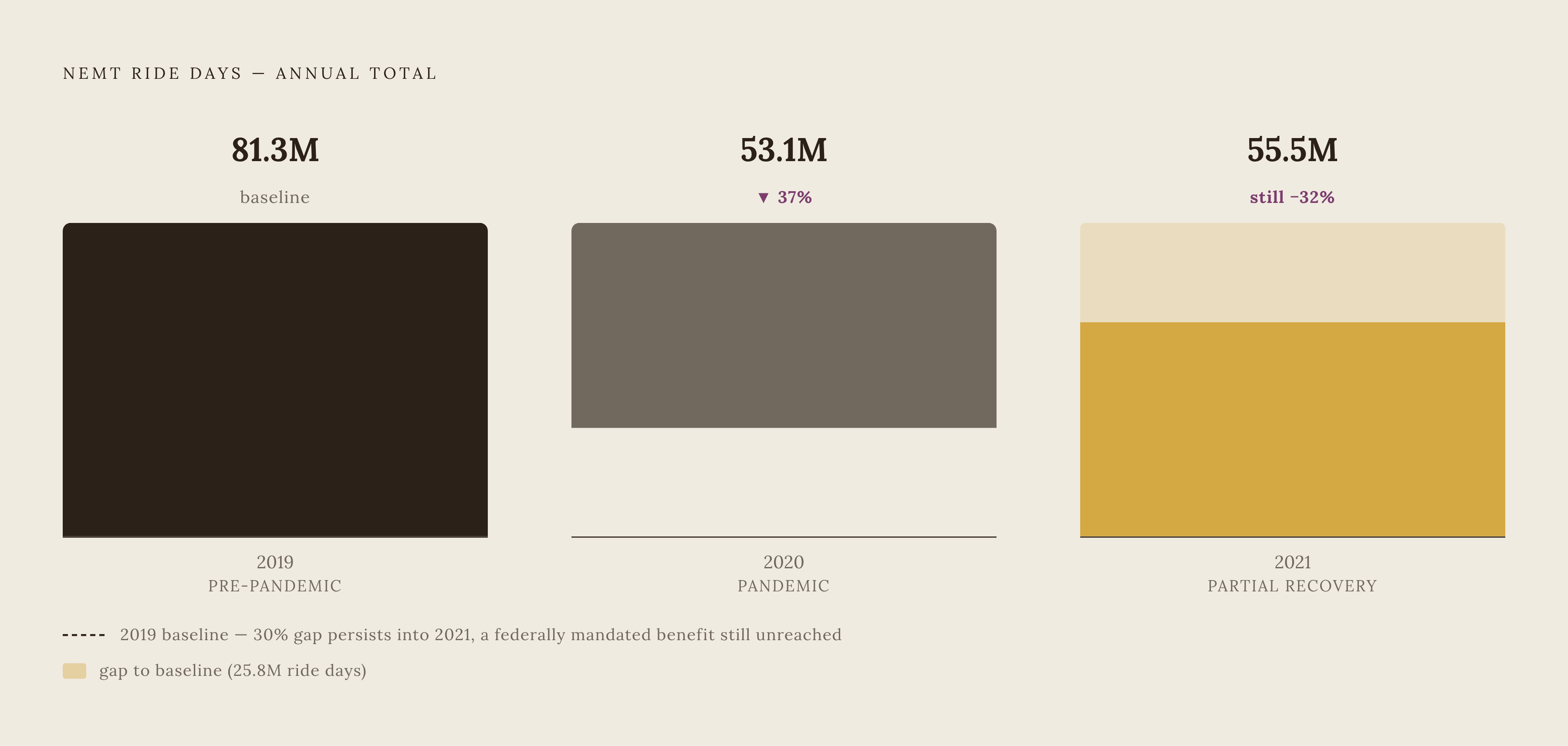
Before the pandemic, NEMT utilization sat at a fairly stable baseline. In 2019, 3.9 million beneficiaries, about 5% of the entire Medicaid population, used the benefit, generating 81.3 million ride days that year https://traumasoft.com/nemt/nemt-trends-statistics/.
Then 2020 hit, and the numbers didn't just dip, they collapsed. Total annual NEMT ride days fell 37% in a single year, from 81.3 million down to 53.1 million https://traumasoft.com/nemt/nemt-trends-statistics/. The number of beneficiaries using the benefit dropped from 3.9 million to 3.5 million in 2020, a 4% year-over-year decline in overall program share, and it kept falling into 2021, down to 3.3 million users https://traumasoft.com/nemt/nemt-trends-statistics/. That's a sustained decline, a benefit that, for a meaningful stretch, effectively stopped functioning at anywhere near its normal scale for millions of people who presumably still needed rides to medical appointments. That's a benefit that, for a meaningful stretch, effectively stopped functioning at anywhere near its normal scale for millions of people who presumably still needed rides to medical appointments.
In 2021, ride days climbed more than 4%, reaching 55.5 million for the year https://traumasoft.com/nemt/nemt-trends-statistics/. That sounds like meaningful progress until it's measured against the pre-pandemic baseline: the monthly ride-day count in 2021 remained roughly 30% below pre-pandemic levels, and the number of beneficiaries using the program stayed 23% below where it had been before https://traumasoft.com/nemt/nemt-trends-statistics/.
What does that gap actually mean? It suggests the statutory mandate and the operational reality of delivering NEMT are two different things entirely. 1396a(a)(4). A benefit written into statute is only as reliable as the operational chain beneath it, and that chain, once disrupted by a shock like the pandemic, doesn't snap back in a single budget cycle. It takes years, based on how slowly the 2021 numbers climbed back toward 2019 levels.
Reliability problems and broker accountability gaps that beneficiaries should know about
The broker model that delivers roughly 70% of all Medicaid transportation trips in the United States runs on a financial structure that creates a built-in tension https://elitemedfinancials.com/nemt-broker-billing-guide-2026/. Brokers get paid a fixed capitated amount regardless of how many trips they actually complete, and they keep whatever's left after paying subcontracted drivers. That raises an uncomfortable but fair question: what happens when fulfilling every scheduled trip cuts into the margin a broker keeps? The incentive structure doesn't automatically reward more rides. It rewards fewer costs.
ModivCare's Chapter 11 filing in August 2025, and the subsequent delisting of its stock from NASDAQ, is the clearest illustration of what happens when that tension breaks in the wrong direction. The nation's largest NEMT broker, ModivCare, filed Chapter 11 bankruptcy in August 2025, was delisted from NASDAQ, and as of April 1, 2026 no longer provides NEMT in Georgia's Central, Southwest, and East regions, which transferred to Verida. Beneficiaries in those regions didn't cause that instability and had no way to see it coming. They just needed a ride to dialysis or a behavioral health appointment while their broker's finances were unraveling behind the scenes.
Advance scheduling requirements further compound the difficulty of relying on the service. Verida requires transportation to be scheduled at least three business days in advance, not including the day of the appointment. SafeRide Health requires two business days for routine trips in Texas, and five for anything long-distance. Those windows exist for legitimate operational reasons, coordinating vehicles and drivers isn't instantaneous, but they also mean the benefit doesn't flex well around anything urgent that isn't a true emergency.
The unmet-need numbers from earlier sections point back to this same accountability question. If 25% of Medicaid beneficiaries report transportation as a barrier to care despite a federally mandated benefit designed to solve exactly that problem, the gap between statutory right and operational delivery is doing a lot of the damage https://www.beckerspayer.com/payer/transportation-is-the-missing-infrastructure-layer-in-healthcare/. That gap is not evenly distributed either. Rural counties leaning on mileage reimbursement because broker networks can't reach them, states mid-transition between one broker and another, family caregivers who don't know the reimbursement option exists in the first place: each of these is a different flavor of the same underlying issue, which is that a benefit guaranteed in statute still depends entirely on functioning infrastructure to reach the person who needs it. Between 2018 and 2021, the NEMT benefit was used by 3–4 million Medicaid beneficiaries annually https://www.milliman.com/en/insight/the-road-to-care-non-emergency-medical-transportation. Between 2018 and 2021, the NEMT benefit represented 4%–5% of total Medicaid beneficiaries each year across the country https://www.milliman.com/en/insight/the-road-to-care-non-emergency-medical-transportation. Combined federal and state Medicaid NEMT spending exceeds $3 billion annually https://elitemedfinancials.com/nemt-industry-statistics/. Ambulatory NEMT transport rates nationally in 2026 range from $25–$90 https://elitemedfinancials.com/medicaid-nemt-rates-by-state/. Wheelchair NEMT transport rates nationally in 2026 range from $45–$120 https://elitemedfinancials.com/medicaid-nemt-rates-by-state/. Stretcher NEMT transport rates nationally in 2026 range from $100–$250 or more https://elitemedfinancials.com/medicaid-nemt-rates-by-state/. Mental health transportation is the fastest-growing application segment, with a projected compound annual growth rate of 10.11% through 2030 https://elitemedfinancials.com/nemt-industry-statistics/. In Iowa, 6% of expansion members without NEMT missed a health appointment in the past 6 months due to transportation https://academic.oup.com/healthaffairsscho. The Iowa study assessing transportation barriers for 3 adult Medicaid groups included a sample size of 2,181 https://academic.oup.com/healthaffairsscho. The IRS medical-mileage rate in 2026 is 20.5 cents per mile https://medicaid.georgia.gov/programs/all-programs/non-emergency-medical-transportation. The IRS medical-mileage rate in 2025 was 21 cents per mile https://medicaid.georgia.gov/programs/all-programs/non-emergency-medical-transportation.
Sources
- Non-Emergency Medical Transportation
- Texas Medicaid: SafeRide Health will manage transportation in 2026 | UHCprovider.com
- Assurance of Transportation | Medicaid
- Medical Transportation - Cabinet for Health and Family Services
- CoveredUSA | Free Health Insurance Eligibility Check
- milliman.com
- elitemedfinancials.com
- thefutureofpatientlogistics.com