Medicaid Programs That Pay Family Caregivers by State
Every state funds family caregiver pay through Medicaid, but programs vary drastically by location.
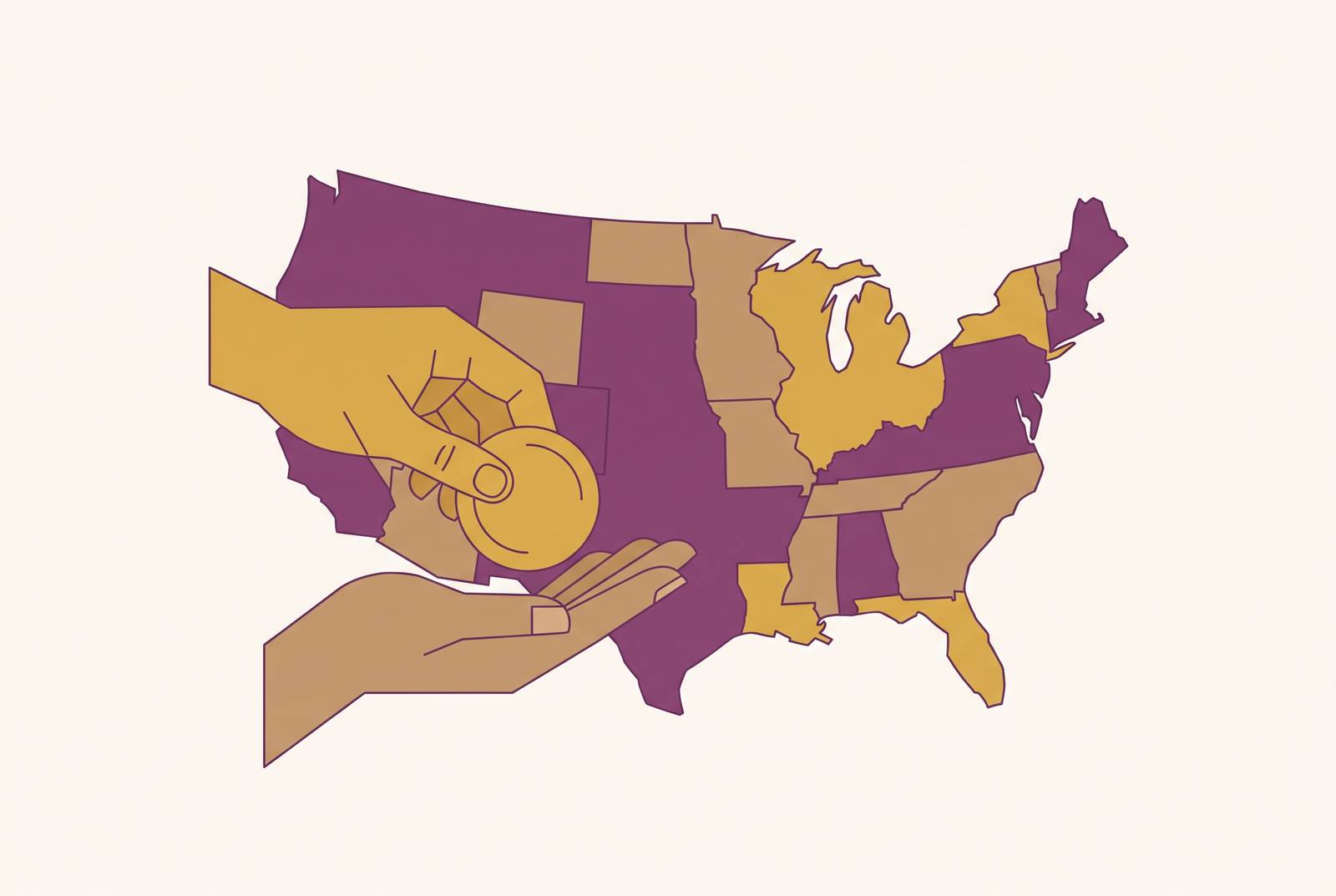
Every state and the District of Columbia has at least one Medicaid program that can pay a family member to provide care, yet most caregivers do not know this, let alone which specific program applies to them. That gap is not really a knowledge problem so much as a design problem. The honest answer to "can Medicaid pay me to care for my father" is "it depends," because program names, payment structures, eligibility thresholds, and the relationships a state chooses to exclude shift enough from state to state that a general yes is close to meaningless without the specifics attached.
That confusion carries real stakes. Caregivers who cut back hours or leave jobs entirely to provide hands-on care absorb a real income loss, and payment through Medicaid was built, in part, to offset exactly that loss. This is the policy logic that gave rise to self-direction as a Medicaid option in the first place. KFF estimates that millions of Medicaid enrollees rely on home care, with Medicaid covering nearly two-thirds of home care spending nationally in 2023. That is a central pillar of the safety net. It is one of the primary ways the country funds long-term care outside of nursing homes, and family members are, increasingly, the workforce delivering it.
Why does so little of this filter down to the people actually doing the caregiving? Part of the answer is that Medicaid-specific pay rates are often hidden from view. States frequently bundle personal care into broader service categories or route payment through managed care plans that do not publish what they pay, making it hard for a caregiver to find out what the job is worth before applying. That is set to change, at least partially. A federal rule taking effect in July 2026 will require states to publish average hourly fee-for-service rates for personal care, home health aide, homemaker, and habilitation services, which should make the numbers easier to find going forward. Until then, the burden of figuring out what applies falls almost entirely on the caregiver, one state agency phone call at a time.
The three federal mechanisms states use to fund family caregiver pay
Nearly every paid family caregiver program traces back to one of a handful of federal Medicaid authorities: §1915(c) waivers, §1115 waivers, §1915(i), §1915(j), §1915(k), or the standard Medicaid state plan itself. Knowing which of these mechanisms underlies a given state program tells a caregiver most of what they need to anticipate: how hard it will be to get in, how the pay is structured, and whether there is a cap on how many people the state will let in the door.
Start with HCBS waivers, authorized under §1915(c) and §1115. These are the single biggest funding source for family caregiver pay in 2026, and they exist in every state, though enrollment is capped: a legal right to be paid can coexist with a years-long waitlist. But "waiver" is the operative word here. Waivers are capped programs. A state can grant someone a legal right to be paid for caring for a family member and still put that same person on a waitlist that lasts years, because the number of waiver slots is fixed by budget, not by need. A program that exists on paper but is closed in practice appears repeatedly across the state landscape covered later in this piece.
The second mechanism is self-directed, or consumer-directed, personal care. Every state has some version of it, and nearly all allow at least some Medicaid enrollees to direct their own home care. The names change: CDPAP in New York, CDASS in Colorado, IRIS in Wisconsin. The branding differs, but the mechanism is identical. The Medicaid enrollee, or someone acting on their behalf, controls a budget for personal care and uses it to hire whoever they choose, including a relative. This is the pathway that touches the largest number of caregivers, and it gets its own detailed treatment later in this piece.
The third distinct model is Structured Family Caregiving, or SFC. It works differently from the other two in a meaningful way: instead of an hourly wage, the caregiver lives with the person they are caring for and receives a daily stipend that is not taxed. As of 2026, eleven states run some version of SFC: Connecticut, Georgia, Indiana, Louisiana, Massachusetts, Missouri, Nevada, North Carolina, Ohio, Rhode Island, and South Dakota, and North Dakota offers a comparable benefit under the name Family Personal Care. There is also Community First Choice, authorized under §1915(k) and created by the Affordable Care Act, which is a smaller but still notable state plan option that permits self-direction. Nine states have adopted it, among them California, Montana, Maryland, Oregon, and Texas.
One distinction matters more than any other for a caregiver trying to figure out what to expect: waiver programs cap enrollment and can carry waitlists, while state plan benefits, such as Michigan's Home Help program, have no cap and no waitlist. That single fact, whether a program lives inside a waiver or inside the state plan, often predicts more about a caregiver's timeline than anything else in the application.
What the care recipient must qualify for before any caregiver can be paid
None of this works backward. A family member cannot get paid to provide care unless the person receiving that care first qualifies for Medicaid and for the specific program in question. That ordering trips people up constantly. Caregivers search for their own eligibility, when the actual gate is the health and financial status of the person they are caring for.
The baseline is consistent across states in its shape, even where the numbers differ. The care recipient has to be enrolled in Medicaid and has to need help with activities of daily living, things like bathing, dressing, eating, mobility, and toileting, or with instrumental activities of daily living. Beyond that baseline, income and asset limits come into play, and here the numbers only work as general benchmarks. For HCBS waiver applicants in 2026, income limits generally run several thousand dollars a month, and the asset limit for the applicant is generally set at $2,000. For regular Medicaid, the standard state plan rather than a waiver, income limits tend to run lower than the waiver thresholds, though the asset cap is roughly the same range. These figures move by state and by year, so anyone trying to use them should treat them as a starting point for a call to their state Medicaid office.
Most waiver programs also require the care recipient to meet a nursing-home level of care standard, meaning their functional needs have to be severe enough that, without home-based services, they would likely need institutional placement. Michigan's Home Help program breaks from that pattern; it does not require a nursing-home level of care determination at all, which makes it noticeably more accessible than many waiver-based alternatives.
California caregivers need to pay attention to a specific, recent shift. The state reinstated an asset limit for individuals and couples under its non-MAGI Medi-Cal programs, including IHSS, effective January 1, 2026. Anyone whose care recipient had been relying on the prior asset rules should confirm eligibility again under the new threshold before assuming nothing has changed. Payment for family caregivers shows up most often in waivers serving people with intellectual or developmental disabilities. Much of the state-level policy movement described in the next section is actually concentrated there.
Who states allow, and refuse, to pay: the spouse and legally responsible relative problem
Here is where the general promise of "Medicaid can pay family caregivers" runs into its sharpest limit. Most states will pay an adult child, a sibling, or another relative who has no legal duty to support the care recipient. An adult child caring for an aging parent is, in most states, the easy case. The hard case, the one that actually decides whether a huge share of caregivers qualify, is whether a state will pay a spouse or the parent of a minor child.
Spouses and parents of minor children have a legal duty of support, which states historically used to exclude them from payment. The reasoning was fiscal at its core, that paying someone for care the law already obligates them to provide would create a perverse incentive, essentially paying twice for an obligation that exists either way.
New York draws this line firmly. CDPAP excludes the Medicaid member's spouse, any designated representative, and the parent of a consumer under the age of 21. Michigan follows a similar path. Its Home Help Program opens the door to family members and friends generally but names spouses and parents of minor children as explicit exclusions.
California and Colorado take the opposite position. IHSS is one of the only programs in the country that allows a spouse to be paid as a caregiver, and Colorado's CDASS program permits the same. Neither position is obviously wrong. It is a real disagreement about where the fiscal risk actually sits, and different states have landed on different sides of it.
The exclusion of parents caring for minor children with disabilities is where the more interesting movement is happening right now, and several states have begun carving out exceptions. Maine created a new Family Home Health Aide program that lets parents get paid for home health services provided to minor children, with implementation beginning in early 2026. Oregon opened a new §1915(c) waiver allowing parents of minor children with disabilities to be paid for attendant care. Alaska amended its Children with Complex Medical Conditions, People with Intellectual and Developmental Disabilities, and Individual Supports Waivers as of September 2024 to let a parent or guardian of a minor be paid for up to 40 hours of care per week, subject to requirements including lack of qualified providers and the service being habilitative and necessary to avoid institutionalization. Arizona, starting in February 2024, allows parents of minors to be paid for attendant care and habilitation services that meet an "extraordinary care" definition, subject to a weekly hour cap per child; a set of new rules that would have narrowed this option got paused as of October 15, 2025.
Alabama's Personal Choices program offers a monthly allowance that can cover some family caregiving and is believed to let parents of minors get paid through a §1915(j) state plan amendment. Connecticut's legislative committees approved paid family caregiving for its three developmental disability waivers back in 2023, though parents of school-age children face a combined cap of 800 awake support hours annually, with an exception process available for cases that need to exceed it. Colorado runs a Parent CNA Program that lets a parent or guardian become a certified nursing assistant specifically to care for their own child and get paid for it, and both IHSS and CDASS in Colorado separately allow parents to be paid for personal care services. California: parents and other family members can be paid through IHSS; parents or guardians who are nurses can be paid for RN, LPN, or LVN care through the state Medicaid plan; the Home and Community Based Alternatives program also allows legally responsible individuals to be paid under specific conditions including that the LRI quit a full-time job or cannot get one due to caregiving, no other suitable provider is available, and the participant faces risk of out-of-home placement without services, per Kids' Waivers.
How self-directed programs work in the highest-enrollment states
Self-direction is the pathway most caregivers will actually encounter, and the biggest state programs show both what makes the model work and where it tends to strain.
IHSS is one of the very few programs in any state that permits a spouse to be paid as a caregiver. The program's newest wrinkle is the reinstated asset limit for non-MAGI Medi-Cal programs, effective January 1, 2026, with separate thresholds for individuals and couples. Florida iBudget Waiver (IDD).
The program went through the most disruptive operational change in its recent history on April 1, 2025, when the state consolidated roughly 600 fiscal intermediaries down to one statewide intermediary, Public Partnerships LLC, a change mandated by the FY 2024–25 enacted budget. New eligibility standards introduced in September 2025 are now fully in effect heading into 2026. Missouri Consumer Directed Services. Pay typically in a mid-range hourly band, per CARE Homecare research.
Wisconsin's IRIS program demonstrates how consistent the underlying mechanism is across state lines, even when the branding differs entirely. IRIS is Wisconsin's consumer-direction program, operating on the same self-direction model as CDPAP and IHSS under a different name. Michigan Home Help. Texas (STAR+PLUS, Community First Choice).
Colorado ranks among the higher-paying states for in-home caregiving generally, with GoodRx listing it above the national average for general in-home caregiver rates. Wisconsin IRIS. Colorado CDASS.
Michigan's Home Help program stands apart structurally: it operates as a Medicaid State Plan benefit rather than a waiver, so there is no enrollment cap and, correspondingly, no waitlist. It allows family members and friends to be hired as personal care providers, though spouses and parents of minor children remain excluded, and it carries no nursing-home level of care requirement, which keeps the door open to people who might not qualify under a stricter waiver standard. Allows eligible Medicaid members to choose and hire their own personal caregiver, including a friend or family member, subject to relationship exclusions (spouse, designated representative, and parent of a consumer under 21 are excluded). Pay runs roughly $16 to $23 per hour, per CARE Homecare research.
Texas runs both STAR+PLUS and Community First Choice, and has offered Community First Choice as a state option since 2015. Pay tends to run in a mid-range hourly band. Oregon combines a new 1115 waiver, covering in-home support and caregiver support for people 65 and older or living with physical disabilities, with the new 1915(c) waiver already mentioned that lets parents of disabled minor children be paid for attendant care, and it ranks above the national average for in-home caregiver pay generally. New York CDPAP.
Florida's iBudget Waiver, its primary program for people with intellectual and developmental disabilities, illustrates the enrollment cap at its most extreme. Tens of thousands of people sit on its waitlist, with waits of more than 10 years for non-crisis categories, illustrating the enrollment cap problem that affects all §1915(c) waivers. That is a central fact in the story. It is the clearest evidence available that a state can build a legally sound program for paying family caregivers and still leave the people who need it most waiting the better part of a decade to get in. California IHSS. Among the largest Medicaid in-home personal-care programs in the United States, with hundreds of thousands of recipients projected for 2025–26 at tens of billions of dollars in total funding.
Sources
- The States That Pay Family Caregivers Through Medicaid - GoodRx
- Paid Parent Caregiving Information - Kids' Waivers
- Medicaid Structured Family Caregiving (SFC): Benefits & Eligibility
- Paid Family Caregiver Statistics - Updated June 2026 - Medicaid, VA and State Programs - CARE HOMECARE | 24 Hour In-Home Care Services | Los Angeles, CA
- Medicaid’s Home Care Support for Family Caregivers in 2025 | KFF