Average Hourly Pay Rates for Medicaid Family Caregivers
State minimum wages and program design shape what Medicaid pays family caregivers across America.
Medicaid family caregiver pay typically falls somewhere between $13 and $25 an hour, but that range tells a caregiver almost nothing about what they'll actually be paid in their own state. The real answer depends on a stack of overlapping rules, state budget decisions, and program designs that most caregivers never see until they're already deep into an application. This piece walks through why the number is so hard to pin down, what actually determines it, and how to find the figure that applies to a specific situation.
What makes Medicaid family caregiver pay hard to pin down
A search for "how much does Medicaid pay family caregivers" tends to produce a handful of contradictory numbers, none of which match what a caller is told when they phone their state's Medicaid office. That's not a search problem. Medicaid is the largest payer of home care in the country and the primary public channel through which a family member can get paid for caregiving they may already be doing for free, yet many states have struggled to report their own average hourly payment rates with any consistency. States that rely on managed care plans face a separate problem: the managed care organizations handling claims are often not required to report rate data back to the state, so the state itself may not have a clean number to publish even if it wanted to. Researchers working from official government data can't always tell a caregiver what they're going to earn, and that gap in the public record is the reason this article exists. A federal rule set to take effect July 1, 2026, CMS Final Rule CMS-2442-F, will require states to publish all Medicaid fee-for-service payment rates on a public website, and specifically for home and community-based services, to calculate and publish average hourly rates for personal care, home health aide, homemaker, and habilitation services. That will be the first federal mechanism built to produce a standardized, publicly comparable dataset for these services, but until it takes hold, the burden of figuring out the real number falls on the caregiver.
The layered system that sets what a caregiver earns
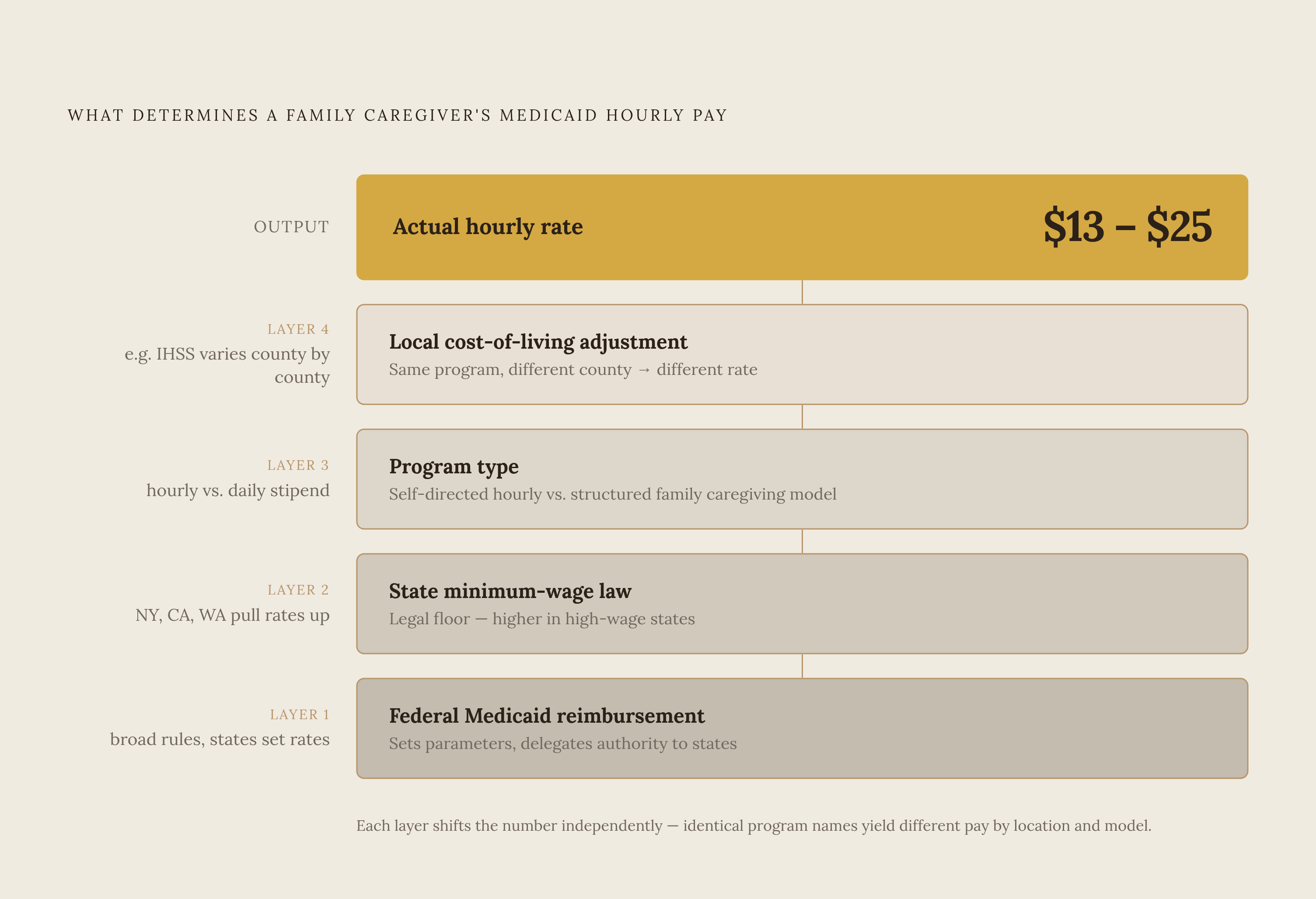
A caregiver's hourly rate is the output of at least four layers stacked on top of each other, and each one can push the number up or down independently of the others. The first layer is federal Medicaid reimbursement rules, which set broad parameters but hand the actual rate-setting authority to the states. States deliver paid family caregiving through two main channels, State Plan authorities and HCBS waivers, and the authority a state chooses shapes what kind of rate structure is even permitted.
The second layer is state minimum-wage law, which sets the floor below which no Medicaid rate can legally fall. In states with high minimum wages, that floor often pulls the actual rate up well past the legal minimum. As of January 1, 2026, New York City and the Long Island/Westchester region, California (both through county-level IHSS rates and city minimum wage ordinances), and Washington state all set minimum wages for home care workers that cluster near the top of the national range, though the exact effective dates and which workers they cover vary by jurisdiction.
The third layer is program type. Self-directed hourly programs pay by the hour worked, the way a traditional job does, while structured family caregiving programs, often abbreviated SFC, pay a daily stipend regardless of the exact hours logged. These are different payment logics entirely, not variations on the same one. Georgia and Indiana are among the states using an SFC model, and Missouri runs both systems side by side, offering a Consumer Directed Services hourly track alongside a separate SFC daily stipend option.
The fourth layer is local cost-of-living adjustment. Others adjust by geography. California's IHSS program is administered at the county level, so a caregiver working in the Bay Area is paid at a different rate than one working in a rural county, even though both are enrolled in the same statewide program. Each of these four layers interacts with the ones below it. The same program name can produce different take-home pay depending on where, and under what structure, the caregiving happens.
The structural opacity built into this four-layer system doesn't just make the hourly figure hard to predict. It makes it hard for a caregiver to know whether they qualify for payment. Brevy Care addresses that specific gap by checking eligibility for Medicaid caregiver payment programs state by state, cutting through the inconsistency in how programs report and structure their rates to show a caregiver what they actually qualify for.
The national rate range and median
With the four-layer structure in view, the $13 to $25 per hour range stops looking like noise and starts looking like the product of real, identifiable forces pulling in different directions. This is a genuine span across states, not a margin of error caused by sloppy data collection, and where a given state lands within it depends on which of the four layers is dominant there. A state with a high minimum wage and a locally adjusted rate structure, for instance, will tend to be near the top. A state with a low minimum wage, a flat statewide rate, and a stipend-based program will tend to be near the bottom.
The median obscures a fairly pronounced regional split. A higher-paying tier, made up of states like Washington, California, New York, Massachusetts, and Colorado, generally is in the upper portion of the national range. Below that sits a larger mid-range tier where rates cluster closer to the middle of the distribution. What matters for a caregiver trying to orient themselves is recognizing that the tails of this distribution, the handful of states paying close to $25 and the handful paying closer to $13, are where the real variation lives, and that variation is explainable once the underlying mechanics are understood rather than treated as a black box.
State-by-state rates, from highest to lowest
The states at the top and bottom of the pay scale aren't scattered at random. They reflect the same interaction of minimum-wage law, state reimbursement generosity, and program design discussed above, just expressed through specific, named examples.
New York's CDPAP program sits among the highest-paying programs in the country, and it gets a full section of its own later in this piece because it's also one of the most administratively troubled, which makes it a useful case study in the limits of a high posted rate. Washington state belongs in this tier as well: its state minimum wage for home care workers, effective January 1, 2026, sets an effective pay floor among the highest in the country, independent of what any particular Medicaid waiver says.
In the middle of the distribution sits Illinois, whose Home Services Program pays in the mid-range under a consumer-directed model. Spouses are not eligible to be paid Personal Assistants under HSP, a restriction set out in 89 Ill. Admin. Code 684.30; spouse eligibility exists only under the separate Community Care Program as of April 2026, which is a distinction that trips up a fair number of applicants who assume the two programs work the same way.
Stipend-model states form a distinct category separate from the hourly-rate states above, because comparing a daily stipend to an hourly wage isn't a like-for-like comparison. Indiana runs both the Health and Wellness Waiver, for people age 59 and under, and the PathWays for Aging Waiver, for those 60 and older, which replaced the former A&D Waiver on July 1, 2024. A comprehensive state-by-state table covering rates beyond these examples is available for readers who want to look up a state not named here, but the mechanism behind the numbers is the same one described throughout this piece.
New York's CDPAP: what happens when a high rate meets administrative failure
CDPAP is simultaneously one of the highest-paying Medicaid family caregiver programs in the country and one of the most administratively troubled, and that combination makes it the clearest illustration of a point this piece has been building toward: a high rate on paper is not the same thing as a reliable paycheck. In 2026, CDPAP base wages vary by region, highest in New York City, somewhat lower in Nassau, Suffolk, and Westchester counties, and lower still elsewhere in the state, with all personal assistants receiving a modest wage increase effective January 1, 2026.
The trouble started with a structural change. In April 2025, New York consolidated the program from roughly 600 fiscal intermediaries down to a single contractor, Public Partnerships LLC, known as PPL. A federal judge has preliminarily approved a $162 million class action settlement covering a large class of home care workers over alleged payroll and benefits violations tied to this transition. In June 2026, the U.S. Department of Justice went further, filing a lawsuit in federal court against PPL, the New York State Department of Health, and two of its officials, Commissioner Dr. James McDonald and Medicaid Director Amir Bassiri, alleging fraud and misrepresentation in how PPL was selected as the state's single fiscal intermediary.
What the CDPAP case demonstrates is that pay-rate policy, administrative structure, and wage enforcement aren't separate questions that can be evaluated in isolation. They collapse into a single practical outcome: whether the caregiver actually receives a paycheck, on time, for the correct amount. Any state's high posted rate is only as reliable as the payment infrastructure standing behind it, a lesson that applies well beyond New York, and that infrastructure deserves at least as much scrutiny from a prospective caregiver as the hourly figure itself.
Medicaid family caregivers paid below workforce-competitive levels
Among states that reported time-based payment rates for personal care providers, more than half pay below levels competitive with the broader professional home care labor market, where posted in-home caregiver positions average roughly $22 an hour nationally. That's true even in states that have the data available to make the comparison themselves, which suggests the gap isn't a failure of information so much as a failure of funding.
That funding constraint deserves to be taken seriously rather than waved away. This is the strongest argument against treating every low rate as a simple policy failure, because it isn't one.
But the downstream consequences of those low rates are measurable and significant. Low pay produces a workforce shortage, a workforce shortage produces a waiting list, and a waiting list means families end up providing the care themselves, unpaid, while they wait. The transparency gap compounds all of this. Without mandatory public reporting, advocates and policymakers can't build a data-backed case for raising rates, because the baseline numbers don't exist in comparable form across states. That circularity, no data, no case for change, no change, no new data, is what the July 2026 CMS rule is designed to interrupt.
The unpaid caregiving economy that sits beneath the paid system
Every figure discussed so far describes a formal, paid system that is, in truth, a relatively small layer sitting on top of a much larger informal economy of unpaid family care. Roughly one in four Americans serves as a family caregiver, tens of millions of people, spending a substantial share of their week helping a loved one, according to AARP and the National Alliance for Caregiving's Caregiving in the US report. The overwhelming majority of them receive no compensation.
For a caregiver reading this piece while weighing whether to pursue a paid Medicaid program, that context matters directly. The financial toll of unpaid caregiving, lost wages, reduced retirement contributions, reduced future Social Security benefits, accumulates quietly over years and is easy to underestimate in the moment. The case for pursuing payment is that the unpaid default is worse, and understanding the layered system described earlier is what allows a caregiver to find whatever paid option their state actually offers.
Finding your state's pay rate and enrollment process
Knowing the national range is only a starting point. Getting paid requires identifying the specific program, rate, and eligibility rule that applies in one particular state, and those details are rarely gathered in one place. Starting July 1, 2026, CMS's Access Rule disclosure requirements will require every state to post fee-for-service hourly rates for personal care, home health aide, homemaker, and habilitation services, which should make state Medicaid websites a meaningfully more reliable resource than they've been up to that point.
Before applying to any program, a few questions need answers. Does the person receiving care qualify for Medicaid? And who conducts the needs assessment that sets the number of approved paid hours, since that assessment, not the posted rate alone, often determines how much a caregiver ultimately earns?
The enrollment process itself, eligibility screening, waiver applications, needs assessments, fiscal intermediary selection, and ongoing compliance, is where most families miss benefits they already qualify for. Getting help navigating that complexity can make the difference in whether a family receives benefits it already qualifies for. Understanding which layer applies in a given state, federal rules, state minimum wage, program type, and local adjustment, requires knowing not just the system in the abstract but a family's own eligibility within it. The national range of $13 to $25 an hour was never going to answer the question a caregiver actually has. Finding the real number means working through the layers this piece has laid out, state by state, program by program, until the figure that applies to one specific caregiving arrangement comes into focus.