Low Income Home Energy Assistance Program for Caregiving Households
Federal program prioritizes energy assistance for households juggling childcare and elder care.
LIHEAP, the federal Low Income Home Energy Assistance Program, is built around a population that rarely gets named directly in energy policy: households caring for an elderly parent, a disabled family member, or a young child, often all at once.
Why caregiving households face disproportionate energy insecurity
Caregiving does two things to a household's energy situation at once, and both push in the same direction. The 2025 edition of Caregiving in the US, released by AARP and the National Alliance for Caregiving, finds that tens of millions of Americans are now caregivers, a figure that has grown sharply since 2015. A meaningful share of them belong to the so-called sandwich generation, raising children under 18 while also caring for an aging adult. A single household can contain every demographic category that drives up energy need: a senior, a child, sometimes a person with a disability, under one roof and one utility account.
This is not a household that can simply turn the thermostat down when the bill spikes. Research using 2021 to 2023 Behavioral Risk Factor Surveillance System data finds that disabled ADRD caregivers report elevated rates of housing, food, and job insecurity, and they disproportionately rely on public assistance programs. Energy insecurity in these households is one symptom in a pattern of compounded hardship that runs across housing, food, and employment simultaneously, so a program addressing it needs to be built with caregiving specifically in mind.
LIHEAP's Federal Design and Caregiving Households
Federal statute requires every state administering LIHEAP to give priority, when funds are limited, to households with elderly members, people with disabilities, and young children. The populations named in that statute are the same ones that define a caregiving household. It's the organizing logic of the program.
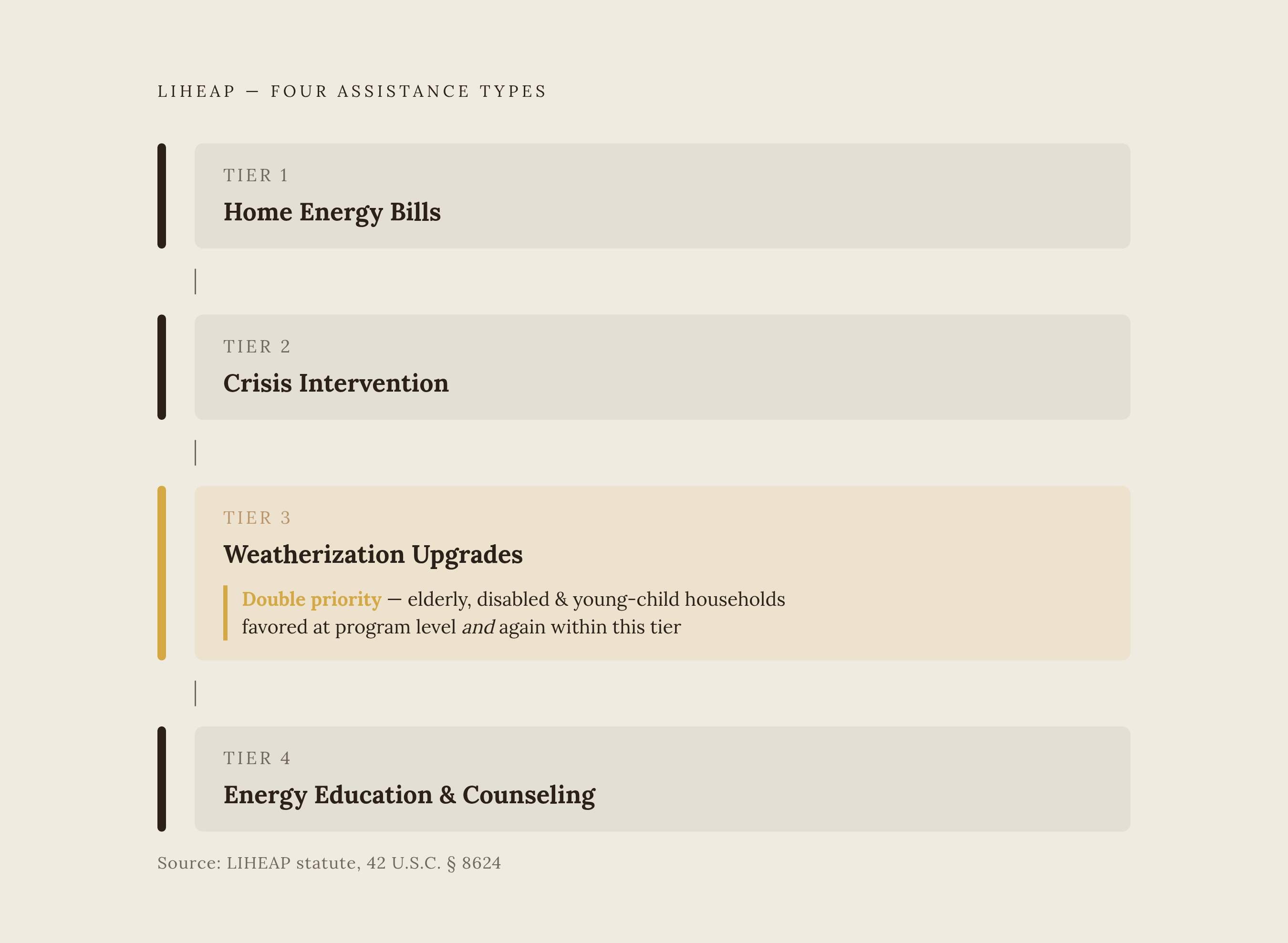
The composition of actual LIHEAP recipients confirms the design works as intended: a large majority of households served include at least one senior citizen, one person with a disability, or one child under six, the three markers that most often signal a caregiving arrangement is underway in that home. The program backs this priority structure with four distinct types of assistance: home energy bill help for ongoing costs, energy crisis intervention for disconnect notices or imminent shutoffs, weatherization upgrades to reduce future need, and energy education and counseling. California's version of the program shows the menu in practice: the Home Energy Assistance Program (HEAP) for balancing utility bills, the Energy Crisis Intervention Program (ECIP) for disconnect-notice emergencies, LIHEAP Weatherization for free efficiency upgrades, and ongoing education on energy efficiency practices. Weatherization adds its own second layer of priority on top of the general benefit structure, favoring households with elderly or disabled members and those with young children, so the caregiving population gets prioritized twice over inside the same program.
What LIHEAP actually provides and how benefit amounts work across states
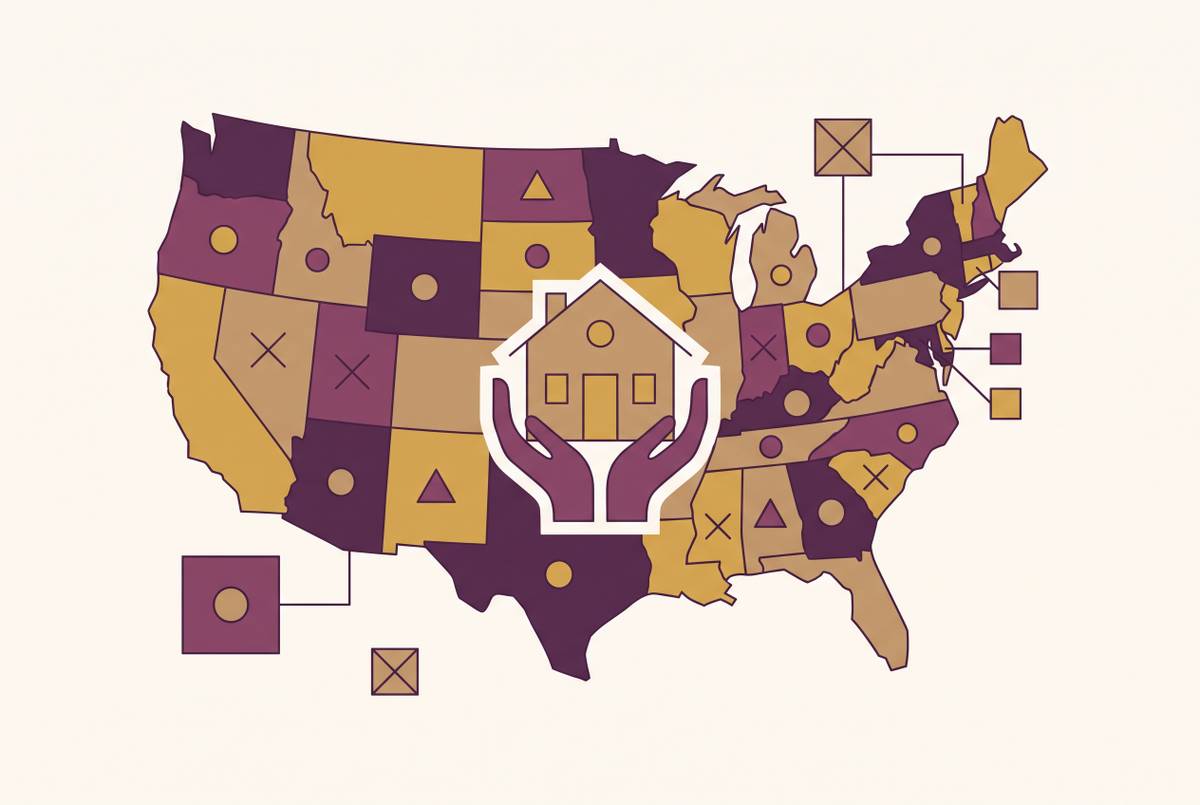
LIHEAP is administered by states, and the form, amount, and delivery of benefits differ from one state to the next, but the underlying structure is consistent enough that a caregiving household in nearly any state can predict what to expect. In Pennsylvania, these grants range from $200 to $1,000 depending on household size, income, and fuel type, paid directly to the utility provider or fuel company, and the money does not have to be repaid. In New Jersey, the heating benefit amount for FFY 2026 is set by income, household size, fuel type, and heating region, and the state also offers medically necessary cooling assistance as a flat $300 credit applied to an active electric account, or issued as a one-party check to the eligible applicant.
New Jersey links the cooling benefit explicitly to health need, and health need in these households usually traces back to an elderly or disabled family member whose body cannot regulate temperature safely on its own. Crisis grants sit alongside the regular benefit when a household faces an acute emergency. Pennsylvania's crisis program covers broken heating equipment, lack of fuel, shutoff of a main or secondary heating source, a fuel supply under 15 days, or imminent utility termination, with eligible applicants receiving benefits within 10 business days, sooner if the situation is life-threatening. One form, two benefit streams.
None of this should be mistaken for a complete solution to a household's energy costs. Access to that layer comes down to eligibility.
Income Thresholds and Eligibility Rules That Work in Caregivers' Favor
States can set LIHEAP income thresholds as high as 60% of State Median Income, the federal maximum, but most states instead use 150% of the Federal Poverty Guidelines or a threshold somewhere between 110% and 150% FPL. A caregiver can work part-time, log substantial hours of unpaid care, and still fall below 60% of State Median Income, while thinking of the household as middle-class. That assumption, more than the actual rule, is often what keeps eligible caregivers from applying.
The 2026 numbers make the range concrete. In New Jersey, the FFY 2026 standard is 60% SMI, with monthly income limits running from $4,167 for a household of one to $12,021 for a household of 12, adding $241 per additional member. Pennsylvania's 2026 to 2027 limits, effective February 1, 2026, run from $23,940 annually for a household of one to $100,620 for a household of ten, adding $8,520 per additional person. California's 2026 limits run from $3,331.66 monthly for a household of one to $9,226.25 for a household of ten, adding $192.21 per additional person.
Several rules reduce the friction further. You might expect a rule this favorable to be common knowledge among the households it's built for. It isn't: nearly one in three low-income households earning under $25,000 have never heard of LIHEAP. The eligibility rules are not the obstacle here. Awareness is the obstacle, which makes the whole program an application problem.
Priority Status, Earlier Access, and Less Competition for Funds
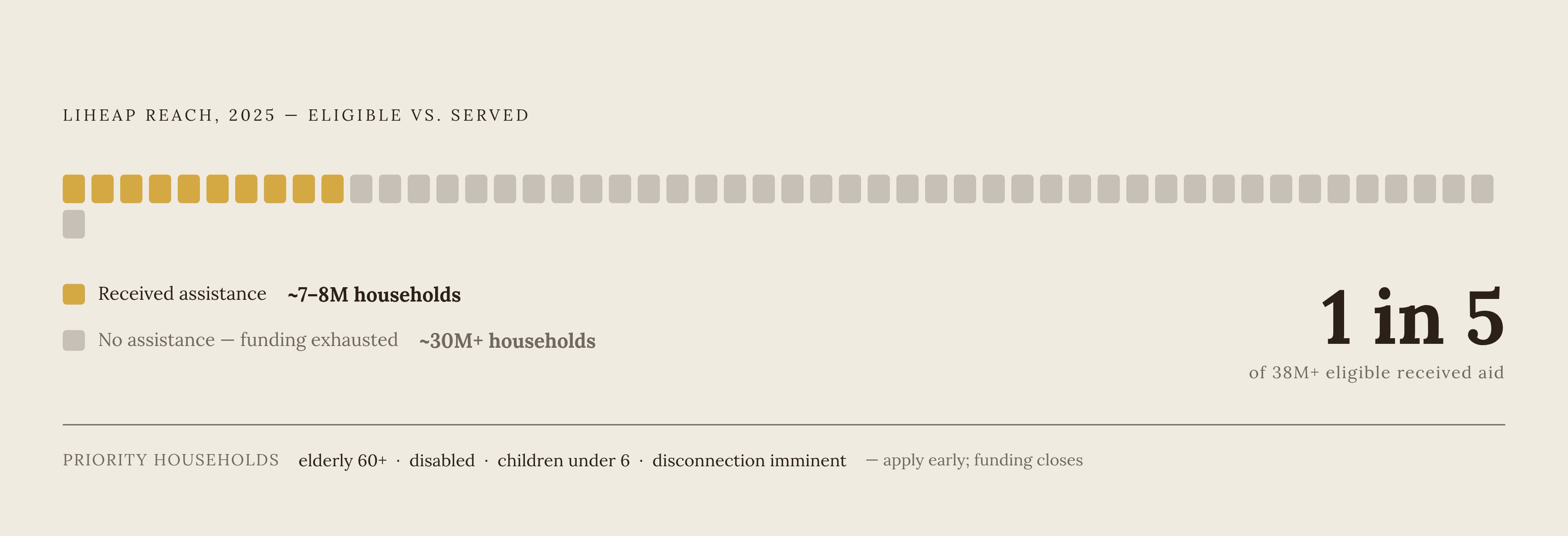
LIHEAP runs on a first-come, first-served basis, and funds routinely run out before every eligible household gets served. When a program's total funding is fixed and finite, getting in line early is what lets a household receive anything at all, turning priority status from a symbolic gesture into a material financial advantage. More than 38 million households qualified for LIHEAP in 2025, but funding ran short, so only about one in five of them actually got assistance. Priority access moves a household to the front of that line before the money is gone.
Champaign County, Illinois, offers a clear example of how this plays out on the ground. The Regional Planning Commission there opened applications for priority group households, meaning older adults 60 and up, individuals with a disability, families with children under six, and households already disconnected or at imminent risk, on October 1, 2025, in person only. If you apply a month earlier, in that case, you get more than faster processing. You lock in a benefit before the fuel cost rises, so the same grant buys more.
States also strip away the practical barriers that keep elderly and disabled applicants from using their priority status. New Jersey's FFY 2026 fact sheet allows applicants aged 60 or over, or who are disabled, to receive and return applications by mail, or to request a home visit from the local agency, removing the transportation and mobility hurdles that otherwise keep a caregiving household from making it to an in-person appointment. Pennsylvania also runs a fast-track for crisis situations, so if a household faces a life-threatening heating emergency, it gets benefits faster than the standard 10-business-day window for regular crisis grants.
The Current Funding Threat for Caregiving Households
LIHEAP is fully funded and operating for the current season. The Administration for Children and Families confirmed that the full FY2026 federal outlay, approximately $4.13 billion, was disbursed to all states in two releases: $3,713,859,933 on November 28, 2025, and a final release of $421,540,067 between April 17 and 20, 2026. Caregiving households that apply this season are applying into a program that is funded and is actively distributing money.
The picture past this season is less settled. The White House's FY2027 budget request, submitted in April 2026, proposes eliminating LIHEAP funding entirely, a cut of roughly $4 billion, and that would end the only federal program built specifically to help low-income families pay heating and cooling bills. In June 2026, the House Appropriations Subcommittee on Labor-HHS advanced a FY2027 draft that would raise LIHEAP funding by $10 million rather than cut it, and House Appropriations Committee Chair Tom Cole of Oklahoma has said publicly that he opposes eliminating the program. The National Consumer Law Center and the National Energy Assistance Directors Association, in a joint statement, warned that "the elimination of federal staff threatens the stability of this popular, essential program in the coming fiscal years," pointing to a separate problem: the program is already running without dedicated federal administrative staff, even as its funding question remains unresolved.
The disruption this uncertainty causes is not hypothetical. A federal government shutdown pushed Pennsylvania to delay the opening of its 2025 to 2026 LIHEAP season by a full month, to December 3, 2025, because the state's Department of Human Services had not yet received its federal allocation; the season had originally been scheduled to open November 3, 2025. In Kentucky, officials are weighing whether the state should step in if it loses more than $50 million in funding that now supports an estimated 150,000 households. None of this changes what a caregiving household should do today. It does mean that applying during an open, funded season is not a step worth delaying.
How to Apply for LIHEAP as a Caregiving Household
LIHEAP is funded federally, but a state or county agency runs it, so start there, not at a federal website. Each state runs its own season and timeline. Pennsylvania's 2026 to 2027 season is scheduled to open November 2, 2026, with applications track-able at trackmybenefits.pa.gov; the prior 2025 to 2026 season ran from December 3, 2025 to May 8, 2026. New Jersey's FFY 2026 application period runs October 1, 2025 to June 30, 2026, first-come first-served, with applications available online at www.energyassistance.nj.gov or by phone at 1-800-510-3102, and mail or home-visit options available to applicants aged 60 or older or living with a disability. In Champaign County, Illinois, priority group applicants could begin scheduling in-person appointments on September 17, 2025, at locations in Champaign and at the Community Service Center of Northern Champaign County in Rantoul, reachable at 217-384-1226, with general applicants able to schedule starting November 1, 2025, by phone, in person, or online.
Most states ask for a similar set of documents regardless of which agency processes the application: proof of gross income for every household member covering the 30 days before the application date, Social Security numbers for household members (applicants without an SSN or ITIN can still apply in some jurisdictions), current heat and electric bills issued within the last 30 days, and, for renters whose heating costs are folded into rent, a copy of the lease or rental agreement. If you're already enrolled in SNAP, SSI, or TANF, say so when you apply, because automatic eligibility pathways in most states let you skip separate income documentation. Pennsylvania's crisis pathway, for instance, covers broken heating equipment, lack of fuel, shutoff of a main or secondary heating source, a fuel supply under 15 days, or imminent utility termination.
LIHEAP as one component of a broader benefits strategy for caregiving households
LIHEAP stands out as one of the more accessible federal benefits available to caregiving households, but its real value comes from pairing it with the other programs these households are disproportionately eligible for and disproportionately likely to overlook: Medicaid, SNAP, caregiver compensation programs, and state-level utility supplements. The interaction between programs is sometimes built directly into the paperwork. In New Jersey, filing for LIHEAP also files for the Universal Service Fund, and if you're enrolled in SNAP or SSI, that typically triggers automatic LIHEAP eligibility, so connecting to one program often takes you most of the way into the next. California lists several programs meant to run alongside LIHEAP rather than instead of it: the California Alternate Rates for Energy (CARE) program, offering a discount on utility bills; the Family Electric Rate Assistance Program (FERA), offering an electricity discount for households that slightly exceed CARE's income limits; and the Energy Savings Assistance Program (ESA), which provides no-cost weatherization including attic insulation, energy-efficient furnaces, weatherstripping, and repairs to doors and the building envelope.
The scale of unmet need points to a navigation gap among households that already qualify. Caregiving households sit at the center of that gap, since the same financial compression that makes energy assistance necessary, reduced work hours, unpaid care responsibilities, strained savings, also makes them strong candidates for Medicaid waivers, paid family caregiver programs, and SNAP, programs they are statistically likely to qualify for and statistically likely to never apply to. What separates a caregiving household that captures these benefits from one that doesn't is awareness of what exists and timing: applying during an open season before funds run out, the two things a household can actually control.
Sources
- LOW INCOME HOME ENERGY ASSISTANCE PROGRAM UNIVERSAL SERVICE FUND
- Low-Income Home Energy Assistance Program (LIHEAP)
- LIHEAP Income Eligibility
- Apply for the Low Income Home Energy Assistance Program (LIHEAP)
- Low Income Home Energy Assistance Program
- Expanded Eligibility Highlights New LIHEAP Program Year, with Appointments for Champaign County Residents Beginning October 1
- President’s FY 2026 Budget Eliminates Federal Funding For LIHEAP