Retroactive Enrollment in Medicaid Caregiver Payment Programs
Families must navigate two separate legal tracks to recover caregiver pay through Medicaid.

Retroactive enrollment in Medicaid caregiver payment programs runs on two separate legal tracks, and most families arrive at the subject having heard only the phrase "retroactive pay" without knowing it splits in two. Confusing the two leads families to assume that once a parent or spouse qualifies for Medicaid, the person who has been feeding, bathing, and managing their medications for months will automatically get paid for that time. That assumption is wrong, and it costs real money.
Track 1 is retroactive medical coverage for the care recipient, built on Section 1902(a)(34) of the Medicaid Act. Federal law has historically required states to cover eligible medical bills incurred up to three calendar months before the month of application, as long as the applicant would have qualified at the time the care was given. An application submitted in May 2026 reaches back to February, March, and April 2026, the three full calendar months preceding May, not simply the ninety days before the paperwork was signed. That distinction determines which bills get paid and which don't.
Track 2 is back pay to the caregiver. The sequence only runs in one direction: Track 2 cannot be activated until Track 1 is settled. If families grasp this order of operations, they avoid the single most common misunderstanding that derails caregiver compensation claims before they start.
Track 1: Retroactive Medical Coverage
Retroactive Medicaid coverage for care recipients offers genuine protection, but it is conditional in a way that narrows most families' actual exposure well below the full three-month window. A family that assumes the full window applies to them, without checking whether the recipient actually met every test during each of those months, is likely to overestimate what they can recover.
Three conditions have to be true simultaneously for any given prior month to count. Retroactive coverage reimburses the facility at the state Medicaid rate, while the resident's own income, Social Security or a pension, still counts toward the share of cost; Medicaid fills only the gap above that contribution.
Consider a person who enters a nursing home in March 2026 and whose family files the Medicaid application in May 2026. If the family was still spending down assets in February and only crossed the eligibility threshold in March, February gets nothing. This is why the retroactive window delivers the most value to families who spent down quickly and qualified early but simply filed the paperwork late. A family still mid-spend-down when the application goes in has little or nothing to recover from the retroactive period, because they were not eligible during those earlier months.
Retroactive eligibility applies to Regular State Plan Medicaid, and in some states extends to HCBS Medicaid Waiver programs as well, though that extension is neither universal nor guaranteed. Families generally do not file a separate retroactive application. Instead, during the standard Medicaid application process, they indicate that services were received in prior months, and the state works through eligibility month by month within the window, paying only for the months where every condition lines up.
How Track 2 works: conditions for caregiver back pay
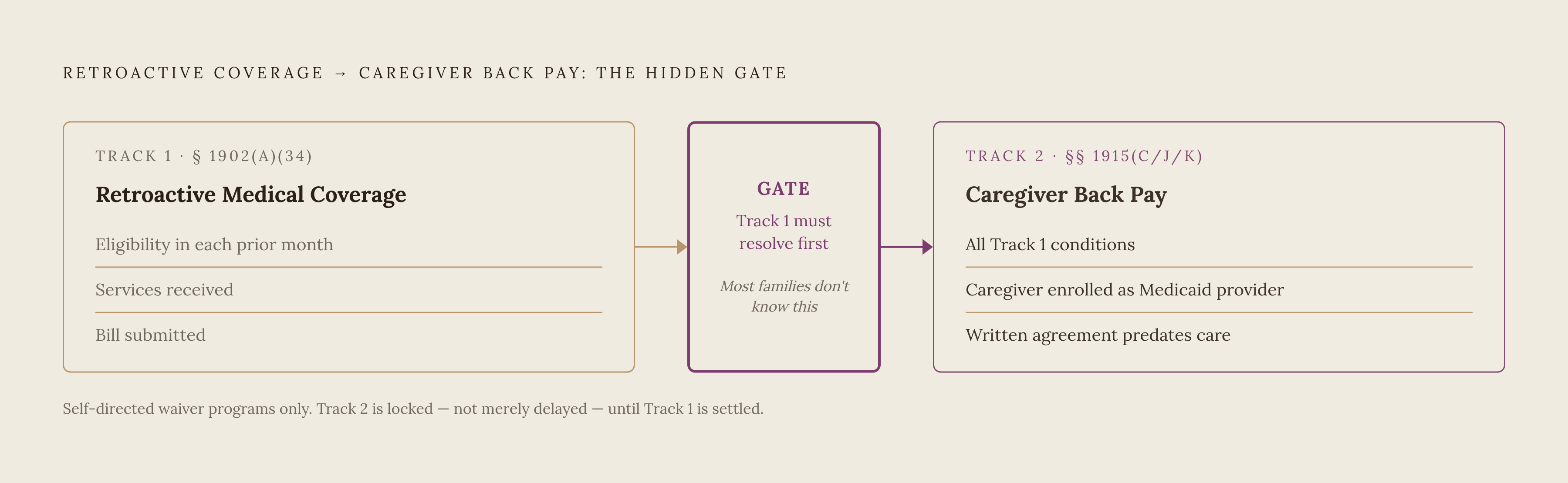
Caregiver back pay through Medicaid self-directed programs is legally available, but it demands far more than the recipient's eligibility alone. Three things need to be in place at once: the care recipient's retroactive eligibility under Track 1, the caregiver's own enrollment as a Medicaid provider or through a fiscal-employer agent, and a written agreement, executed before the care was given, that distinguishes paid employment from ordinary family obligation.
The federal authorities that make this possible are the Medicaid self-directed care programs under sections 1915(c), 1915(j), and 1915(k), which let recipients hire, train, manage, and dismiss their own caregivers, including family members, though doing so rarely goes smoothly in practice.
The documentation bar sits high because Medicaid caseworkers treat care delivered without a prior written contract as "love and affection", an unpaid family duty. The agreement needs to predate the services, not describe them after the fact. That timing requirement is the practical reason otherwise-qualifying families lose back pay they would have otherwise been entitled to: the care happened and the hours were worked, but the paper trail wasn't there when the caseworker needed to see it.
Who can be paid varies by state. Massachusetts's MassHealth Personal Care Attendant program allows friends, neighbors, and certain family members, including adult children, but excludes current spouses, legal guardians, and surrogates.
Pennsylvania's 2025 State Plan Amendment, SPA TN 25-0015, effective April 1, 2025, shows how granular the administrative rules can get.
The caregiver's own enrollment status has nothing to do with the recipient's eligibility. Services like Brevy combine AI-powered eligibility screening with live enrollment specialists, and they are built to identify which retroactive programs a given family actually qualifies for before that confusion turns into a denied claim. For anyone currently providing care without a Medicaid application yet filed, the documentation work starts now: a signed agreement, dated before the care begins, is the single highest-leverage step available before the paperwork even reaches a caseworker's desk.
How system delays consume the retroactive window
The three-month retroactive window was designed to bridge the gap between a medical crisis and a completed Medicaid application. In practice, that gap often swallows nearly the entire window, leaving families exposed for close to the exact stretch of time the rule was written to protect.
The events that trigger a Medicaid application, a sudden health decline, an unplanned nursing home placement, rarely happen on a schedule. By the time a family files, weeks or months of the retroactive window may have already passed simply in the course of responding to the emergency.
A separate structural hazard compounds this for HCBS waiver programs. Unlike state plan Medicaid, HCBS waivers are not entitlement programs. They carry enrollment caps and waiting lists, and a family cannot access retroactive caregiver billing through a waiver until an actual slot opens. By September 2026, the Family Supports Waiver alone had 11,455 people on that list. For every one of those families, care provided during the wait falls entirely outside any retroactive compensation framework, because waiver enrollment, and the retroactive billing right that comes with it, begins only once a slot becomes available.
The practical effect shifts the cost of care onto unpaid family caregivers, a group that skews disproportionately female, until caregiver burnout eventually forces institutionalization, an outcome that costs Medicaid more than paying the family caregiver would have cost up front.
How the retroactive window varies by state
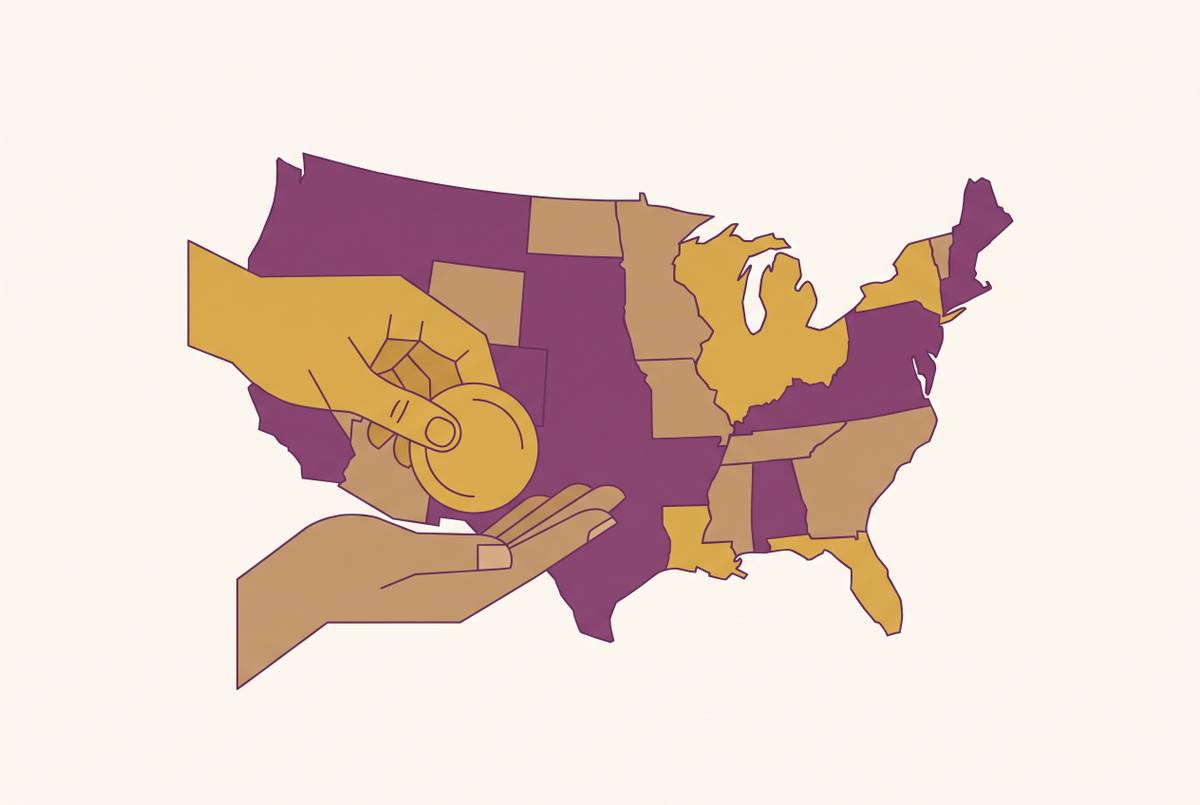
Most states still provide the full three-month retroactive look-back in 2026 under the federal default established by Section 1902(a)(34), including California, New York, Illinois, Texas, Pennsylvania, Ohio, Michigan, Washington, Colorado, New Jersey, and Minnesota. Roughly a dozen states, however, have eliminated or sharply restricted the window for at least some populations, and the restrictions almost never fall evenly across every eligibility category.
Arizona's AHCCCS program has eliminated retroactive coverage for most adults, though pregnant women, postpartum women, and children under 19 keep it, and long-term care applicants in Arizona get no special exception under the state's Section 1115 waiver. Delaware eliminated the window for most adults under its prior DSHP waiver, but effective January 1, 2025, retroactive coverage was restored for all eligible DSHP and DSHP-Plus members under the renewed waiver. Florida eliminated retroactive coverage for adults generally, while pregnant women and children under 21 retain it through state policy and waiver authority; the Statewide Managed Care Long-Term Care waiver's Participant Direction Option, which permits paid spousal caregivers, is a separate program from the state's medical coverage eligibility rules, and the two do not contradict each other.
Georgia eliminated retroactive coverage specifically for its Pathways to Coverage demonstration enrollees, while aged, blind, disabled, and all other standard Medicaid categories retain the full three-month window under the regular state plan. Hawaii's Med-QUEST program runs a 10-day window for most enrollees, but long-term care applicants retain the full three months under the same waiver authority. Indiana's HIP program eliminated the window for expansion adults but kept it for pregnant women; children, seniors, and people with disabilities fall outside HIP entirely, so they get coverage through separate Indiana Medicaid state plan programs instead. New Hampshire's attempt to eliminate the window for expansion adults was vacated by a federal court in 2019 and the waiver authority expired December 31, 2023, so the state currently must provide the standard three-month period. Utah eliminated the window only for adults enrolled in its ESI/COBRA premium subsidy demonstration population, leaving most other adult groups and children under 19 with the full three months.
Massachusetts shows this most clearly: the state has cycled through different policies over nearly three decades. As of August 18, 2025, every MassHealth benefit-eligible applicant receives the three-month retroactive period, with the exception of Health Safety Net, Children's Medical Security Plan, Qualified Medicare Beneficiaries, and Health Connector programs.
A pattern holds across nearly every restrictive state: pregnant women, children, and long-term care or nursing home applicants almost always keep the three-month protection even when working-age expansion adults lose it. But studies that examined that claim found no evidence that tighter retroactive rules actually lead to earlier applications.
One Big Beautiful Bill Act Changes, January 1, 2027
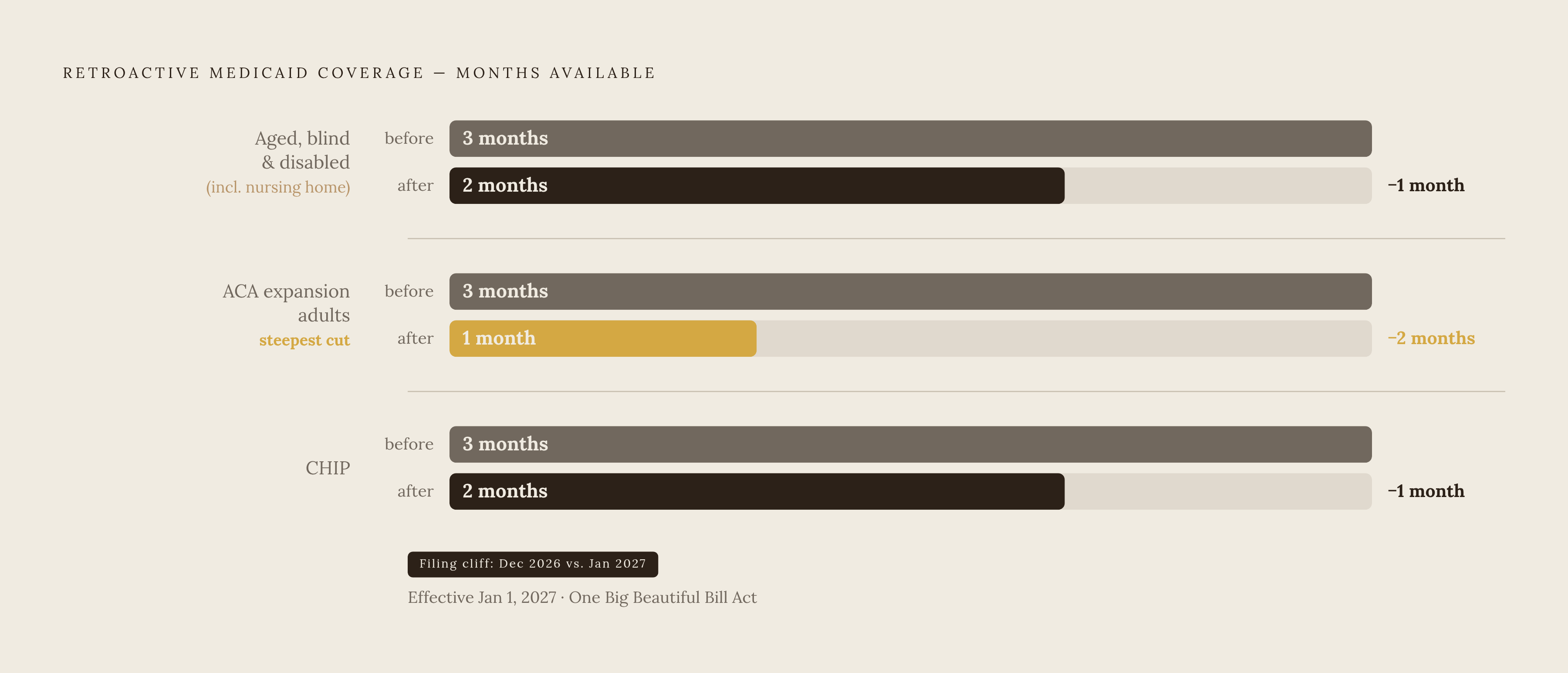
Medicaid has offered up to three months of retroactive coverage since 1972, a cushion lawmakers built specifically to protect people who could not file an application the same month they got sick or hurt. 1, signed July 4, 2025, shortens that federal window beginning January 1, 2027, the first reduction to the standard in more than five decades, and it creates a hard filing cliff where the calendar year of an application changes what a family can recover.
The reduction does not land evenly. Aged, blind, and disabled applicants, the pathway that covers nursing home residents and most long-term care HCBS users, move from three months of retroactive coverage down to two. Adults covered under the ACA Medicaid expansion, the working-age, income-based group, see a steeper cut, from three months down to just one. CHIP follows the same reduction applied to traditional enrollees.
The mechanics are exact. The date on the application, not the date the care began, decides which rule governs.
The dollar consequence of that lost month depends heavily on where a family lives. The policy itself is uniform nationwide; its financial weight is not.
This change does not arrive on its own. The OBBBA also moves eligibility redeterminations for expansion adults from annual to six-month cycles, starting with redeterminations due December 31, 2026, and introduces new work requirements for non-disabled, non-pregnant adults ages 19 to 64 effective January 1, 2027. Together these provisions tighten coverage stability for working-age caregivers who are themselves Medicaid-eligible, compounding the effect of a shorter retroactive window with more frequent eligibility checks and new conditions to maintain coverage.
Where caregiver payment terms remain contested
Qualifying for retroactive enrollment does not settle the question of who actually gets paid, for how many hours, or under what conditions. Those terms remain live legal and administrative battlegrounds in several states, even where the retroactive framework itself is functioning as designed.
Pennsylvania's 2026 litigation shows how this plays out. The resulting lawsuit, filed in September 2026, demonstrates that retroactive enrollment being technically available does not mean the compensation terms attached to it are settled or uncontested.
Several structural restrictions recur across states. Caregivers generally need to meet training or certification requirements before they can enroll as providers at all, and retroactive billing depends on that enrollment having already been in place during the period being claimed.
The "love and affection" problem threads through all of this. Without a prior written caregiver agreement, a Medicaid caseworker has standing to treat past care as an unpaid family obligation rather than paid employment, and documentation that wasn't created at the time the care happened is difficult to reconstruct convincingly after the fact. End-to-end Medicaid self-direction enrollment support, of the kind Brevy provides, is built around guiding families through exactly these layered documentation requirements, so a caregiver can establish eligibility for retroactive compensation without working through the bureaucracy unassisted. The strongest claims are the ones built prospectively, agreement signed, hours logged, enrollment filed, before any application reaches a caseworker's desk.
What families should do before December 31, 2026
Families already providing care, who have not yet filed a Medicaid application, are working against a window that narrows every week they wait. Filing before year-end 2026 preserves the three-month retroactive look-back for traditional enrollees under the rule as it stands today; filing in January 2027 or later means operating under the reduced window the OBBBA puts in place.
The fourth step is filing the Medicaid application as early as possible. Applications filed in December 2026 still fall under the current three-month rule.
The fifth step applies specifically to families on HCBS waiver waiting lists. Retroactive caregiver back pay through a waiver program does not begin until a slot opens, and care provided during the wait is not retroactively compensable through that waiver once a slot does become available. Families in this position should look into whether Traditional State Plan Medicaid personal care services offer a parallel pathway that does not require sitting on a waiting list.
Given the number of moving pieces, two eligibility tracks, a state-by-state patchwork, a federal deadline, and documentation rules that punish anything filed after the fact, few families can reasonably expect to navigate all of it correctly on the first attempt without support. Tools built specifically for this kind of layered eligibility screening and enrollment guidance, Brevy included, exist because the system was not designed to be self-explanatory. The families who recover the most are the ones who understand both tracks before they file, have their documentation in order before the application goes in, and act while the current three-month rule still applies.