How Caregiving Years Reduce Social Security Retirement Benefits
Unpaid caregiving creates zeros in Social Security's benefit calculation.

Unpaid caregiving can reduce Social Security retirement benefits because the calculation rewards taxed earnings. When a caregiver has fewer than 35 earning years, zeros enter the average that determines their benefit.
How the SSA's 35-year averaging formula turns caregiving years into zeros
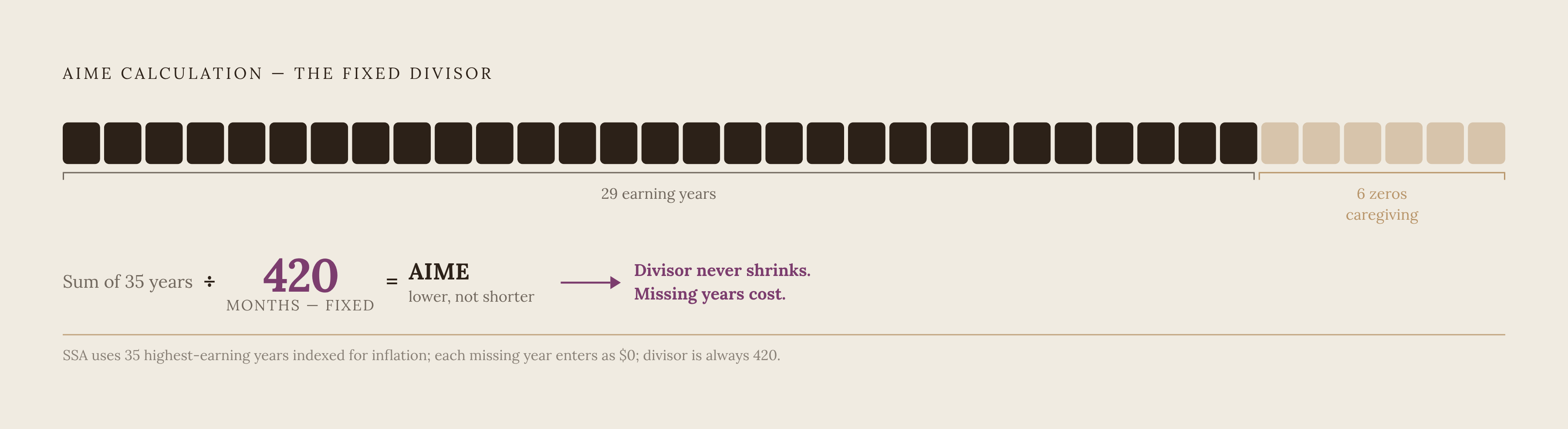
The agency calculates Average Indexed Monthly Earnings, or AIME, by adding a worker’s 35 highest years of indexed earnings and dividing the total by 420 months. First, it indexes earnings across the work history to account for changes in wage levels. It then selects the years that enter the calculation. If the worker has fewer than 35 earning years, each missing year enters as zero. The divisor stays the same even when earnings are missing.
That fixed denominator explains the loss. A worker with unpaid caregiving years does not receive an average based only on the years they worked. Instead, their covered earnings must stretch across the full calculation period. Indexing cannot fill those gaps because zero multiplied by an adjustment factor is still zero. A care-related absence therefore reduces AIME whenever it leaves an unfilled place among the 35 years.
Section 215 of the Social Security Act bases the calculation on wages paid and self-employment income credited to the worker. Unpaid family care brings in neither form of covered earnings, so no Social Security payroll taxes are paid on that work. The formula has no provision for valuing that work.
Why the zero-fill rule hits caregivers harder than other workers who take time off
A work interruption does not always create a zero in the final average. Someone who takes a sabbatical or experiences a brief layoff may still accumulate 35 strong earning years. In that case, years without earnings fall outside the selected record. Caregivers often lack that buffer when they leave mid-career. Their vulnerability depends on both the length of the absence and which earning years it displaces.
The average caregiver leaves the workforce for approximately six years. Those absences also cluster in mid-career, with the average caregiver aged 51, in a peak-earning decade for many workers. Losing that period can remove years that would otherwise have ranked among the most valuable inputs to AIME. Even when earlier earnings keep a zero out of the record, losing years with higher earnings can still bring down the average.
The benefit formula then translates AIME into a primary insurance amount, or PIA, which underlies retirement and certain family benefits. Its progressive bend points replace a greater share of lower earnings than of higher earnings. However, an AIME reduction within the highest-replacement tier also removes more monthly benefit per dollar lost than a reduction within a lower-replacement tier.
The SSA requires at least 40 work credits for retirement benefits, and earnings must reach a threshold to produce the maximum four credits per year. Someone whose reduced earnings fall short may accumulate credits too slowly to qualify. The distinction is important because qualifying for a benefit and determining its size are different calculations.
The scale of the loss and who bears it
Women make up three in five caregivers, so exposure to missing earnings is not evenly distributed. For women who leave employment to care for elderly family members, the resulting loss in lifetime Social Security benefits can be substantial. That loss reflects a smaller recurring payment.
Longevity extends the financial consequences of that smaller payment. Women live longer than men on average, so reduced benefits can persist across more years of retirement and increase the risk of outliving savings. The loss does not end when caregiving ends. Once missing or low-earning years remain in the final benefit calculation, their effect follows the caregiver into retirement.
Still, the gender gap and the caregiving gap are not interchangeable. The mechanism does not establish that every difference between women’s and men’s benefits results from care-related absences. The relevant questions are how many years remain unfilled, how much covered income those years would otherwise have contained, and where the resulting AIME falls within the benefit formula.
The ripple effects — spousal benefits, survivor benefits, and the limits of existing protections
A reduced PIA can affect more than the caregiver’s own check. A spousal benefit can reach up to 50% of the higher earner’s PIA, so care-related reductions in that earner’s record also lower the maximum available to a spouse. Survivor benefits also depend on the earnings record they are based on. A lower benefit can follow a surviving spouse through 15–25 years of widowhood. The household consequence depends on whose record provides the benefit.
Spousal benefits nevertheless offer a meaningful counterweight in some households. A caregiver married to a high earner may receive a spousal benefit that exceeds the retirement benefit supported by their own reduced record. The SSA pays only the higher of the two amounts the caregiver qualifies for. This can cushion the caregiver’s personal earnings loss. It does not put earnings back into their record.
That protection depends on a qualifying relationship and a spouse’s earnings record strong enough to provide an offset. Single caregivers cannot assume access to it, while divorced and widowed caregivers must consider the benefits applicable to their circumstances. A reduced personal PIA remains especially consequential where no larger family benefit compensates for it.
The Social Security Fairness Act offers context for the limits of these protections. The Congressional Research Service describes the law as repealing the Government Pension Offset and the Windfall Elimination Provision. Those changes removed benefit cuts for another group of workers. They did not create earnings credit for unpaid caregiving. Congress can change benefit rules, but relief from one kind of reduction does not resolve the zero-year mechanism.
The one path that earns real credits today — paid caregiving through Medicaid programs
As of June 2026, no federal law grants Social Security credit for unpaid family care. A qualifying paid-care arrangement can change the calculation, however, when it produces earnings subject to Social Security taxes. W-2 wages or documented covered self-employment income can replace a zero in the earnings record. Payment alone is not the decisive feature. The income must receive the treatment that makes it count toward Social Security.
North Carolina’s Medicaid CAP/DA waiver offers a Consumer Direction option through which an enrolled Medicaid member can hire a relative as a paid caregiver. The person receiving care must already be enrolled in CAP/DA. Hiring a spouse requires at least one of five extraordinary circumstances. Taxable caregiving earnings through this channel can build Social Security credits.
Missouri’s Consumer Directed Services program provides another route. Its attendants are W-2 employees, with payroll taxes including Social Security and Medicare withheld from their checks. New York’s Consumer Directed Personal Assistance Program also provides a consumer-directed Medicaid channel for paid care. These examples cover only part of the state inventory. Access depends on the particular program and the circumstances of the person receiving care.
The tax treatment deserves particular attention before enrollment. IRS Notice 2014-7 allows certain Medicaid payments to a caregiver living with the care recipient to be excluded from federal taxable income. An income-tax exclusion should not, by itself, be treated as proof that payments will or will not earn Social Security credits.
Three partial remedies available right now, short of legislative change
For caregivers who cannot get covered paid-care work, the first of three partial remedies is to keep working part-time where possible. Even a small amount of covered earnings can replace a zero, and earning enough for four credits per year adds to the credits needed to qualify. This does not recreate a lost peak-earning year.
The second is protecting retirement savings during caregiving years. Savings outside Social Security can supplement a reduced benefit, although they do not repair AIME. Proposed legislation shows how that complementary approach could develop. The Improving Retirement Security for Family Caregivers Act of 2026 would ease Roth IRA contribution rules, while the Catching Up Family Caregivers Act of 2026 would expand access to employer-plan catch-up contributions for qualifying caregivers.
Rep. Brittany Pettersen, D-CO, and Rep. María Elvira Salazar, R-FL, introduced the measures, with Senate companions from Sens. Collins and Warner. The proposals use a 500-hour caregiving threshold. Neither is an available entitlement under current law. These proposals distinguish retirement-saving strategies from Social Security earnings credits.
The third is to check the Social Security earnings record through the SSA’s online portal. A year wrongly listed as zero adds to the gap left by caregiving, even though the caregiver did paid work that year. Correcting reporting errors addresses a different problem from unpaid care. It restores earnings that should already count, rather than assigning value to work the law does not recognize. None of these measures is a complete substitute for missing covered earnings.
What proposed federal legislation would change — and what it would leave intact
The Social Security Caregiver Credit Act of 2026 would address missing earnings directly by amending Title II of the Social Security Act. It would assign deemed wages for up to five years of qualifying unpaid care. Eligibility would require at least 80 hours per month of care for a dependent child or chronically ill relative.
The proposed wage credit would be approximately half of the national average wage, currently estimated at tens of thousands of dollars annually. Months that qualify would count as earnings even if the caregiver received no wages. The benefit would arrive through a higher monthly retirement payment, or a higher disability or survivor benefit where applicable. It would not be a lump-sum caregiver payment. Its effect would depend on how the credited amounts changed the recipient’s earnings calculation.
The proposals introduced in April 2026 remain at an early legislative stage. Congress.gov lists the Senate measure as referred to the Committee on Finance, while House consideration would involve the Ways and Means Committee. Passage cannot be assumed. The Social Security trust funds are already under pressure, and extending deemed wages to tens of millions of unpaid caregivers raises financing questions that the proposals have not fully resolved.
Even with financing settled, the structural limitation would remain. Five credited years could replace up to five zeros with a mid-level earnings figure, but a longer absence could leave other years unfilled. Caregivers below the 80-hours-per-month threshold would not qualify. The 35-year averaging rule itself would stay intact.
The actionable step is to identify which existing Medicaid programs, state caregiver compensation options, and benefit combinations fit a particular household. Where covered paid-care work is available, signing up can start adding earnings to the record under current rules. Where it is not, the distinction between replacing zeros and cushioning their consequences remains the foundation of a realistic retirement plan.