State Tax Credits for Family Caregivers
Most states offer credits that actually cover caregiving costs where federal tax law falls short.

Roughly 63 million Americans, about 1 in 4 adults, provide unpaid care for a family member, and the average out-of-pocket cost runs $7,200 a year. The federal tax code barely acknowledges any of this. What follows is a state-by-state look at where real relief exists, why it exists at the state level instead of the federal one, and how a caregiver actually goes about claiming it.
What the federal tax code offers caregivers, and where it falls short for most families
Search a federal tax return for the word "caregiver" and it will not appear. No line item, no dedicated schedule, no box to check. What exists instead is a patchwork of five provisions, each built for a different purpose, none of them built specifically for the person driving a parent to dialysis three times a week or covering the cost of a home health aide.
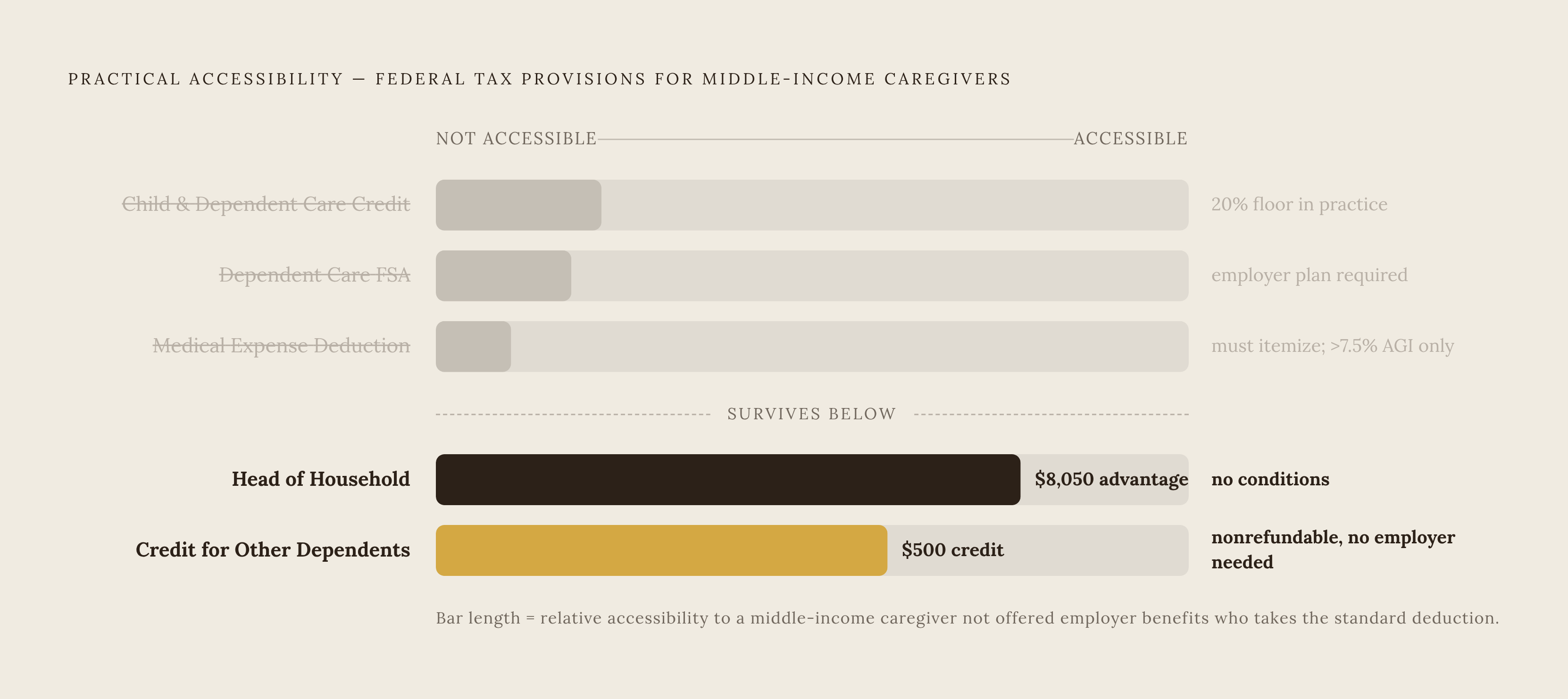
Start with the Credit for Other Dependents. It is nonrefundable, worth $500, and requires that the dependent's gross income stay under $5,300 for 2026 and that the caregiver cover more than half of that person's support. It is real money, but $500 does not go far against $7,200 in annual costs.
The Child and Dependent Care Credit sounds more promising on paper. The top rate climbed to 50% for 2026, up from 35%, which is a genuine legislative improvement. But that top rate only kicks in at the lowest income levels. Most middle-income families are at the 20% floor instead, which limits the effective credit to a much smaller amount than the headline rate suggests. The headline rate and the rate most families actually receive are two different numbers, and the gap between them is where a lot of confusion starts.
A Dependent Care FSA can help too, now with a contribution limit permanently raised to $7,500 for 2026. That is a meaningful tax shelter, but only for caregivers whose employer offers the benefit. No employer plan, no FSA, regardless of how legitimate the caregiving expenses are.
Then there is the Medical Expense Deduction, which sounds like the obvious fit and rarely is. It requires itemizing, and only the portion of medical expenses exceeding 7.5% of adjusted gross income counts. With the 2026 standard deduction set at $24,150 for head of household and $16,100 for single filers, most middle-income families never clear the itemizing threshold to begin with. Even for those who do, most caregiving costs, the custodial kind, bathing, dressing, supervision, are not medically deductible expenses under the federal definition. The deduction was built around clinical care, leaving out the daily work of keeping someone safe at home.
Head of Household filing status is the one piece of the federal menu that actually delivers for a lot of caregivers. The standard deduction jumps to $24,150 for 2026, an $8,050 advantage over the single-filer rate, and it is available to unmarried caregivers paying more than half of a dependent's household costs. Notably, the parent does not need to live with the caregiver for this to apply.
Stripping away the noise, the federal menu for a middle-income caregiver comes down to two usable options: the $500 Credit for Other Dependents and Head of Household status. Everything else phases out at typical income levels, demands itemizing most households can't reach, or depends on an employer benefit that may not exist. That is not a caregiver credit system so much as a set of general-purpose provisions that occasionally brush up against caregiving.
One search result muddies this further. Type "caregiver tax credit" into any search engine and articles referencing a "$5,000 caregiver tax credit" appear, described in language that makes it sound settled and claimable. That figure belongs to a bill sitting in Congress; no one has ever actually claimed it on a return. That figure belongs to a bill sitting in Congress; no one has ever actually claimed it on a return. The confusion is genuinely common, so it deserves addressing directly.
The pending federal legislation caregivers keep hearing about
The bill behind that $5,000 figure is the Credit for Caring Act, reintroduced in March 2025 as a bill numbered. 2036 in one chamber of the federal legislature and a companion bill numbered S. 925 in the other chamber. Two members of the lower chamber sponsor that chamber's version; two members of the upper chamber sponsor the companion version.
As written, the CCA would offer a nonrefundable credit worth 30% of qualifying caregiving expenses above a $2,000 floor, capped at $5,000. A caregiver spending just above the floor would see the credit apply only to the portion exceeding it, resulting in a modest credit well below the headline maximum. The credit reaches its full $5,000 ceiling only once expenses climb well past a much higher figure. The care recipient would also need functional or cognitive limitations certified by a licensed practitioner, and the caregiver would need earned income of at least $7,500 to qualify.
None of that is available today. The bill sits in committee, where it has sat before in earlier sessions under different bill numbers, and no caregiver has ever claimed a dollar of it. A related measure, S.3295, introduced in the 119th Congress, would create a smaller $2,000 credit for adult children who share a home with a qualifying relative for at least six months and provide at least 10 hours of care. It, too, is in committee, with its status beyond referral unconfirmed.
That raises an obvious question for anyone reading headlines about either bill: what is a caregiver supposed to do in the meantime? The answer, increasingly, is to stop looking at the federal capital and start looking at the state capitol.
Why state caregiver tax credits work differently for families the federal system misses
State caregiver credits solve the exact problem that guts the federal medical expense deduction. They function as direct credits against state income tax owed, not deductions against income, so the standard-deduction math that keeps most families from itemizing federally simply doesn't apply. A caregiver in one of these states doesn't need to clear any itemizing threshold or track total medical spending against 7.5% of AGI. The credit exists independent of all that.
Most of these state credits also don't require federal itemization as a precondition, which alone removes the single biggest obstacle caregivers run into at the federal level. And in several states, the credit is structured so that if it exceeds what the caregiver owes in state income tax, the state pays out the difference as a refund. That refundability is a meaningfully different design than anything on offer federally, where the caregiver-adjacent credits at the federal level are nonrefundable and therefore of limited value to a caregiver whose tax liability is already near zero.
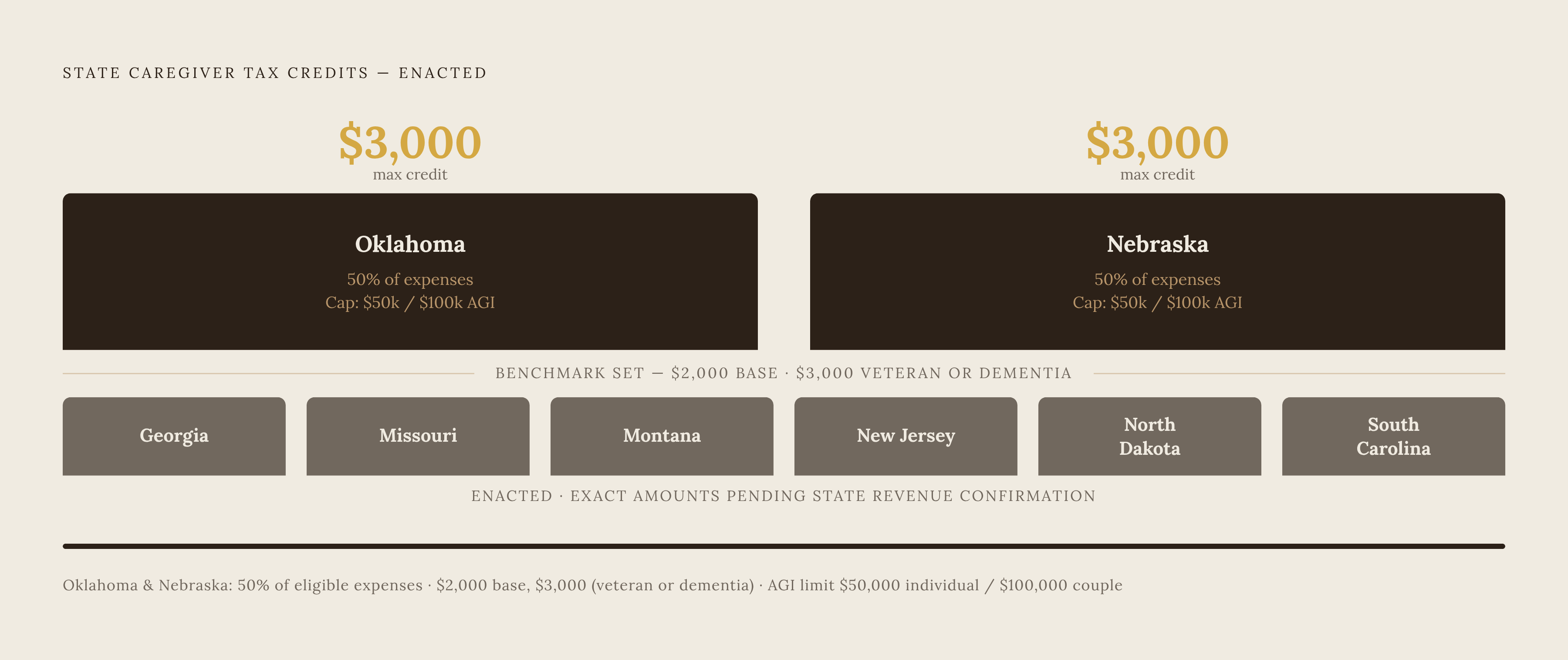
As of early 2026, eight states have enacted caregiver-specific tax credits: Georgia, Missouri, Montana, Nebraska, New Jersey, North Dakota, Oklahoma, and South Carolina. Oklahoma and Nebraska have published the most detailed frameworks among the eight states, making their credit structures the most thoroughly documented.
Oklahoma: the nation's first caregiver tax credit, now expanding
Oklahoma got there first. The Caring for Caregivers Act was signed into law in 2023 and took effect January 1, 2024, and the credit first became claimable on 2025 tax returns. As of January 2026, Oklahomans are now filing those returns with the credit available for its first full tax year, even if that data isn't public in granular form yet.
The credit covers 50% of eligible caregiving expenditures, up to $2,000. That ceiling rises to $3,000 if the family member receiving care is a veteran or carries a dementia diagnosis, an important distinction for the many caregivers managing a cognitive decline case rather than a purely physical one.
Eligibility hinges on two conditions. The care recipient must be 62 or older, and must need help with at least two activities of daily living, the standard shorthand (ADLs) that covers things like bathing, dressing, transferring, and toileting. The caregiver, meanwhile, faces an income cap: federal adjusted gross income under $50,000 for an individual, or under $100,000 for a couple. The cap signals exactly who the legislature built this for: middle-income households, not upper earners who can already absorb $7,200 in annual costs without much strain.
Nebraska: the second state, with a credit that closely mirrors Oklahoma's framework
Nebraska followed with LB937, signed by Governor Jim Pillen in April 2024, operative for tax years beginning on or after January 1, 2025. Nebraska is described as the second state in the country to adopt a caregiver credit of this scope, and the framework it landed on tracks Oklahoma's almost exactly: 50% of eligible expenditures, a $2,000 cap, rising to $3,000 for a veteran or a dementia diagnosis.
The income caps mirror Oklahoma's structure too, with one small wording difference. Nebraska sets the threshold at federal AGI under $50,000 for all filing statuses except married filing jointly, which gets the $100,000 ceiling. Functionally, that lands in the same place as Oklahoma's individual-versus-couple framing.
Where Nebraska diverges is in who counts as a qualifying care recipient. The law covers a dependent, spouse, parent, or other relation by blood or marriage, but only if that person lives in a private residence and needs help with at least two ADLs, certified by a licensed health care provider. Family members residing in an assisted-living center, a nursing facility, or a residential care home are explicitly excluded. That is a meaningful boundary: the credit is built around home-based care, not care delivered in a licensed facility, which tracks with the broader policy goal of keeping people out of institutional settings for as long as it's safe to do so.
The other six states with enacted caregiver credits: Georgia, Missouri, Montana, New Jersey, North Dakota, and South Carolina
Six more states have enacted caregiver-specific credits: Georgia, Missouri, Montana, New Jersey, North Dakota, and South Carolina. What isn't available, at least not at the same level of published detail as Oklahoma and Nebraska, are the specifics: credit amounts, exact income thresholds, activities-of-daily-living requirements, or application procedures.
That gap should be named honestly rather than papered over. Caregivers in these six states have a real filing opportunity sitting on the books right now, and the existence of the credit itself is confirmed. But the mechanics, how much, under what income cap, for which care recipients, aren't detailed in the same public record that Oklahoma and Nebraska have generated through active claims and legislative documentation. Anyone filing in these six states should treat this as the starting point for a conversation: pull up the state department of revenue's caregiver credit page directly, or bring the question to a licensed tax professional who works returns in that state. The credit exists. The paperwork trail on the specifics is thinner, and it deserves confirmation before a caregiver builds a filing strategy around assumed numbers.
What ties all eight states together, though, is the pattern itself. Eight state legislatures have decided, independently, that unpaid family caregiving deserves direct tax recognition, while the federal Credit for Caring Act sits untouched in committee year after year. That is not a coincidence so much as a signal: state governments are often faster labs for this kind of policy, precisely because they don't require the same national consensus a federal credit does.
Qualifying expenses and the costs most caregivers wrongly assume are covered
Across both Oklahoma and Nebraska, the list of qualifying expenses looks remarkably similar. Hiring a home care aide counts. So does respite care, adult day care, personal care attendants, health care equipment and assistive technology, and home modifications, ramps, grab bars, stairlifts, anything that lets the family member stay safely at home rather than move into a facility. Oklahoma adds one item Nebraska doesn't specify: mileage for medical appointments, a detail that matters more than it sounds like it should, given how many caregiving hours go into transportation alone.
Nebraska, meanwhile, draws an explicit line around what doesn't qualify. General household maintenance, painting, plumbing, electrical repairs, exterior upkeep, is excluded regardless of the reason behind it. A caregiver who repaints a hallway because a parent with dementia needs consistent visual cues won't be able to claim that expense, even though the underlying motivation is caregiving-related. The credit is built around care activities and the tools that support them directly, not general home upkeep that happens to benefit someone receiving care.
That distinction is worth comparing back to the federal medical expense deduction, because the contrast illuminates why state credits are more accessible in practice. The federal deduction requires a licensed care plan and a formal "chronically ill" designation before custodial care expenses even become eligible for deduction consideration. Most state caregiver credits skip that entirely and use the ADL-assistance standard instead: does the person need help with two or more activities of daily living, certified by a provider? That's a lower, more concrete bar, and it's the reason these state credits reach families the federal system was never built to reach.
How to claim a state caregiver credit: the steps, the timing, and what most people miss
The mechanics start with a fairly simple question: does the state of residence have a caregiver credit? For the eight states covered here, the answer is yes. For everywhere else, the current answer is no, at least not yet, though the pace at which Oklahoma and Nebraska moved suggests more states could follow.
From there, the process runs through a handful of concrete checkpoints. First, confirm the care recipient meets the state's specific eligibility bar, whether that's Oklahoma's age-62-plus-two-ADLs standard, Nebraska's private-residence requirement, or whatever criteria the other six states have set. Second, get the activities-of-daily-living limitation certified by a licensed health care provider; this isn't a self-assessment a caregiver can just write down on the return, it needs documentation behind it. Third, track expenses throughout the year, not retroactively in March. Home care aide invoices, adult day care receipts, mileage logs for medical appointments, home modification invoices: all of it needs a paper trail, because a credit worth up to $3,000 is exactly the kind of claim a state revenue department will ask to see backed up.
Fourth, check the income cap against federal AGI, not gross income, before assuming eligibility one way or the other. A caregiver with a gross income somewhat above $50,000 but with pre-tax retirement contributions and other adjustments might land under Oklahoma's or Nebraska's $50,000 AGI threshold even though the sticker number looks too high at first glance. That's a detail a lot of caregivers miss simply because they never check their AGI line against the cap directly.
What most people miss entirely, though, is the existence of the credit in the first place. A credit that quietly launched in 2023 or took effect in 2025 doesn't come with a national advertising campaign attached. It appears in a state's tax instructions, maybe a line item on a specific schedule, and unless someone is actively looking for caregiver-specific relief, it's easy to file a return the same way as every prior year and leave $2,000 or $3,000 on the table.
That is the core argument underlying all of this. The federal system offers caregivers a real but modest set of tools, and the one bill that might expand that meaningfully, the Credit for Caring Act, remains stuck in committee with no clear timeline. Meanwhile, eight states have already built something more direct, more accessible, and in some cases refundable. For a caregiver in Oklahoma, Nebraska, Georgia, Missouri, Montana, New Jersey, North Dakota, or South Carolina, checking state eligibility before filing this year isn't a minor housekeeping task. It might be the single most consequential five minutes spent on that return.
Sources
- Caregiver Tax Credit Act | Nebraska Department of Revenue
- How Caregivers Can Save With Tax Credits &… | ArchWell Health
- Caregiver Tax Checklist 2026: Deductions & Credits for Family Caregivers| U.S. News
- The 2026 Guide to Federal and State Caregiver Tax Credits: How to Maximize Your Tax Benefits — Paid.Care
- ltsschoices.aarp.org
- Caregiver Tax Credit 2026: What You Can Actually Claim
- aspe.hhs.gov
- oklahoma.gov